
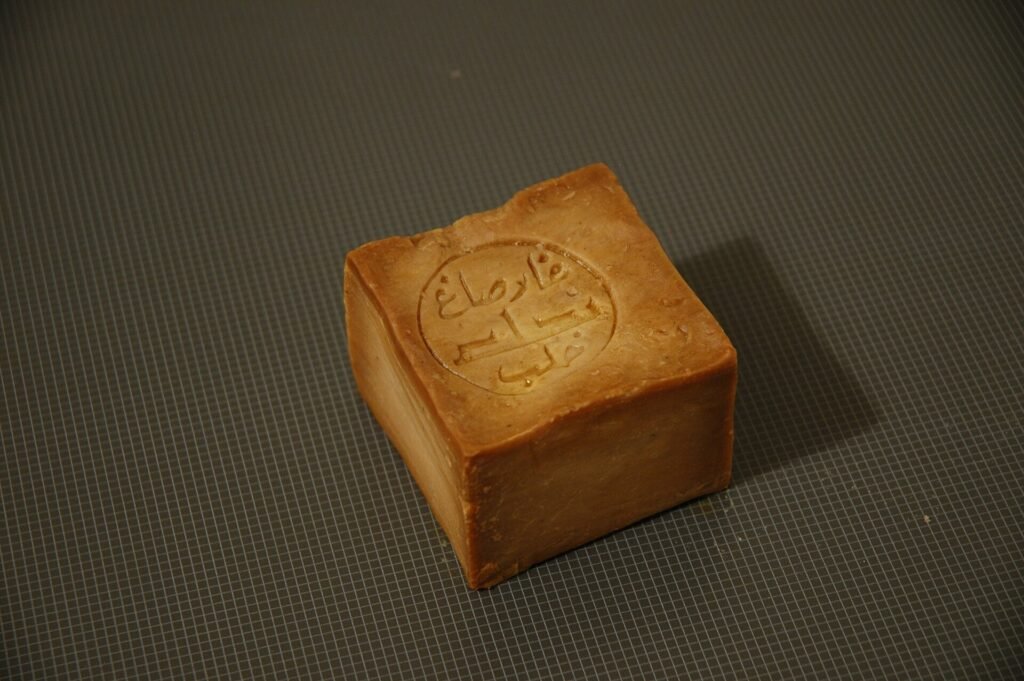
A handmade hard bar soap crafted from olive oil and laurel berry oil, Aleppo soap represents centuries of Syrian artisanal knowledge and remains a living craft practiced in its city of origin.
In UNESCO’s words
The crafting of Aleppo ghar soap in the Syrian Arab Republic is based on traditional knowledge and skills that combine natural, locally produced olive oil (metraf) and laurel oil (ghar). In autumn, families pick the wild laurel berries from surrounding forests and boil them in water until they split. When the oil rises to the surface, it is skimmed off. The soap production begins in winter. Natural lye, metraf and ghar are combined and cooked. The mixture is poured on the floors of traditional soap factories and allowed to cool. Craftsmen then don large wooden shoes to cut the giant slab into cubes, using their body weight and a rake. Each cube is hand-stamped with the family name in an expression of family legacy and identity. The stamped soap cubes are stacked into cylindrical towers or pyramids to facilitate airflow and are stored to dry for six to nine months. Aleppo craftsmanship is transmitted informally within families, with children helping to collect olives and berries. Girls observe their mothers extracting the oil, and children learn soap-making from their fathers. The collaborative production process promotes community and family unity and intergenerational dialogue.
Official description, UNESCO Intangible Cultural Heritage List — Craftsmanship of Aleppo Ghar soap
At a glance
Aleppo ghar soap is made by combining natural olive oil and laurel oil using traditional knowledge passed down through families. The craft begins with collecting wild laurel berries from forests in autumn, boiling them until the oil rises to the surface. In winter, soap makers blend natural lye with both oils, cook the mixture, and pour it onto factory floors to cool into giant slabs that are then cut into cubes.
Origins & history
The practice developed in the Syrian Arab Republic where local olive oil and laurel berries were naturally available. Craftsmanship has been transmitted informally within families across generations, with children learning by helping to collect olives and berries, watching their mothers extract oil, and working alongside their fathers during soap production.
The practice
Production takes place in traditional soap factories where the prepared mixture is poured onto floors to set. Craftsmen wear large wooden shoes and use rakes to cut the cooled slab into cubes, employing their body weight for the work. Each cube is hand-stamped with the family name to mark family legacy and identity. The stamped cubes are then arranged into cylindrical towers or pyramids to allow air circulation and left to dry for six to nine months.
Cultural significance
The collaborative production process strengthens community and family unity while fostering intergenerational dialogue. Each hand-stamped cube carries the maker's family name, embedding identity and legacy into the soap itself. The practice represents traditional knowledge and skill that connects families to the natural materials—olive oil and laurel berries—at the foundation of their craft.
Key facts
- Country: Syrian Arab Republic
- Inscribed: 2024
- UNESCO list: Representative List of the Intangible Cultural Heritage of Humanity
- UNESCO reference: 02132
- UNESCO vocabulary: Craft workers; Family; Soap
- Map: Aleppo — the locality named in UNESCO’s official description of this element
- Related World Heritage site: Ancient City of Aleppo (a different UNESCO designation, not the place of the tradition)
Where to experience it
Aleppo ghar soap is crafted in the Syrian Arab Republic, where families continue the traditional process across generations. Visitors to soap-making communities can observe the autumn laurel berry collection from surrounding forests, the winter production in traditional factories, and the hand-stamping of soap cubes with family names. The craft thrives through informal family transmission, with children learning alongside parents in workshops where olive oil and laurel oil are combined and transformed into cubes that dry for months before completion. The collaborative nature of production means that witnessing the craft offers insight into how families preserve their heritage and cultural identity through this ancient skill.
Sources & resources
- UNESCO — official element page: Craftsmanship of Aleppo Ghar soap
- UNESCO — open data record: Intangible Heritage List, reference 02132
- UNESCO — official photograph: The biggest piece of soap in the world weighing 1,520 kgs; soap Khan; Aleppo; 'Dakka Kadima' — Manzoum — Syrian Trust for Development, 2023
- Reference — Wikipedia (secondary): Aleppo soap — consulted as a secondary reference, not as confirmation
- Cultural Heritage Online: Our archive and city guides

Find it on the map
See this place and what’s around it →📷 Become a Cultural Heritage Online photographer
Share your photos of places: they stay published under your name as the author. The more they're seen, the more you get noticed — and soon a contest will reward the most appreciated photos.
Log in or sign up free to add a photo