
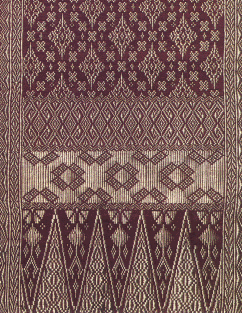
A hand-woven textile tradition where silk or cotton is interlaced with gold or silver threads to create shimmering brocade cloth, worn across maritime Southeast Asia for centuries as formal dress and ceremonial fabric.
At a glance
Songket is a supplementary weft weaving technique in which metallic threads are inserted between silk or cotton weft threads to produce intricate, luminous patterns. The practice spans Malaysia, Indonesia, and Brunei, with dozens of regional variations. Weavers work at hand looms to create fabric suitable for formal occasions, royal ceremonies, and everyday wear among communities across the region.
Origins & history
Evidence from statuary at Bumiayu Temple in South Sumatra suggests songket has been worn since the 8th century CE, during the Srivijaya Empire. Palembang, believed to have been Srivijaya’s capital, remains closely associated with the tradition. Trade networks and intermarriage across maritime Southeast Asia spread the practice to Brunei, Malaysia, and Singapore, where it became embedded in local textile cultures.
In Malaysia, the government recognised songket as intangible national heritage in 2012. UNESCO designated it a Masterpiece of Oral and Intangible Heritage in 2021.
The practice
Weavers sit at hand looms and pass silk or cotton weft threads across the warp while simultaneously inserting metallic gold or silver threads between them. This supplementary weft technique creates patterns that catch light, producing the characteristic shimmer that distinguishes songket from plain cloth.
The finished fabric is typically worn as formal sarongs, scarves, or ceremonial dress by both men and women. Regional styles vary—Palembang, Pandai Sikek, Silungkang, Lombok, Bali, and Sambas each produce distinctive patterns and colour schemes reflecting local aesthetic traditions and available materials.
Production occurs across Indonesia—from Sumatra to Sulawesi, Bali, and Sumbawa—as well as in Malaysia and Brunei. Many weavers work from home studios or small workshops.
Cultural significance
Songket marks important life moments and ceremonies across its communities. It signals status, occasion, and cultural identity. For many wearers, songket connects them to ancestral practices and regional heritage, particularly in Southeast Asian contexts where formal dress remains central to celebrations and state occasions.
The practice sustains local economies and embodies knowledge passed between generations of weavers, most traditionally from mother to child.
Key facts
- Countries: Malaysia, Indonesia, Brunei
- Anchor community: Kuala Terengganu, Malaysia (5.32975, 103.13133)
- Primary materials: silk or cotton warp and weft; gold or silver metallic threads
- Technique: supplementary weft weaving
- UNESCO ICH reference: 01505
- UNESCO inscription: 2021
- Regional variants recognised in Indonesia: Palembang (2013), Sambas (2013), Pandai Sikek (2014), Beratan, Bali (2018), Silungkang (2019)
Where to experience it
Kuala Terengganu and the Terengganu region form the heartland of Malaysian songket weaving. You can visit active weaver studios and small textile workshops throughout the state. Museums and cultural centres in Kuala Terengganu display historical and contemporary songket, and artisan markets offer opportunities to purchase cloth and meet makers. In Indonesia, the Palembang region and West Sumatran towns including Pandai Sikek and Silungkang remain primary weaving centres.
Sources & resources
Find it on the map
See this place and what’s around it →📷 Become a Cultural Heritage Online photographer
Share your photos of places: they stay published under your name as the author. The more they're seen, the more you get noticed — and soon a contest will reward the most appreciated photos.
Log in or sign up free to add a photo