

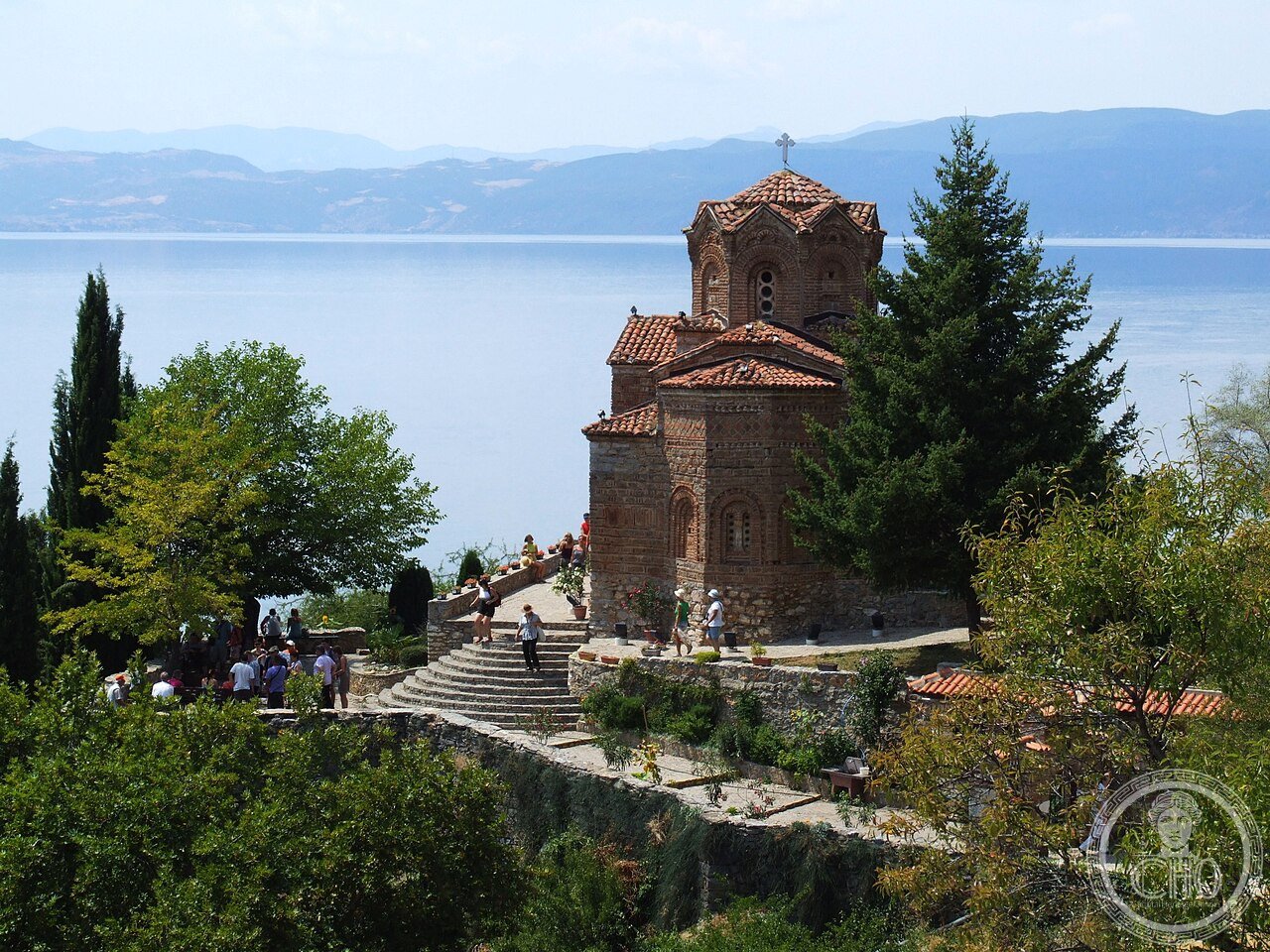
Probably built in the thirteenth century on a cliff sheer above Lake Ohrid, this small church dedicated to John of Patmos joins Byzantine and Armenian influences in an inscribed-cross plan unique in the central Balkans. Its oldest frescoes, dated to around 1290, stayed hidden under layers of plaster and repainting until a restoration in 1964 revealed the whole cycle, including the figures of Saint Clement of Ohrid and Saint Erasmus of Lychnidos.
About the Church of St. John at Kaneo
The Church of St. John at Kaneo stands on a cliff above Kaneo Beach, overlooking Lake Ohrid in the city of Ohrid, North Macedonia, and is dedicated to John of Patmos, traditionally regarded by some as the author of the Book of Revelation and sometimes identified with John the Apostle. The exact construction date remains unknown, but documents relating to the church’s property suggest it existed before 1447, and archaeologists believe the church was most likely built in the 13th century, before the rise of Ottoman power in the region; reconstruction work followed in the 14th century, shortly before the arrival of the Ottoman Turks in Macedonia. Architecturally, the church is built in the form of a cross inscribed within a rectangle, topped by a single dome whose roof cornice forms angled tympanums rather than the flat or undulating profile more typical of the region — a unique configuration within the broader central Balkans, reflecting a distinctive blend of Byzantine and Armenian architectural influences. The earliest surviving frescoes, dated to around 1290, are preserved in the dome’s apse, while the naos contains fragments of Passion scenes; a comprehensive restoration in 1964 uncovered a fuller cycle of murals that had been concealed beneath later overpainting and plaster. Following the traditional programmatic arrangement of Orthodox church decoration, the altar space depicts liturgical scenes and the Adoration of the Lamb, flanked by portrait busts of church fathers, while the wider fresco cycle includes notable portraits of saints connected to the Ohrid Archbishopric, among them Saint Clement of Ohrid, Saint Erasmus of Lychnidos, and Saint Constantine Cabasilas.
Key facts
- 13th century (probable): church built on the cliff above Lake Ohrid
- Before 1447: earliest documentary evidence of the church’s existence
- 14th century: reconstruction shortly before Ottoman arrival in Macedonia
- c. 1290: earliest surviving frescoes, preserved in the dome’s apse
- 1964: restoration uncovers the fuller fresco cycle hidden under later plaster
- Architecture: a unique Byzantine-Armenian hybrid cross-inscribed plan
- Notable frescoes: portraits of Saint Clement of Ohrid and Saint Erasmus of Lychnidos
History
The church’s unique blend of Byzantine and Armenian architectural elements, expressed in its unusual angled-tympanum roof cornice, situates Kaneo as a singular case study in the cross-cultural exchange characteristic of the medieval Balkan Orthodox world, its exact origins and the source of its Armenian influence still debated among architectural historians. The 1964 restoration’s uncovering of the full fresco cycle, hidden for centuries beneath later overpainting and plaster, exemplifies how many of the region’s most significant medieval artworks survived not through continuous display but through accidental concealment, only rediscovered through modern conservation techniques.
The presence of Saint Clement of Ohrid among the church’s fresco portraits ties Kaneo directly to the wider Ohrid Archbishopric’s foundational figures, situating this small cliffside church within the broader historical narrative of Ohrid’s status as one of medieval Orthodox Christianity’s most significant regional centres of learning and church governance.
What you see
The church’s compact cross-inscribed plan, capped by a single dome with its distinctive angled-tympanum cornice, sits dramatically on the cliff edge above Lake Ohrid, making it one of the most photographed sites in North Macedonia. Inside, the surviving frescoes — the earliest dating to around 1290 — include liturgical scenes, the Adoration of the Lamb, and portraits of major saints associated with the Ohrid Archbishopric, uncovered in their fuller extent during the 1964 restoration.
Practical information
- Opening hours: generally open daily with seasonal variation; check current hours before visiting; small admission fee may apply
- Address: Kaneo, Ohrid, North Macedonia
Getting there
The Church of St. John at Kaneo is located on a cliff above Kaneo Beach in Ohrid, reachable on foot along the lakeside path from the old town. GPS: 41.1111° N, 20.7888° E.
Nearby
- Kaneo Beach — immediately below the church, on Lake Ohrid
- Ohrid Old Town — the historic centre, a short walk away
- Samuel’s Fortress — the medieval fortress overlooking Ohrid, nearby
Sources
- Wikipedia — “Church of St. John at Kaneo” (en.wikipedia.org)
- North Macedonia Timeless — “St. John Kaneo” (macedonia-timeless.com)
- Religiana — “St. John the Theologian Kaneo” (religiana.com)
Find it on the map
See this place and what’s around it →📷 Become a Cultural Heritage Online photographer
Share your photos of places: they stay published under your name as the author. The more they're seen, the more you get noticed — and soon a contest will reward the most appreciated photos.
Log in or sign up free to add a photo