

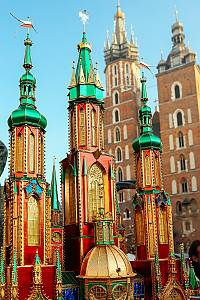
Elaborate wooden nativity scenes built around architectural replicas of Kraków’s landmarks, a Christmas tradition that transforms the city’s most recognizable buildings into stages for the birth narrative.
In UNESCO’s words
The Nativity Scene (szopka) tradition in Krakow is a social practice originating from Christmas celebration customs, centred around constructing cribs. Born in the nineteenth century, the tradition is indissolubly connected to the City of Krakow and based on skills and knowledge passed down for generations. The szopka is a lightweight construction featuring the nativity scene surrounded by representations of houses and monuments of Krakow, all transformed by the individual maker. Other scenes are also represented through figurines and artificial lighting, depicting historical, cultural and contemporary social events relating to life in the City of Krakow, Poland and the world. On the first Thursday of every December, makers gather on Krakow Main Square to present their work, and the Historical Museum of the City of Krakow makes their work accessible to the public from December to February, helping to transmit knowledge related to the practice. Practitioners include a group of forty of the most active bearers, who construct new cribs every year and run workshops and lectures to promote the practice and transmit related knowledge. The tradition is open to everyone, encompassing a wide circle of people including spectators and visitors belonging to the urban community. The practice also has significant educational functions, passing on knowledge about the history of the city, its local architecture and customs.
Official description, UNESCO Intangible Cultural Heritage List — Nativity scene (szopka) tradition in Krakow
At a glance
The szopka is a lightweight construction that presents the nativity scene surrounded by representations of Krakow's houses and monuments, each transformed by its maker. Beyond the central nativity, makers depict historical, cultural and contemporary social events through figurines and artificial lighting, drawing on scenes relating to life in Krakow, Poland and the wider world. The tradition is open to everyone and forms part of Christmas celebration customs centred around constructing cribs.
Origins & history
Born in the nineteenth century, the szopka tradition originated from Christmas customs and became indissolubly connected to Krakow. The practice developed through skills and knowledge passed down across generations, with craftspeople building on earlier methods to create these distinctive scenes. Over time, the tradition has remained rooted in the city, sustained by families and communities of makers who continue the established ways.
The practice
Makers construct szopki using lightweight materials, incorporating architectural representations of Krakow's buildings and monuments that they transform through their individual choices. A working group of around forty active practitioners construct new cribs every year and run workshops and lectures to transmit related knowledge and skills. On the first Thursday of December, makers gather on Krakow Main Square to present their completed work to the public.
Cultural significance
The tradition carries significant educational functions, passing on knowledge about the city's history, local architecture and customs. For the urban community—including spectators, visitors and practitioners—the szopka practice affirms continuity and binds residents to their city's landscape. By grounding the nativity in Krakow's own buildings and depicting local life, the practice claims the sacred story as shared and rooted in place. The Historical Museum displays szopki from December to February, helping sustain and transmit the tradition.
Key facts
- Country: Poland
- Inscribed: 2018
- UNESCO list: Representative List of the Intangible Cultural Heritage of Humanity
- UNESCO reference: 01362
- UNESCO vocabulary: Architecture; Effigies; Religious practice
- Map: Krakow — the locality named in UNESCO’s official description of this element
- Related World Heritage site: Historic Centre of Kraków (a different UNESCO designation, not the place of the tradition)
Where to experience it
The Nativity Scene tradition thrives in Krakow, where it originated in the nineteenth century and remains deeply woven into Christmas celebrations. On the first Thursday of December, makers gather on Krakow Main Square to display their creations—intricate constructions that blend the nativity scene with representations of the city's houses and monuments, enhanced by figurines, artificial lighting, and scenes reflecting local and contemporary life. The Historical Museum of the City of Krakow exhibits these works from December to February, allowing visitors to appreciate the craftsmanship and learn about the tradition's connection to the city's history and architecture. Active practitioners run workshops and lectures throughout the year, welcoming anyone interested in understanding this distinctive practice and its role in transmitting knowledge about Krakow's cultural heritage.
Sources & resources
- UNESCO — official element page: Nativity scene (szopka) tradition in Krakow
- UNESCO — open data record: Intangible Heritage List, reference 01362
- UNESCO — official photograph: The Nativity Scene by Zbigniew Gillert placed on the footsteps of the Adam Mickiewicz Monument on the Main Square in Krakow. The crib shows constructor's inspiration: the architecture of St. Mary's Church, particularly its towers. — Andrzej Janikowski — Andrzej Janikowski/Historical Museum of the city of Krakow (Poland), 2012
- Reference — Wikipedia (secondary): Krak%C3%B3w szopka — consulted as a secondary reference, not as confirmation
- Cultural Heritage Online: Our archive and city guides
Find it on the map
See this place and what’s around it →📷 Become a Cultural Heritage Online photographer
Share your photos of places: they stay published under your name as the author. The more they're seen, the more you get noticed — and soon a contest will reward the most appreciated photos.
Log in or sign up free to add a photo