
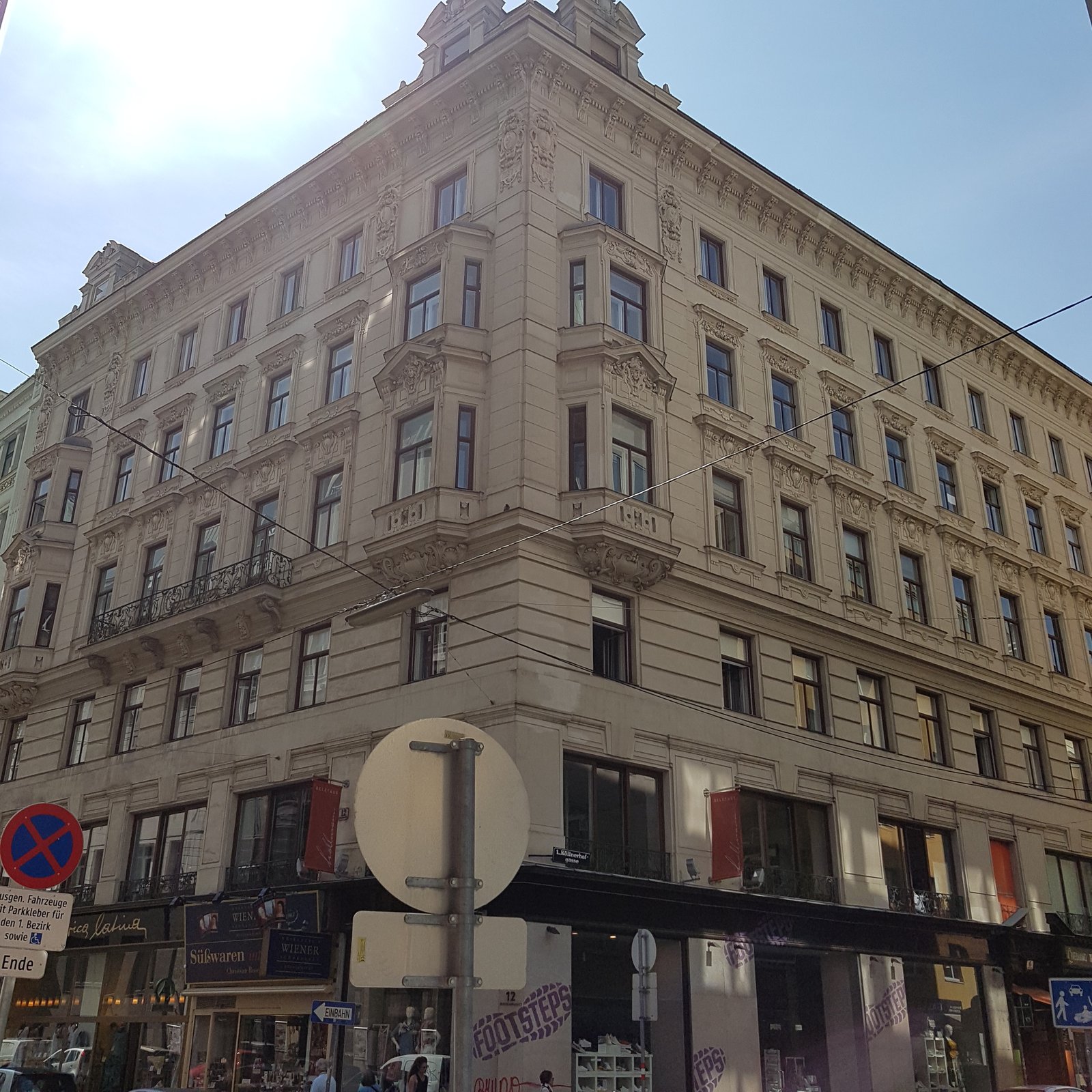
A protected corner building named for a Greek merchant, rebuilt in the last years of the Ringstrasse era.
At a glance
The Buxbaum Boutique Hotel occupies the Darvarhof, a listed corner building standing free on three sides at Köllnerhofgasse 6, Fleischmarkt 12 and Grashofgasse 1, in Vienna’s first district. The current building dates to 1894–1895, designed by master builder Alois Schumacher in late-Historicist, neo-Baroque forms, but the site’s name and history run back further — to a 17th-century house and to the Greek-Orthodox merchant Ioannis Darvar, who gave the property its name after buying it in 1795.
Key facts
- Name: Darvarhof, historically also Zwölferhaus
- Address: Köllnerhofgasse 6 = Fleischmarkt 12 = Grashofgasse 1
- Architect: Alois Schumacher (Baumeister)
- Year built: 1894–1895
- Style: late Historicism, neo-Baroque forms
- Status: protected monument (Bundesdenkmalamt)
History
A house on this site, known as the Zwölferhaus, was largely rebuilt in 1667 for the physician Dr. Johann Zwölfer. In 1795 it passed to Ioannis Darvar, a Greek-Orthodox merchant, who had it renovated — the building has carried his name, Darvarhof, ever since. The Greek educator Demeter Nikolaus Darvar died in the house in 1823, one link in Vienna’s long history as a centre of the Greek merchant diaspora.
The older structure did not survive into the 20th century: in 1894, the building was replaced by the current late-Historicist Neubau, designed by master builder Alois Schumacher and completed in 1895. The new Darvarhof kept the old name but not the old fabric — a common pattern along the Fleischmarkt, where 19th-century rebuilding erased much of the district’s earlier housing stock. The building is today a protected monument and houses the Buxbaum Boutique Hotel.
What you see
Schumacher’s 1894–95 facade reads as a confident, late-Historicist corner composition: the building stands free on three sides, its neo-Baroque detailing announcing itself to Fleischmarkt, Köllnerhofgasse and Grashofgasse simultaneously. It belongs to the last generation of Vienna’s inner-city rebuilding before the Secession movement changed the city’s architectural language within a decade.
Look for the corner massing and the rhythm of window surrounds across all three facades — a building designed to be read from multiple angles at once, in a district where narrow streets rarely allow a single unobstructed view.
Practical information
- Address: Köllnerhofgasse 6, 1010 Vienna
- Access: the exterior is visible from the street at any time; the interior is accessible to hotel guests
- Best viewed: from the Fleischmarkt side, where the full corner elevation is visible
Getting there
The building sits in Vienna’s historic centre, a short walk from Stephansplatz and the U-Bahn lines U1 and U3. It is easily reached on foot from the Ringstrasse or by tram to Schwedenplatz.
Nearby
- St. Stephen’s Cathedral — five minutes on foot
- Griechenbeisl (one of Vienna’s oldest inns) — around the corner on Fleischmarkt
- Ruprechtskirche, Vienna’s oldest church — a short walk toward the Danube Canal
Sources
- Wien Geschichte Wiki (City of Vienna), “Zwölferhaus” and “Fleischmarkt” — geschichtewiki.wien.gv.at
- cityabc.at, “Fleischmarkt 12” — cityabc.at
- University of Vienna, “Die Wiener Griechen” — wienergriechen.univie.ac.at
Find it on the map
See this place and what’s around it →📷 Become a Cultural Heritage Online photographer
Share your photos of places: they stay published under your name as the author. The more they're seen, the more you get noticed — and soon a contest will reward the most appreciated photos.
Log in or sign up free to add a photoIs this page about you?
This page is read by travellers and heritage enthusiasts who find it on Google. Tell us how you are connected to this place and we will take it from there.