
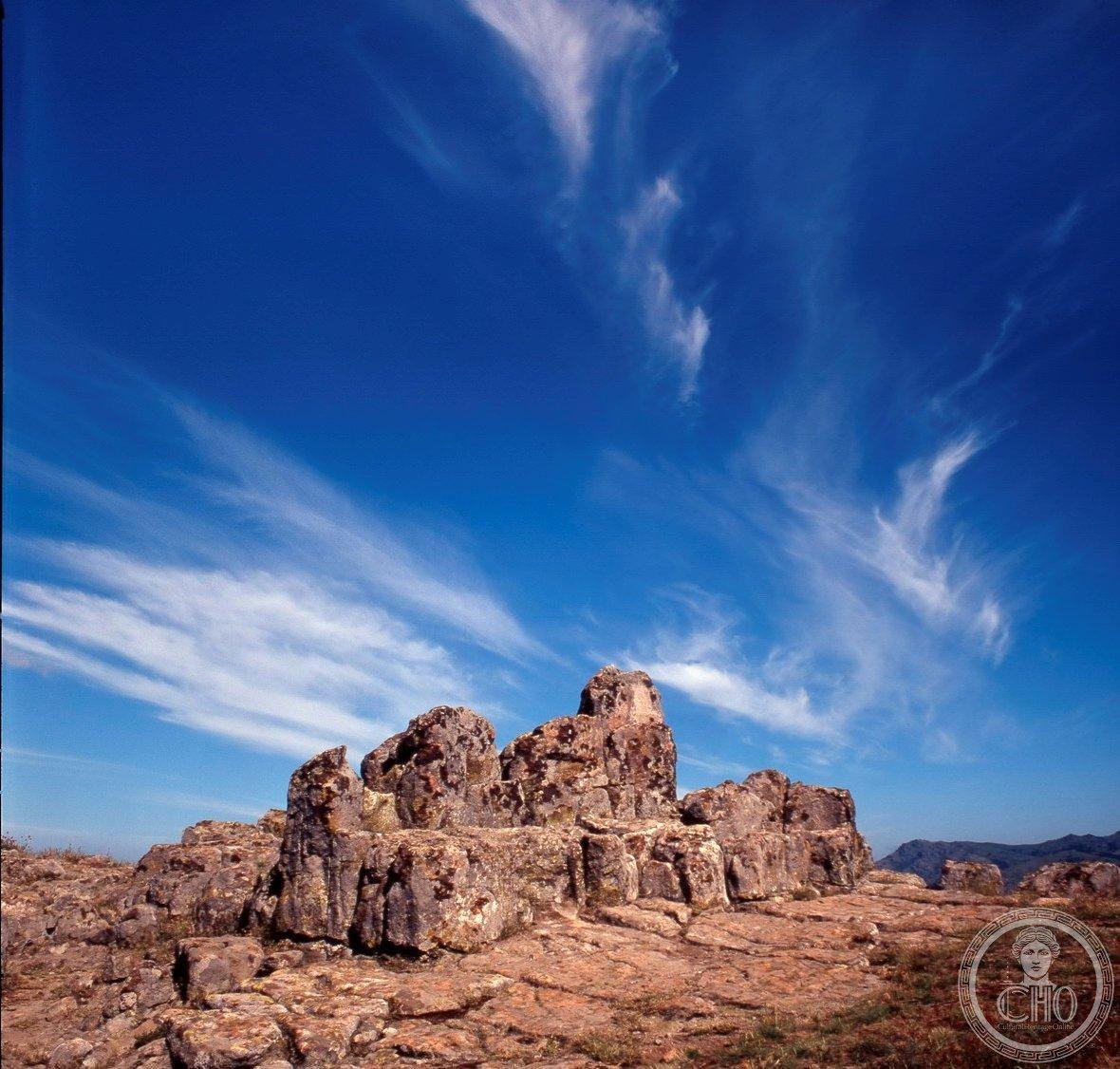
On a volcanic ridge 1,013 metres above sea level in North Macedonia, four stone seats carved into the rock face east, each positioned so that a person seated in one sees the sunrise at a precise astronomical moment: the summer solstice, the winter solstice, and the lunar standstills. The alignment is accurate to within a few arc-minutes.
At a glance
Kokino is a Bronze Age hilltop sanctuary approximately 30 km northeast of Kumanovo, discovered by archaeologist Jovica Stankovic in 2001. The site is a rhyolite volcanic ridge whose eastern face was used as a sophisticated astronomical observation and ritual site between approximately 1800 and 1200 BC. Four stone “thrones” or seats are carved facing east, each aligned to a specific sunrise event: the summer solstice, winter solstice, spring and autumn equinoxes, and the lunar major and minor standstills. A system of horizon markers carved into the eastern rock face creates a calendar visible from the thrones. The site also shows evidence of prolonged habitation and ritual activity.
Key facts
- Period: c. 1800-1200 BC (Bronze Age)
- Altitude: 1,013 metres above sea level
- Discovery: 2001, by archaeologist Jovica Stankovic
- Astronomical features: 4 throne seats + horizon calendar markers aligned to solstices, equinoxes, lunar standstills
- Alignment accuracy: within a few arc-minutes
- Status: National Monument of North Macedonia; managed by National Museum of Kumanovo
- Visitor centre: opened 2006
History
The Kokino ridge was first occupied during the early Bronze Age, approximately 1800 BC. Over several centuries, the hilltop community developed a sophisticated astronomical observation system — evidence of accumulated knowledge passed down across many generations, since precise alignment calibration of the throne seats required years of observation and adjustment.
The site was abandoned around 1200 BC, approximately coinciding with the broader Bronze Age collapse that disrupted civilisations across the eastern Mediterranean. After abandonment, the carved features were preserved by the hard volcanic rhyolite rock, which resists erosion far better than softer stones.
Archaeologist Jovica Stankovic of the National Museum of Kumanovo identified the site in 2001 and recognised the astronomical significance of the carved features. The discovery was announced internationally in 2002, accompanied by a widely circulated claim that NASA had ranked Kokino as the “fourth oldest observatory in the world.” Archaeoastronomers have since pointed out that NASA does not maintain such rankings and that the methodology behind this claim is unclear. What is not disputed is the genuine astronomical sophistication of the site. North Macedonia listed Kokino as a national monument; a visitor centre opened in 2006.
What you see
The Kokino site occupies the summit and eastern face of a rhyolite ridge. The most striking features are the four carved seats — deep depressions cut into the volcanic rock face, each forming a seat from which a person faces east and observes a specific point on the horizon. Each seat corresponds to a specific astronomical event marked by sunrise: the summer solstice sunrise, the winter solstice sunrise, the equinox sunrise, and the lunar major and minor standstills (the extreme north and south positions of the moonrise cycle, which repeat approximately every 18.6 years).
On the eastern rock face, carved markers indicate the exact horizon positions where the sun and moon rise at these critical moments, creating a horizon calendar readable from the throne seats. The carving is precise enough that a modern archaeoastronomer standing in the correct throne at sunrise on the summer solstice will see the sun rise exactly over the marked position.
Across the ridge, Bronze Age ceramics, bronze jewelry, ritual objects, and evidence of animal sacrifice have been found, indicating the site was both an observatory and a religious sanctuary. The upper platform has the finest views and the most elaborate stone features.
Practical information
Kokino is accessible by mountain road from Kumanovo (approximately 30 km). A visitor centre opened in 2006 near the base of the site with basic interpretive displays. The ridge is exposed to wind and weather; bring appropriate clothing. The site is open year-round, with the most atmospheric visits at sunrise — particularly around the summer solstice (June 21) when local astronomy enthusiasts gather for the alignment.
Getting there
From Kumanovo (approximately 30 km southwest), take the road towards Staro Nagoricane and then follow signs to Kokino. The journey by car takes approximately 45 minutes on mountain roads. Kumanovo is connected to Skopje (the capital) by motorway, approximately 40 km south. No regular public transport serves the site; visitors typically hire a taxi from Kumanovo or join a guided tour from Skopje.
Nearby
- Staro Nagoricane Monastery — a 14th-century Byzantine monastery with exceptional medieval frescoes, approximately 15 km southwest of Kokino
- Kumanovo — the nearest city, with connections to Skopje and basic services
- Skopje — the Macedonian capital (40 km), with the National Archaeological Museum housing the finest Macedonian prehistoric collections
Sources
- Stankovic, Jovica. “Kokino — A Bronze Age Astronomical Observatory.” National Museum of Kumanovo, 2003.
- Cenev, Gjore. “Megalithic Astronomical Sites in Macedonia.” SEAC (Societe Europeenne pour lAstronomie dans la Culture) proceedings, 2006.
- Wikipedia: “Kokino” — sources and references.
Find it on the map
See this place and what’s around it →📷 Become a Cultural Heritage Online photographer
Share your photos of places: they stay published under your name as the author. The more they're seen, the more you get noticed — and soon a contest will reward the most appreciated photos.
Log in or sign up free to add a photo