
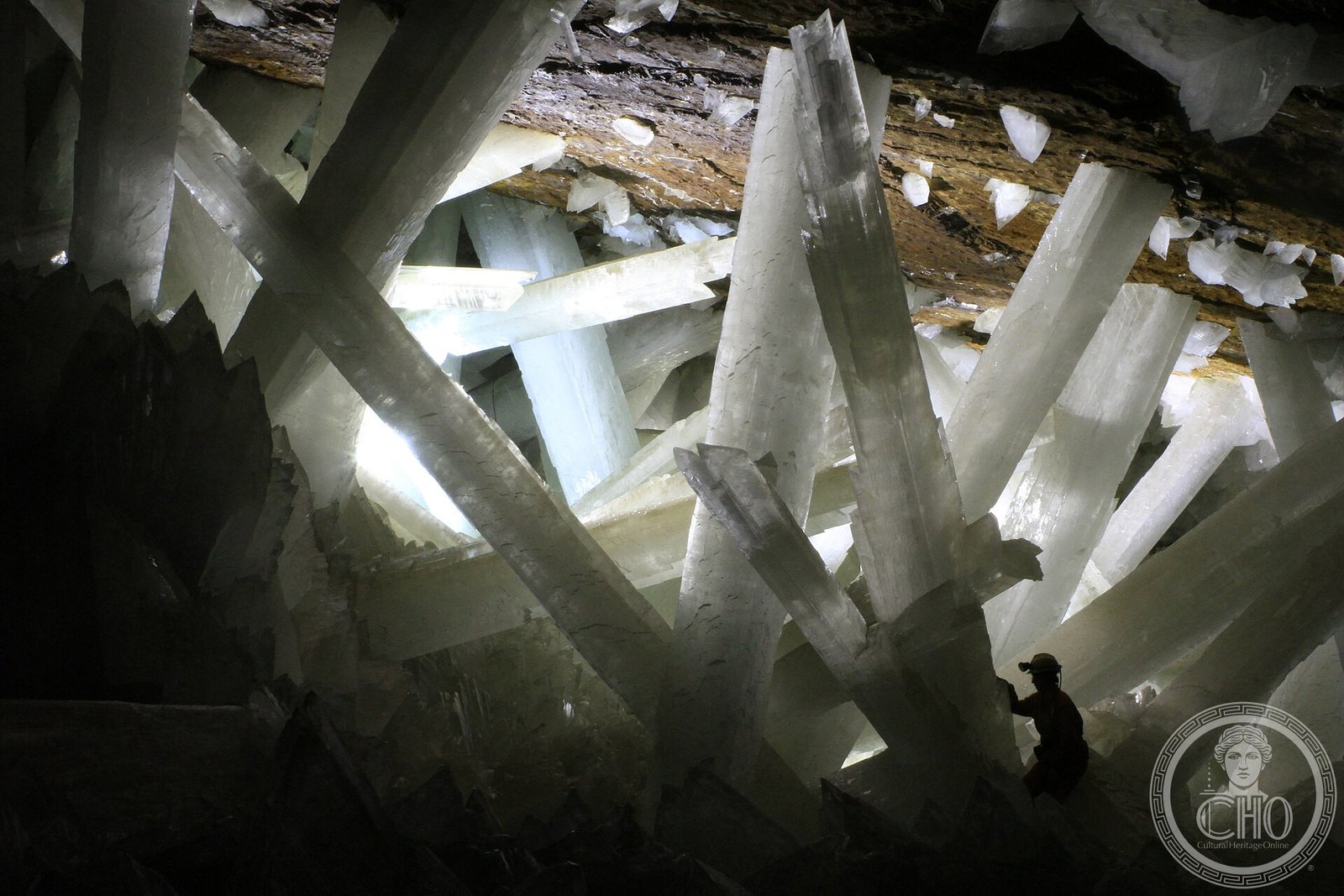
In 2000, miners drilling 300 metres underground in the Chihuahuan Desert broke through a wall and found the largest natural crystals on Earth — beams of selenite up to 12 metres long and 55 tonnes each. The cave is now permanently flooded and inaccessible. It will never be seen again.
At a glance
The Cueva de los Cristales (Cave of the Crystals) beneath the Naica mine in Chihuahua, Mexico, contains gypsum selenite crystals that are the largest natural crystals ever found on Earth: individual beams measuring up to 12 metres in length, 4 metres in diameter, and weighing up to 55 tonnes each. The crystals grew over approximately 600,000 years from mineralised hot spring water that kept the cave flooded at 50 degrees Celsius. When the Naica mining company pumped the cave dry as a side effect of mining operations, the crystals were exposed. In 2017, the company ceased operations and stopped pumping; the cave reflooded. It is now permanently inaccessible.
Key facts
- Discovery: 2000 AD, by miners drilling at 300 metres depth
- Crystal size: up to 12 metres long, 4 metres wide, 55 tonnes each
- Crystal formation period: approximately 600,000 years
- Cave temperature: 58 degrees Celsius with 99% humidity
- Safe exposure time: approximately 10-15 minutes without protective equipment
- Period accessible: 2000-2017 (17 years, to scientists with ice-pack suits)
- Current status: permanently flooded, inaccessible
History
The Naica mine has been operational since the late 19th century, extracting lead, zinc, and silver from the limestone hills of the Chihuahuan Desert. In 1910, workers discovered a smaller crystal chamber near the surface — the Cueva de las Espadas (Cave of Swords) — containing selenite crystals up to 2 metres long. It was sealed to protect the formations.
On an unrecorded date in 2000, two brothers working as miners for the Penoles company were drilling a new tunnel at 300 metres depth when they broke through a wall into a chamber no human had ever entered. Their headlamps illuminated a cathedral of translucent crystal beams — some stretching the full height of the chamber, glowing amber and white. The chamber was approximately 30 metres long and 10 metres high.
The discovery was reported to the company and then to scientists. Mexican geologist Juan Manuel Garcia-Ruiz led the investigation that established the crystals growth mechanism: the cave had been filled with mineralised water at exactly 58 degrees Celsius for hundreds of thousands of years, slowly depositing selenite (crystalline gypsum) on the cave floor and walls. The water temperature was just below the threshold at which selenite dissolves back into solution, so crystals grew instead of dissolving — the longest-running crystal-growth experiment in geological history.
In 2017, Penoles ceased operations at Naica. Without the pumps running, groundwater flooded the cave again. The crystals, exposed to air for 17 years, may have suffered micro-fracturing and surface damage. Scientists retrieved sediment cores before the flooding and found something extraordinary: dormant microorganisms living inside the crystal matrix itself — extremophiles trapped 50,000 years ago, viable when cultured in the laboratory.
What the cave contained
The Cave of the Crystals occupied a lens-shaped chamber at 300 metres depth. The floor, walls, and ceiling were covered with interlocking selenite beams, their surfaces forming perfect facets that reflected light across the chamber. The crystals were not transparent but translucent — a milky amber-white — and their scale was incomprehensible to the first researchers who entered.
Adjacent to the main cave, smaller chambers contained crystals in different growth stages and configurations. A so-called “Cave of Candles” (Cueva de las Velas) contained tapered crystal formations. The water management infrastructure of the mine — pumps, access shafts, drainage tunnels — wound around and through these geological formations, creating an eerie industrial-natural hybrid environment.
The GPS coordinates given here are for the surface location of the Naica mine town, above the underground chambers.
Practical information
The Cave of the Crystals is not accessible to visitors. It was never open to the public during its 17 years of accessibility (2000-2017) — access was restricted to scientists with specialised equipment (cooling suits containing ice packs, respirators, and monitoring equipment) for sessions of 45 minutes maximum. Since 2017, the cave is flooded and cannot be entered.
The Naica mine town is a small industrial settlement in a remote part of Chihuahua state. There is no tourist infrastructure. The site is notable here as an example of a place of profound heritage significance that humanity has lost permanent access to — a category of place that CHO documents as part of its scope of “places you cannot visit.”
Getting there (surface location)
The Naica mine is located approximately 130 km south of Chihuahua city, near the town of Saucillo. The nearest access point is Naica town, reached by road from Chihuahua via Federal Highway 45. The journey takes approximately 2-3 hours by car. There is no public transport to the mine site, and the mine itself is on private property. Visitors to the Naica area should note there is nothing to see at the surface — the geological phenomenon is entirely underground and inaccessible.
Nearby
- Copper Canyon (Barrancas del Cobre) — the vast canyon system of the Sierra Tarahumara, approximately 200 km northwest, reachable via the Chihuahua al Pacifico railway
- Chihuahua city — state capital with museums, including the Quinta Gameros museum in a Belle Epoque mansion, approximately 130 km north
- Pancho Villa Museum (Chihuahua) — the former home of the revolutionary general, now a museum with his death car on display
Sources
- Garcia-Ruiz, Juan Manuel et al. “Formation of Natural Gypsum Megacrystals in Naica, Mexico.” Geology 35 (2007): 327-330.
- Peniche-Covarrubias, Bernardo. “The Naica Crystal Cave Project.” National Geographic Society report, 2007.
- Dominguez-Rodrigues, Danielle et al. “Identification of microorganisms in Naica crystals.” Astrobiology, 2017.
- Wikipedia: “Cave of the Crystals” — sources and references.
Find it on the map
See this place and what’s around it →📷 Become a Cultural Heritage Online photographer
Share your photos of places: they stay published under your name as the author. The more they're seen, the more you get noticed — and soon a contest will reward the most appreciated photos.
Log in or sign up free to add a photo