

Gustave Eiffel built his iron lattice tower in 1887–1889 as a temporary entrance gate for the Universal Exhibition — its engineers calculated the structural loads on slide rules with an accuracy that computer analysis 130 years later could not improve upon, and the building they said would disfigure Paris has become its universal symbol.
At a glance
The Eiffel Tower (Tour Eiffel) stands on the Champ de Mars in the 7th arrondissement of Paris, its three platforms and 330-metre iron lattice structure visible from most of the city. It was designed by the engineer Gustave Eiffel and his firm (principal engineers Émile Nouguier and Maurice Koechlin; architect Stephen Sauvestre) as a temporary structure for the 1889 Exposition Universelle, celebrating the centenary of the French Revolution. The tower was to be dismantled twenty years after the exhibition; it was saved by the installation of a radio antenna at its tip, which gave it strategic value. It was the world’s tallest man-made structure from 1889 until the completion of the Chrysler Building in New York in 1930. The Eiffel Tower is now part of the UNESCO World Heritage Site “Paris, Banks of the Seine” and receives approximately 7 million visitors annually — the world’s most-visited paid monument.
Key facts
- Engineer/designer: Gustave Eiffel (1832–1923); principal engineers Émile Nouguier and Maurice Koechlin; architect Stephen Sauvestre; construction 1887–1889, 2 years 2 months
- Height: 330 metres to the tip of the current antenna (original 300 metres); the height varies by up to 15 cm depending on temperature (the iron expands in summer heat)
- Structure: 7,300 tonnes of puddled iron; 18,038 metallic parts; 2,500,000 rivets; four arched legs meeting at the first platform (57.6 metres) and tapering to a single column at the third (276 metres)
- Original opposition: 300 signatories of the “Petition of the Three Hundred” (1887) — including Maupassant, Verlaine, and Dumas fils — protested the construction as “a dishonour to Paris”; Maupassant is said to have dined regularly in the tower’s restaurant to avoid having to see it
- World’s tallest 1889–1930: surpassed the 169-metre Washington Monument; surpassed by the Chrysler Building (319 metres) in 1930
- Heritage: part of UNESCO World Heritage Site “Paris, Banks of the Seine,” inscribed 1991
- GPS: 48.8584° N, 2.2945° E
History
The Exposition Universelle of 1889 was organised to celebrate the centenary of the French Revolution and to demonstrate France’s recovery from the defeat in the Franco-Prussian War of 1870–71. The organisers decided that the centrepiece should be a monumental tower that demonstrated French engineering prowess; competitions were held; Gustave Eiffel’s proposal won. The engineering is genuinely extraordinary: Koechlin and Nouguier’s calculations for the wind loading of the structure — done with logarithm tables and slide rules — were verified by computer analysis in the late 20th century with negligible difference. The curved profile of the four legs is not an aesthetic choice but a structural calculation: the curve provides the optimal resistance to wind pressure at every height.
The tower was inaugurated on 31 March 1889; Eiffel climbed the 1,710 steps to the summit and planted the French flag. The exhibition opened on 6 May; the tower was the sensation of the event, receiving 1.9 million visitors in 5 months. When the Exposition concession expired in 1909, the tower should have been demolished; instead, its value as a wireless telegraphy station (which Eiffel had always argued for and developed at his own expense) saved it. In 1914, the tower’s radio transmitters intercepted German communications that contributed to the French victory on the Marne. During the German occupation of Paris in 1940, the lift cables were cut; Hitler’s visit to Paris in June 1940 notably did not include a trip to the top of the tower.
Eiffel continued as the effective owner of the tower until 1909, using the income from visitors to fund his own research in aerodynamics; he built a wind tunnel at the base and later a second wind tunnel at Auteuil. The iron lattice is repainted every seven years in “Eiffel Tower brown” (actually three slightly different shades, darker at the base and lighter at the top, to make the structure appear uniform in colour despite the varying background). Since 1985, a system of lights illuminates the tower at night; the “sparkling” light show (20,000 bulbs flickering for 5 minutes every hour after dark) was added in 1999 for the millennium.
What you see
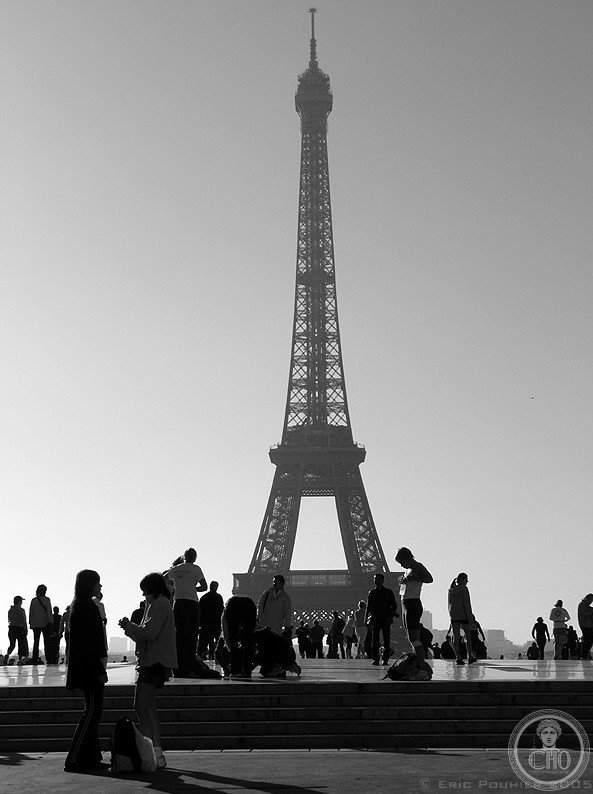
The tower is best seen from the Trocadéro esplanade to the north, where the fountains and the geometry of Chaillot Hill frame the structure symmetrically and provide a reflecting surface at the feet. The four legs arch inward from a wide base (125 × 125 metres) to the first platform in a curve calculated to resist wind at every point. The lattice structure is not merely decorative but structural: the open ironwork allows the wind to pass through rather than accumulate lateral pressure. From a distance, the structure appears delicate; from below, standing between the legs looking up, it is immense.
The view from the third platform (276 metres) on a clear day extends 70 kilometres. The most interesting spatial experience is the second platform (115 metres), from which the relationship of the tower to the city — the Champ de Mars running south to the École Militaire, the Trocadéro across the Seine, the entire Left Bank laid out below — is most legible. At night, the tower is lit from within (not floodlit from outside), giving it a warm amber glow visible from across Paris.
Practical information
- Address: Champ de Mars, 5 Avenue Anatole France, 75007 Paris, France
- Hours: daily 9 am–11:45 pm (last ascent 10:45 pm); to midnight in summer
- Admission: 2nd floor by stairs EUR 14.20; 2nd floor by lift EUR 19.10; top by lift EUR 28.30; mandatory online booking (toureiffel.paris) — walk-up queues can be 2–3 hours
- Stairs: available to the 2nd floor; 674 steps; significantly quicker than the lift queue at busy times and gives a much better sense of the structure
- Night visits: the tower closes after midnight but the light show is visible from outside until 1 am on most nights
Getting there
Metro 6 (Bir-Hakeim station) or Metro 9 (Trocadéro); RER C (Champ de Mars–Tour Eiffel). Trocadéro esplanade on the north bank gives the classic view; Champ de Mars to the south for a less crowded approach. GPS: 48.8584, 2.2945.
Nearby
- Musée du Quai Branly–Jacques Chirac — the non-European civilisations museum immediately east of the tower; Jean Nouvel’s building with its famous green wall; excellent Oceanic, African, and American collections
- Les Invalides & Musée de l’Armée — Napoleon’s tomb and the national military museum; 10 minutes on foot east; the gold dome is visible from the Champ de Mars
- Palais de Chaillot / Trocadéro — the 1937 World’s Fair complex housing several museums; the Cité de l’Architecture et du Patrimoine is the best architecture museum in France
- Musée d’Orsay — the Impressionist and Post-Impressionist collection in the former 1900 railway station; 20 minutes on foot along the Seine
Sources
- Wikipedia, Eiffel Tower, accessed June 2026
- Official tower site: toureiffel.paris
- UNESCO, Paris, Banks of the Seine, WHS reference 600, inscribed 1991
- Joseph Harriss, The Tallest Tower: Eiffel and the Belle Epoque, Unlimited Publishing LLC, 2004
Find it on the map
See this place and what’s around it →Events here — now on & upcoming
- Anniversary: The Eiffel Tower is Completed — March 31, 188931 Mar 2027See the event →
📷 Become a Cultural Heritage Online photographer
Share your photos of places: they stay published under your name as the author. The more they're seen, the more you get noticed — and soon a contest will reward the most appreciated photos.
Log in or sign up free to add a photoIs this page about you?
This page is read by travellers and heritage enthusiasts who find it on Google. Tell us how you are connected to this place and we will take it from there.