
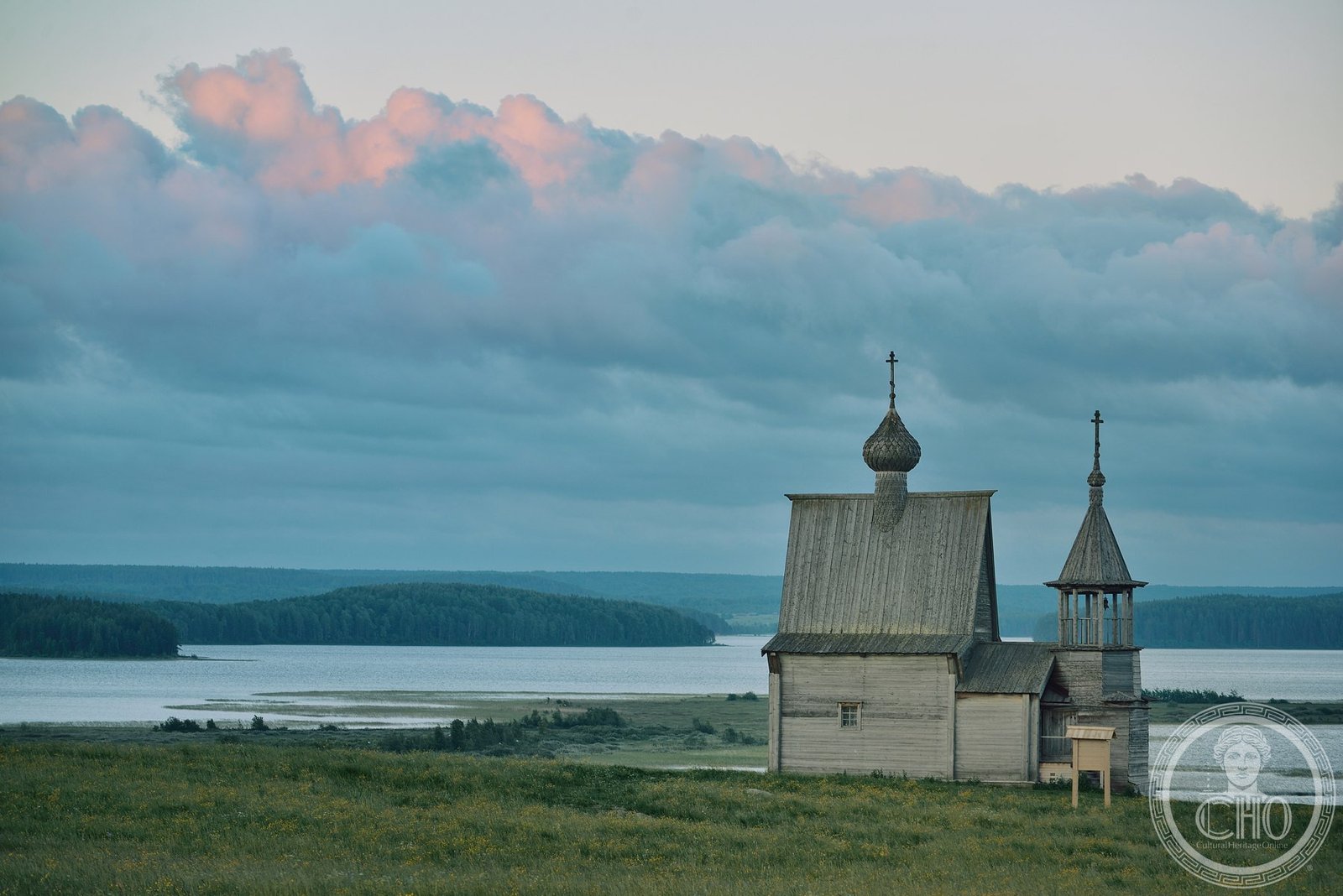
In Arkhangelsk Oblast, among the boreal forests of the Russian Far North, Lake Kenozero holds a cultural landscape of rare integrity: villages of wooden houses, Orthodox chapels with painted interiors, sacred groves of birch and spruce kept by local tradition, and a fabric of legend and folklore going back to the Middle Ages. One of the most recent UNESCO sites (2023), it tells how a rural community kept its spiritual and material identity alive for centuries.
At a glance
The Cultural and Natural Landscape of Kenozero Lake, inscribed by UNESCO in 2023 (ref. 1688), is a mixed heritage site in Arkhangelsk Oblast in north-western Russia. The property encompasses Lake Kenozero and its surrounding landscape of some 140,000 hectares, including traditional wooden villages, Orthodox chapels with painted ceilings (the “forest Sistine Chapels”), sacred groves called “svyashchennyye roshchi,” and the Kenozero National Park which has protected the area since 1991. The site documents a centuries-old fusion of Orthodox Christianity and pre-Christian Slavic nature worship unique to the Russian North.
Key facts
- UNESCO: World Heritage since 2023 (Kenozero Lake Cultural Landscape, ref. 1688)
- Setting: Lake Kenozero and surroundings, Arkhangelsk Oblast, north-western Russia
- Sacred groves: 38 surviving “svyashchennyye roshchi” (sacred groves) in the landscape
- Chapels: dozens of small wooden Orthodox chapels, several with remarkable painted interiors
- National Park: Kenozero National Park (est. 1991) protects the core area
- Community: the landscape is still inhabited; traditional practices are maintained by local residents
History
The Kenozero region has been inhabited since the Mesolithic period. In the medieval era, Finno-Ugric peoples (Veps) settled the lakeside, later mixing with Slavic settlers. The region came under the influence of the Novgorod Republic and then the Moscow Tsardom, with Christian monasteries established from the 14th century. The landscape reflects a synthesis of Orthodox Christianity with older animist beliefs: sacred groves of trees, believed to protect villages and contain spirits of the dead, were preserved alongside the construction of small wooden chapels on prominent hilltops and lakeshores.
By the 20th century, much of the Russian rural North was depopulated and its traditional wooden architecture neglected. The Kenozero area survived relatively intact thanks to its remoteness. The Kenozero National Park, founded in 1991, undertook systematic documentation and conservation of the chapels, sacred groves, traditional farmsteads and oral traditions. International recognition came with the UNESCO inscription in 2023.
What you see
The landscape around Lake Kenozero is one of boreal forests, meadows and quiet water, punctuated by clusters of wooden houses, log farmsteads and small chapels on hillsides. Some chapels — at Pochin and Ryzhkovo — have painted wooden ceiling panels (the “sky” panels) depicting saints and biblical scenes in a folk-art style that has been compared to the Sistine Chapel for its spiritual power.
The sacred groves are identifiable by their ancient trees and the absence of human activity; they are maintained as living cultural memory. In summer the lake is a mirror of sky and forest; in winter the landscape is snow-covered and silent, with Orthodox services still held in the chapels.
Practical information
- Base: Plyos or Kargopol town (nearest with accommodation); Kenozero is 4–5 hrs from Arkhangelsk by road
- National Park: Kenozero National Park visitor centre organises tours, boat trips and chapel visits
- Best time: June–August (summer, boat access); February–March (winter, ice roads, snow landscapes)
- Access: by car or organised tour from Arkhangelsk or Plёs; no regular public transport to the lake
Getting there
Kenozero is accessible from Arkhangelsk (5 hrs by car via Kargopol) or from Plesetsk (2.5 hrs). Arkhangelsk has domestic flights from Moscow. The national park visitor centre in the village of Lekshmozerye or the administrative office in Arkhangelsk can arrange transport. GPS: 61.93° N, 38.17° E.
Nearby
- Kargopol — a small historic town with white-stone Orthodox churches, 130 km south
- Solovki (Solovetsky Islands) — the UNESCO monastery archipelago in the White Sea, 300 km north
- Arkhangelsk — the regional capital on the Northern Dvina River, with a significant open-air museum of wooden architecture (Malye Korely)
Sources
- UNESCO World Heritage Centre — “Cultural and Natural Landscape of Kenozero Lake” (ref. 1688)
- Kenozero National Park official website — kenozero.ru
- Encyclopaedia Britannica — Arkhangelsk Oblast
Find it on the map
See this place and what’s around it →📷 Become a Cultural Heritage Online photographer
Share your photos of places: they stay published under your name as the author. The more they're seen, the more you get noticed — and soon a contest will reward the most appreciated photos.
Log in or sign up free to add a photo