

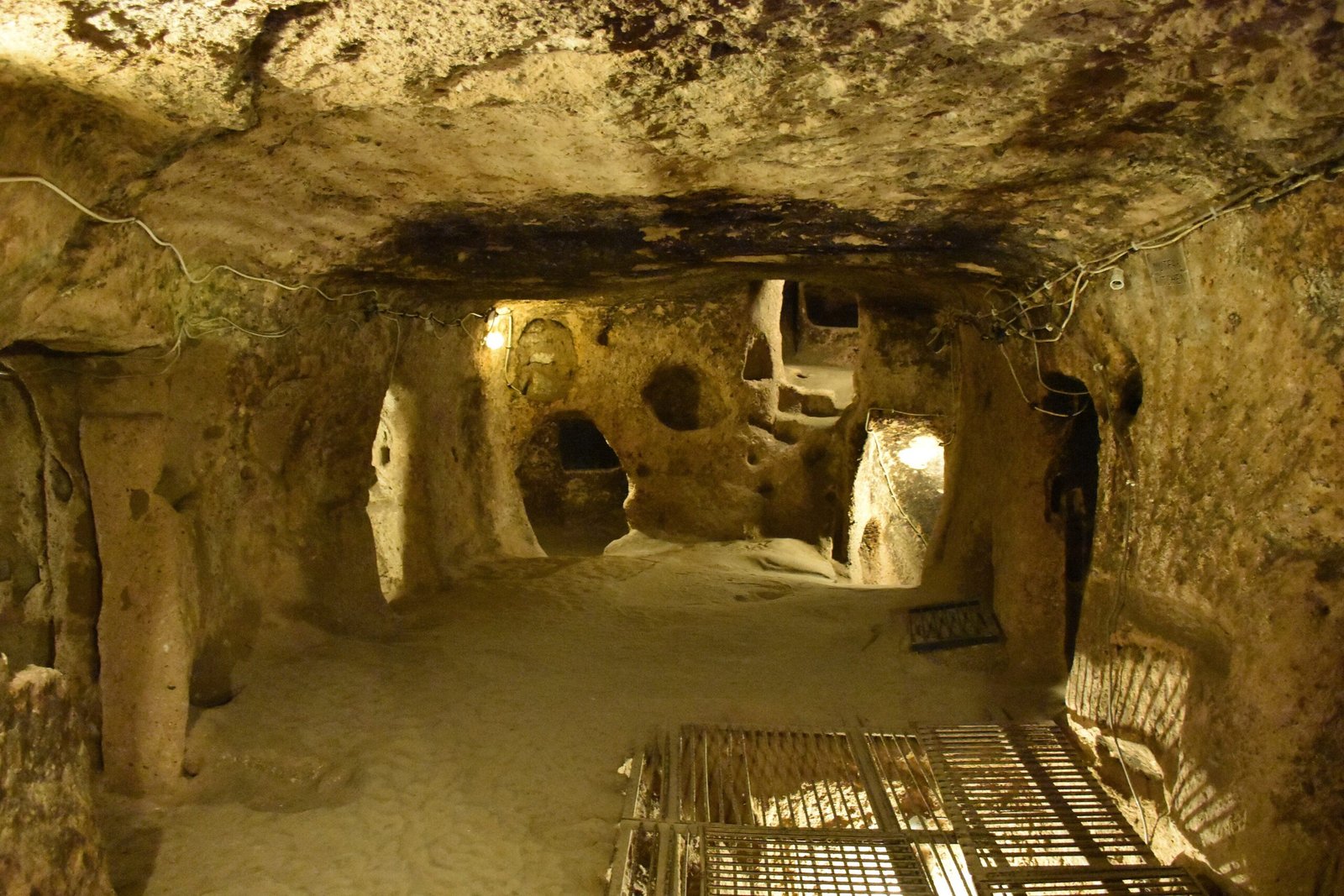
Eight storeys beneath a living village in the heart of Cappadocia, Kaymakli is one of approximately 40 underground cities carved into the volcanic tuff of central Turkey — a labyrinthine refuge built by Byzantine Christians hiding from Arab raiders, complete with stables, a church, wine presses, grain stores, and one-tonne rolling millstone doors that sealed the passages from the inside.
At a glance
Formally documented in 1964, Kaymakli descends eight storeys underground — though only four levels are currently open to visitors. Unlike Derinkuyu (9 km south, already in CHO), which was designed for large refugee populations, Kaymakli appears to have been a more permanent habitation and storage complex, organised around the daily requirements of an extended community. The two cities are connected by an underground tunnel approximately 9 km long — the longest known ancient underground passageway in the world. Modern Kaymakli village sits directly above the underground city; many houses in the village have storage rooms and chapels in the subterranean levels beneath them. The underground city is literally under a living village.
Key facts
- Depth: 8 storeys underground; 4 currently open to visitors
- Carved into: Volcanic tuff (compacted volcanic ash) from ancient eruptions of the Erciyes and Hasan volcanoes
- Formally documented: 1964
- Main users: Byzantine-era Christians, c. 6th–10th century AD, using it as protection against Arab raids
- Connection: Underground tunnel approximately 9 km long connects Kaymakli to Derinkuyu Underground City
- Rolling stone doors: Disc-shaped millstone doors weighing approximately one tonne each; closable from inside to seal passages
- Unique feature: The modern village of Kaymakli is built directly over the underground city; houses have subterranean rooms below
History
The soft volcanic tuff of Cappadocia — the same geological material that produced the famous “fairy chimney” rock formations above ground — is remarkably easy to carve yet structurally stable once cut. This combination of properties led the inhabitants of central Anatolia to begin excavating underground from at least the Hittite Bronze Age, though the exact origins of Kaymakli remain uncertain.
The underground cities of Cappadocia became critically important during the Byzantine period (6th–10th centuries AD), when Arab raids repeatedly struck the Anatolian plateau. Communities needed refuges where they could shelter themselves, their livestock, their food supplies, and their valuables for extended periods while raiders passed through. Kaymakli’s organisation reflects these requirements directly: stables on the upper levels (animals were brought underground), food processing and storage throughout, a church for spiritual needs, and ventilation systems that allowed extended habitation.
After the Arab threat diminished, the underground cities were used intermittently for storage and occasional refuge during later conflicts, including the Mongol invasions of the 13th century. They were formally documented by archaeologists in the 1960s, and Kaymakli was opened to visitors in 1964 and designated part of the Goreme National Park and Rock Sites of Cappadocia UNESCO World Heritage Site (inscribed 1985). Conservative estimates place the maximum simultaneous population of Kaymakli at approximately 1,500 people; optimistic estimates reach 3,500, based on the density of sleeping, storage, and stable spaces on the accessible four floors alone.. The village above has been continuously inhabited throughout this period — giving Kaymakli its unique quality as a living landscape where the ancient underground world meets contemporary domestic life.
What you see
Visitors enter through the current village, descending through narrow passages carved into the tuff. The four open levels include:
- Level 1 (stables): The uppermost level contains carved tethering posts for animals and troughs, designed to house the community’s livestock during periods of refuge underground.
- Level 2 (church): An early Christian church with an apse niche, its plan following the standard Byzantine basilica layout adapted to the constraints of the carved space.
- Wine and oil presses: Carved stone basins and pressing equipment distributed across multiple levels, suggesting significant food production and storage capacity.
- Grain and storage rooms: Numerous carved chambers with smooth floors and walls, used for storing grain, oil, wine, and other provisions for extended underground stays.
- Ventilation shafts: The most critical element of any underground city — deep vertical shafts that also functioned as wells, providing both air circulation and water access.
- Millstone doors: Disc-shaped carved stone doors, approximately one tonne each, positioned at key passage junctions and rollable from the inside to seal sections against intruders.
Practical information
Kaymakli Underground City is located in Kaymakli village, approximately 20 km south of Nevşehir city in the Cappadocia region of central Turkey. The site is open to visitors year-round; entry fees apply. The narrow passages require moderate agility — not recommended for visitors with severe claustrophobia. Guided tours are available and recommended for context. The site is best visited in the morning to avoid midday crowds, which can make the narrow passages uncomfortably congested.
Getting there
The nearest airports are Nevşehir Kapadokya Airport (NAV) and Kayseri Erkilet Airport (ASR), both with connections to Istanbul. From Nevşehir, Kaymakli is approximately 20 km south by road; dolmuş (shared minibus) services run regularly from the Nevşehir bus terminal. Most visitors to Cappadocia combine Kaymakli with Göreme and Derinkuyu in a single day tour.
Nearby
- Derinkuyu Underground City — 9 km south; connected to Kaymakli by the ancient underground tunnel; larger refuge city, different character
- Göreme Open-Air Museum — UNESCO WHS, 20 km north; Byzantine rock-cut churches with extraordinary fresco cycles
- Uchisar Castle — Natural volcanic tuff tower converted into a fortress, 18 km north; panoramic views over the fairy chimney landscape
Sources
- Turchetto, Jacopo & Silani, Moreno. “Underground architecture in Cappadocia.” In Cappadocia in Antiquity. Franz Steiner Verlag, 2018.
- Sinclair, T. A. Eastern Turkey: An Architectural and Archaeological Survey. Vol. 3. Pindar Press, 1989.
- Turkish Ministry of Culture and Tourism. “Kaymakli Underground City.” kultur.gov.tr.
- Crow, Jim. “The infrastructure of a Byzantine city.” In The Byzantine World, ed. Paul Stephenson. Routledge, 2010.
Find it on the map
See this place and what’s around it →📷 Become a Cultural Heritage Online photographer
Share your photos of places: they stay published under your name as the author. The more they're seen, the more you get noticed — and soon a contest will reward the most appreciated photos.
Log in or sign up free to add a photo