

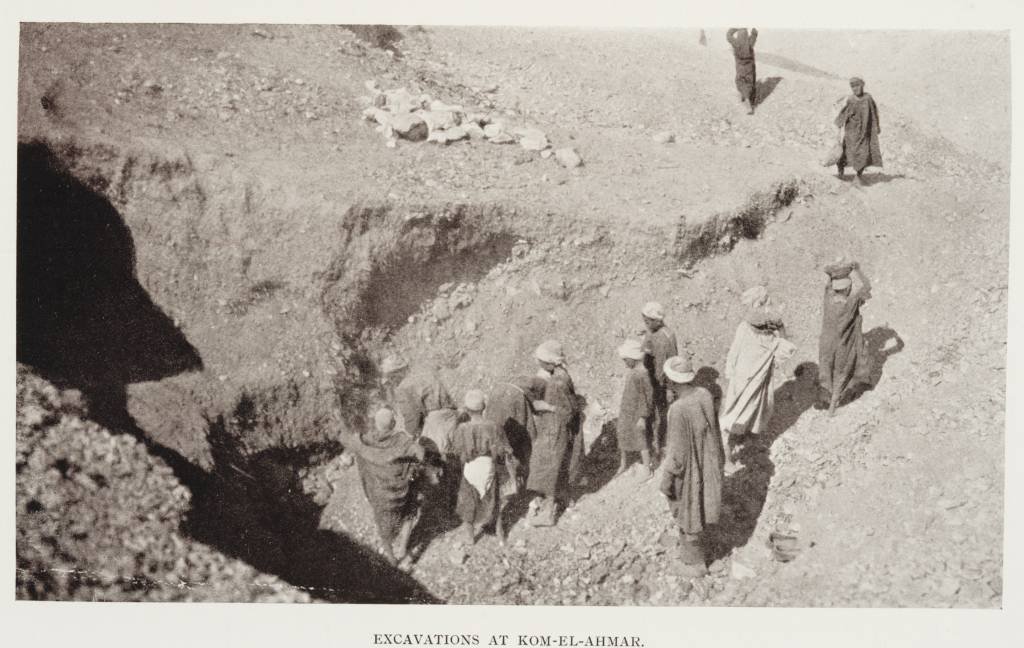
Hierakonpolis — ancient Nekhen, the City of the Falcon — is the largest known Predynastic settlement in Egypt and the birthplace of pharaonic civilisation. It produced the Narmer Palette, the world’s oldest zoo, and the earliest monumental mudbrick architecture in the Nile Valley.
At a glance
Occupied continuously from approximately 4000 to 2600 BC and covering some 3 km² at its maximum extent, Hierakonpolis is where the idea of the Egyptian state was invented. The Greek name — “City of the Falcon” — refers to the city’s tutelary deity Horus, whose falcon cult originated here and later became the emblem of all pharaonic kingship. The site straddles desert and floodplain some 80 km south of Luxor, near Edfu, and remains one of Egypt’s most actively excavated sites, with annual fieldwork by the Hierakonpolis Expedition based at Cambridge.
Key facts
- Period: c. 4000–2600 BC (Predynastic through Early Dynastic)
- Size at peak: approximately 3 km², population estimated at 5,000–10,000
- Narmer Palette (c. 3100 BC): the earliest known historical document naming a ruler and the oldest known political propaganda art; now in the Cairo Egyptian Museum
- World’s oldest zoo (c. 3500 BC): royal menagerie predating any other known zoo by 500 years; included elephants, hippos, hartebeest, aurochs, baboons, and wild cats
- Oldest monumental building in Egypt: mudbrick structure HK29A, c. 3500 BC
- Oldest mural painting in Egypt: discovered in cemetery HK6 — since lost due to exposure after discovery
- Active excavation: ongoing annually by the Hierakonpolis Expedition (Cambridge/British Museum)
History
Hierakonpolis was first settled around 4000 BC during the Naqada I period, when small villages clustered along the edge of the Nile floodplain. By the Naqada II period (c. 3600–3200 BC) it had grown into the largest urban centre in Egypt — with a brewery complex, large pottery production area, and an elite cemetery.
Around 3500 BC, the rulers of Hierakonpolis maintained a royal menagerie. The remains of captive elephants, hippopotamuses, hartebeest, aurochs, baboons, and wild cats were found buried alongside elite humans in cemetery HK6. This predates any other known zoo by approximately 500 years. Some animal skeletons show signs of nutritional deficiency consistent with captivity; at least one elephant had a healed broken leg, implying veterinary care. The animals appear to have been ritually killed and interred as part of elaborate funerary rites for their owners. This zoo predates the invention of writing.
Around 3100 BC, the ruler Narmer unified Upper and Lower Egypt and commemorated the event on the ceremonial cosmetic grinding palette that bears his name. Depicting the king smiting an enemy with a mace and accompanied by hieroglyphic labels identifying named individuals, the Narmer Palette is the oldest known historical document and the oldest known example of formal state political imagery. The companion Narmer Macehead was found in the same deposit (the Main Deposit, HK6). Both objects are now in the Egyptian Museum, Cairo.
Hierakonpolis declined rapidly after unification as political power shifted to Memphis. Excavations began in the 1890s under James Quibell and Frederick Green, who discovered the Narmer Palette, and have continued under the Hierakonpolis Expedition led by Renée Friedman (British Museum / Cambridge).
What you see
The most impressive visible structure is the Fort of Khasekhemwy (HK5B), a massive mudbrick enclosure built around 2700 BC — one of the oldest standing mudbrick structures in the world, its walls still rising several metres above the desert. The Main Deposit area (HK6), where the Narmer Palette and Macehead were found, is marked but unspectacular above ground. The brewery complex and large oval courtyard are partially visible as low mounds.
The key finds — the Narmer Palette, the Narmer Macehead, painted linen shrouds, and zoo animal skeletons — are in the Egyptian Museum in Cairo and the Ashmolean Museum in Oxford. There is no formal visitor centre on site.
Practical information
- Access: Open to visitors with an Egyptian Antiquities Organisation permit; contact the local inspectorate in Edfu
- Location: West bank of the Nile, approximately 80 km south of Luxor, 5 km north of Edfu, near the village of Kom el-Ahmar
- Best season: October–March (summer temperatures can exceed 45°C)
- Facilities: Minimal — no visitor centre; bring water and sun protection
- Photography: Permitted on site; key finds are in Cairo and Oxford
Getting there
The site lies near the village of Kom el-Ahmar on the west bank of the Nile, 5 km north of Edfu. From Luxor (80 km north), take a taxi or microbus to Edfu, cross the Nile by ferry or bridge, and hire a local taxi. From Aswan (115 km south), the same route applies via Edfu. A hired car from Luxor or Aswan for a full day is the most practical option for most visitors; no direct public transport serves the site.
Nearby
- Temple of Edfu — 5 km south, the best-preserved Ptolemaic temple in Egypt, dedicated to Horus — the same deity worshipped at Hierakonpolis 3,000 years earlier
- Elkab — 20 km north, a near-contemporary Predynastic and Dynastic cemetery complex with rock-cut tombs and walled town enclosure
- Luxor and Karnak Temples — 80 km north, the supreme monuments of New Kingdom Egypt
Sources
- Hierakonpolis Expedition — hierakonpolis-online.org
- Friedman, Renée (ed.) — Egypt and Nubia: Gifts of the Desert, British Museum Press, 2002
- Quibell, J.E. & Green, F.W. — Hierakonpolis, ERA Memoir 4–5, 1900–1902
- Flores, D.V. — “The funerary sacrifice of animals during the Predynastic period,” JARCE 40, 2003
- Wikipedia — Hierakonpolis
Find it on the map
See this place and what’s around it →📷 Become a Cultural Heritage Online photographer
Share your photos of places: they stay published under your name as the author. The more they're seen, the more you get noticed — and soon a contest will reward the most appreciated photos.
Log in or sign up free to add a photo