

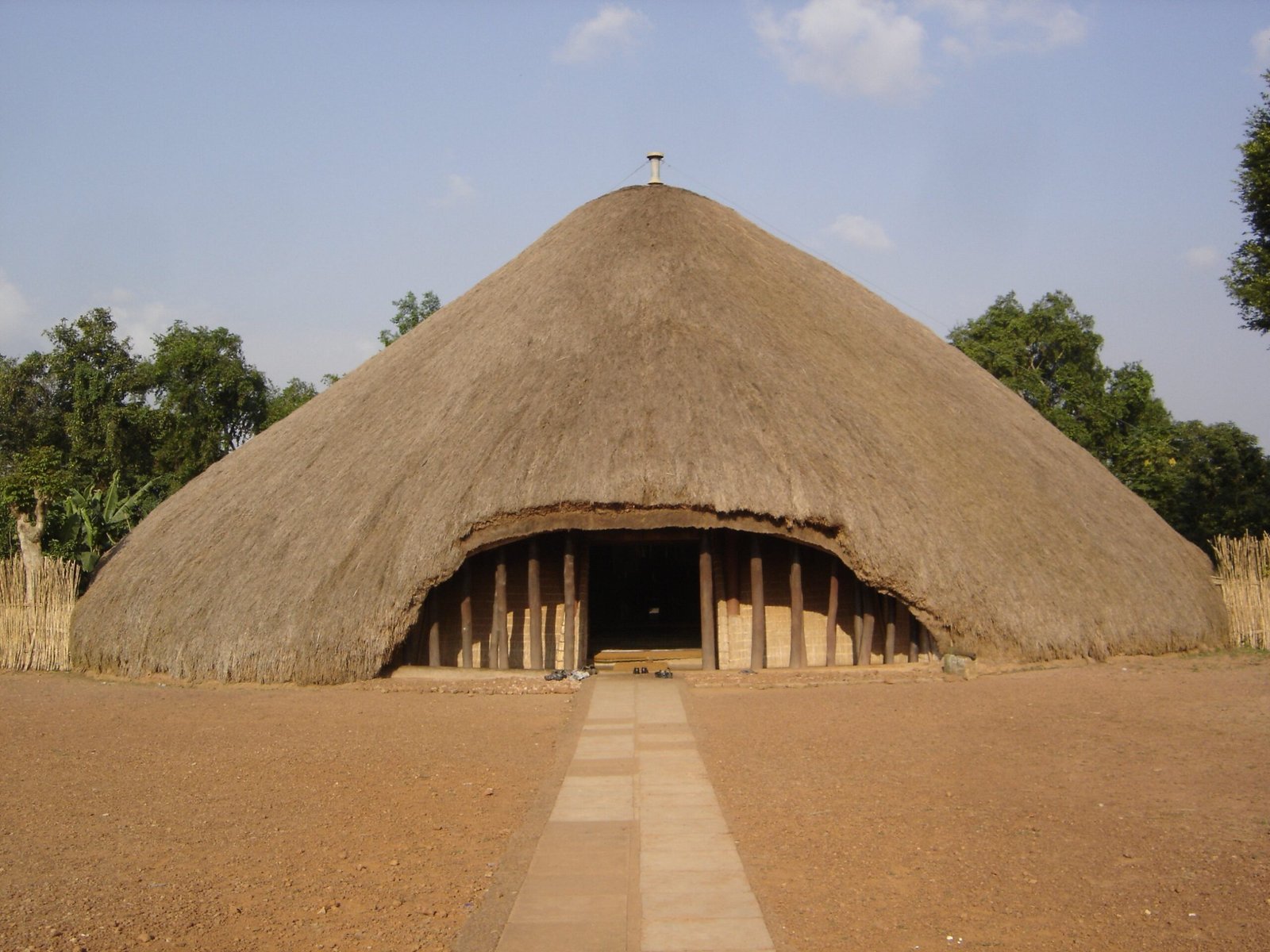
The royal burial ground and living palace of the Kabakas of Buganda on Kasubi Hill in Kampala — the tombs of four kings housed in the world’s largest thatched building, a living cultural site of active royal ceremony, severely damaged by arson in 2010 and now undergoing UNESCO-supported reconstruction.
At a glance
On Kasubi Hill in northwestern Kampala, the royal enclosure of Kasubi is simultaneously a palace, a mausoleum, and a living ceremonial centre of the Buganda Kingdom. The site was established in 1882 by Kabaka Mutesa I, who converted his royal palace into a burial ground after his death and established the tradition that would be followed by three of his successors. The defining structure of the site — the Muzibu-Azaala-Mpanga, a circular thatched building approximately 27 metres in diameter — was considered the world’s largest thatched structure and has functioned since 1882 as the inner sanctuary housing the tombs and symbolic thrones of the four buried Kabakas. Inscribed on the UNESCO World Heritage List in 2001, the Kasubi Tombs were severely damaged by fire in March 2010 in an arson attack; UNESCO and the Buganda Kingdom have been engaged in reconstruction ever since.
Key facts
- UNESCO inscription: 2001 (criteria i, iii, iv, vi); placed on List of World Heritage in Danger after 2010 fire
- Established: 1882 CE; Kabaka Mutesa I converted his palace into the royal burial ground
- Four Kabakas buried here: Mutesa I (d. 1884), Mwanga II (d. 1903), Daudi Chwa II (d. 1939), Mutesa II (d. 1969, Edward Mutesa, also first President of Uganda)
- Main building: Muzibu-Azaala-Mpanga: c. 27 m diameter, grass thatching over a framework of poles, bark cloth wall linings; previously the world’s largest thatched building
- Living site: Clan guardians (the Nalinya, Naalinnya, and Bambi clans) continue to perform royal ceremonies at the site; visitors may observe but not enter the inner tomb chamber
- 2010 fire: March 16, 2010; arson; the Muzibu-Azaala-Mpanga was destroyed; reconstruction ongoing with UNESCO funding and traditional building techniques
- Coordinates: 0.33°N, 32.56°E, Kampala District, Uganda
History
The Buganda Kingdom was the most powerful polity in the Great Lakes region of East Africa by the nineteenth century, a highly centralised monarchy with a sophisticated administrative structure, a standing army, and a maritime force on Lake Victoria. The Kabaka (king) was a figure of enormous religious and political authority; his palace — a compound of large thatched buildings surrounded by a fence of elephant grass — was the centre of the kingdom. When Kabaka Mutesa I died in 1884, his palace on Kasubi Hill was converted, in accordance with royal tradition, into a mausoleum: the main audience hall became the shrine housing the royal regalia and, later, the physical remains of the Kabaka. This precedent established Kasubi as the royal burial ground of the Buganda line, a role it has maintained through three subsequent Kabakas.
The nineteenth-century history of Kasubi intersects with the arrival of European missionaries and the colonial partition of Uganda. Kabaka Mwanga II (buried at Kasubi) resisted both the British and the missionaries, eventually leading an armed revolt; he was exiled to the Seychelles in 1899. His son Daudi Chwa was installed as a minor under British supervision; Daudi’s son Edward Mutesa II became both the last Kabaka of Buganda and the first President of Uganda at independence in 1962, only to be overthrown by Milton Obote in 1966 and to die in exile in London in 1969 — his remains were returned to Uganda in 1971 and interred at Kasubi. The site was at the time in a state of neglect under the Amin and Obote regimes, which suppressed the Buganda Kingdom; restoration began after the Kingdom’s formal restoration in 1993.
What you see
The outer enclosure of the Kasubi Tombs is defined by a fence of elephant grass (Miscanthus violaceus) approximately 3 metres high, which screens the royal compound from outside view — a visual boundary between the profane and sacred that is renewed by the clan guardians when necessary. The main entrance gate — the Bujjabukula — is a large thatched gatehouse through which visitors pass into the inner courtyard. The inner enclosure contains several structures: the restored Ndoga-Obukaba (the drum house), the Bazzekukweta (a building for the Kabakas’ hunting trophies), and the great Muzibu-Azaala-Mpanga. The interior of the Muzibu-Azaala-Mpanga (currently being reconstructed) is divided into sectors corresponding to the four buried Kabakas; the tombs themselves are not visible to visitors but are demarcated by bark cloth and bead curtains. The symbolic thrones of the four Kabakas, their personal objects, and royal regalia are housed here under the care of the clan guardians.
Practical information
- Opening hours: Daily 08:00–18:00; guided tours available from the entrance
- Admission: Foreign adults approx. USD 10; Ugandan citizens reduced rate
- Dress code: Visitors must remove shoes before entering the Bujjabukula gatehouse; women must cover their legs (wraps available to borrow at the entrance)
- Photography: Permitted in outer areas; restricted inside the Bujjabukula and prohibited in the inner sanctuary
- Reconstruction: The site is a working reconstruction project; some areas may be closed; check current access on arrival
Getting there
The Kasubi Tombs are approximately 6 km northwest of Kampala city centre, on Kasubi Hill off Hoima Road. From central Kampala, take a boda-boda (motorcycle taxi) or matatu towards Hoima Road; the site is well-known and most drivers will take you directly. Taxis from Kampala Airport (Entebbe, approximately 40 km south) take 1–1.5 hours depending on traffic; combined visits to the Kasubi Tombs, Kampala city centre, and the Uganda Museum are easily done in one day.
Nearby
- Uganda Museum: 3 km from Kasubi, the oldest museum in East Africa (1908); collections include Buganda royal objects, ethnographic material, and Iron Age finds from Uganda
- Namirembe Cathedral: The Anglican cathedral of Uganda on Namirembe Hill, 2 km from Kasubi; directly connected to the history of the Buganda martyrs of 1886
- Rubaga Cathedral: The Roman Catholic cathedral of Uganda, facing Namirembe across a valley; both cathedrals are on hills deliberately chosen to balance the royal palace on Kasubi Hill
Sources
- UNESCO World Heritage Committee (2001): Tombs of Buganda Kings at Kasubi — Inscription Report
- UNESCO (2010): State of Conservation Report: Kasubi Tombs after the fire of 16 March 2010
- Reid, A. & Medard, H. (1998): “Buganda before Buganda: The Archaeology of the Buganda Heartland.” In Connah, G. (ed.) Transformations in Africa, Leicester University Press
- Wikipedia: Kasubi Tombs
Find it on the map
See this place and what’s around it →📷 Become a Cultural Heritage Online photographer
Share your photos of places: they stay published under your name as the author. The more they're seen, the more you get noticed — and soon a contest will reward the most appreciated photos.
Log in or sign up free to add a photo