

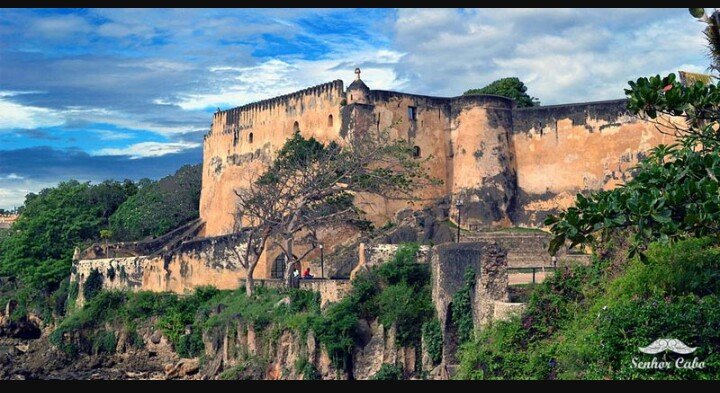
A Portuguese fortress built in 1593 at the entrance to Mombasa harbour that spent four centuries as the most fought-over stronghold on the East African coast — besieged nine times, changing hands twelve times between 1631 and 1875, and now the city’s most important museum and a UNESCO World Heritage Site.
At a glance
Fort Jesus stands on a coral ridge at the southern entrance to the old harbour of Mombasa Island, a position that has made it the key to controlling maritime access to the East African interior since it was built by the Portuguese in 1593. Designed by the Italian military architect João Baptista Cairato and built by a combination of Portuguese engineers, Indian craftsmen, and African labourers, the fort’s irregular pentagonal plan — adapted to the shape of the coral outcrop — is considered one of the finest examples of sixteenth-century Portuguese military architecture outside Portugal. Inscribed on the UNESCO World Heritage List in 2011, the fort is significant both as an architectural document of the Age of Exploration and as a physical record of the four-century struggle between Portugal, Oman, the Mazrui dynasty, and Britain for control of the Swahili coast trade network.
Key facts
- UNESCO inscription: 2011 (criteria ii, iv)
- Built: 1593–1596 CE; architect: João Baptista Cairato (also credited to the school of Michele Sanmicheli)
- Sieges: At least nine sieges documented; the fort changed hands at least twelve times between 1631 and 1875
- Longest siege: 1696–1698: the Omani siege lasted 33 months; the Portuguese garrison was reduced from 2,500 to 11 survivors by plague and combat before capitulation
- Museum: Fort Jesus Museum, opened 1962; houses Swahili coast ceramics, Portuguese cannons, navigation instruments, the San Antonio de Tangá shipwreck cargo (a Portuguese vessel that sank in the harbour in 1697)
- Coordinates: 4.06°S, 39.68°E, Mombasa Island, Kenya
History
Portugal established its presence on the East African coast from 1498, using Mombasa as a provisioning stop on the sea route to India. The decision to build Fort Jesus in 1593 reflected a shift from seasonal exploitation to permanent occupation: the fort was intended to secure Portuguese control over the entire Swahili coast trade network — the cotton textiles, ivory, gold, and enslaved people flowing from the African interior to the Indian Ocean commerce. Construction took three years and required the labour of hundreds of workers; the walls were built of coral rag quarried from the promontory itself, giving them the characteristic pale gold colour that distinguishes the fort in all its representations.
From 1631, when a Swahili sultan briefly seized the fort by deception, Fort Jesus entered a cycle of siege and counter-siege that would continue for two and a half centuries. The most consequential episode was the Omani siege of 1696–1698: Omani forces under the Imam of Oman blockaded the fort for thirty-three months while plague devastated the Portuguese garrison; only eleven Portuguese soldiers survived to surrender in December 1698. The Omanis held the fort until 1728, then lost it briefly to a Portuguese counter-attack, then regained it in 1729 — a final date that effectively ended Portuguese power on the East African coast. Thereafter the fort passed between the Omani sultans, the Mazrui dynasty (an Omani family that broke from the Sultanate), and — from 1837 — the Sultanate of Zanzibar, before the British took nominal control in 1895 and converted it to a prison in 1895, a role it retained until 1958.
What you see
The fort’s irregular pentagonal plan follows the shape of the coral reef on which it stands. Four corner bastions — named Captain’s (São Mateus), St. Augustine, São Filipe, and São Alberto — project outward from the main enclosure at angles calculated to eliminate blind spots in the field of fire; the asymmetrical plan, a departure from the rigidly geometrical Italian Renaissance fortification ideal, is one of the features that makes Fort Jesus architecturally distinctive. The main gate, facing the town, is framed by a bartizan and preserves inscriptions from different occupation periods. Inside, the main courtyard is bounded by a long barracks building (the Omani House, with a characteristic carved plaster frieze) on the northern wall and by the roofless shell of the Portuguese captain’s house on the south. The museum displays include the exceptional collection of Chinese porcelain, Indian textiles, and Portuguese faience recovered from the harbour, demonstrating the commercial reach of the fort’s successive occupants.
Practical information
- Opening hours: Daily 08:00–18:00; last admission 17:30
- Admission: Foreign adults approx. USD 15; Kenyan citizens reduced rate; children under 3 free
- Museum: Fort Jesus Museum is inside the fort; additional entry not required; allow 1.5–2 hours for the full site
- Guided tours: Available from the museum; recommended for understanding the complex siege history
- Accessibility: The coral floor and rampart stairs are uneven; not fully accessible for wheelchairs
Getting there
Fort Jesus is on the southeastern shore of Mombasa Island, 10 minutes on foot from the Old Town ferry landing or 20 minutes from the main Mombasa bus and matatu hub near Mwembe Tayari. Mombasa is connected by daily flights from Nairobi (1 hour) and by the SGR (Standard Gauge Railway) from Nairobi (approximately 4 hours 30 minutes), with Mombasa terminus at Miritini (taxi required to island). From the Mombasa ferry, tuk-tuks and taxis serve the fort directly.
Nearby
- Mombasa Old Town: A UNESCO-listed historic urban area immediately north of the fort, with carved Swahili doorways, mosques, and Indian Ocean merchant houses dating from the eighteenth and nineteenth centuries
- Lamu Archipelago: UNESCO World Heritage Site 250 km north of Mombasa; the oldest and best-preserved Swahili town on the East African coast (Lamu Old Town, inscribed 2001)
- Gede Ruins: Approximately 100 km north near Watamu; the ruins of a substantial Swahili stone town abandoned in the sixteenth or seventeenth century
Sources
- UNESCO World Heritage Committee (2011): Fort Jesus, Mombasa — Nomination Dossier
- Kirkman, J.S. (1974): Fort Jesus: A Portuguese Fortress on the East African Coast. Clarendon Press, Oxford
- Pouwels, R.L. (1987): Horn and Crescent: Cultural Change and Traditional Islam on the East African Coast, 800–1900. Cambridge University Press
- Wikipedia: Fort Jesus
Find it on the map
See this place and what’s around it →📷 Become a Cultural Heritage Online photographer
Share your photos of places: they stay published under your name as the author. The more they're seen, the more you get noticed — and soon a contest will reward the most appreciated photos.
Log in or sign up free to add a photo