
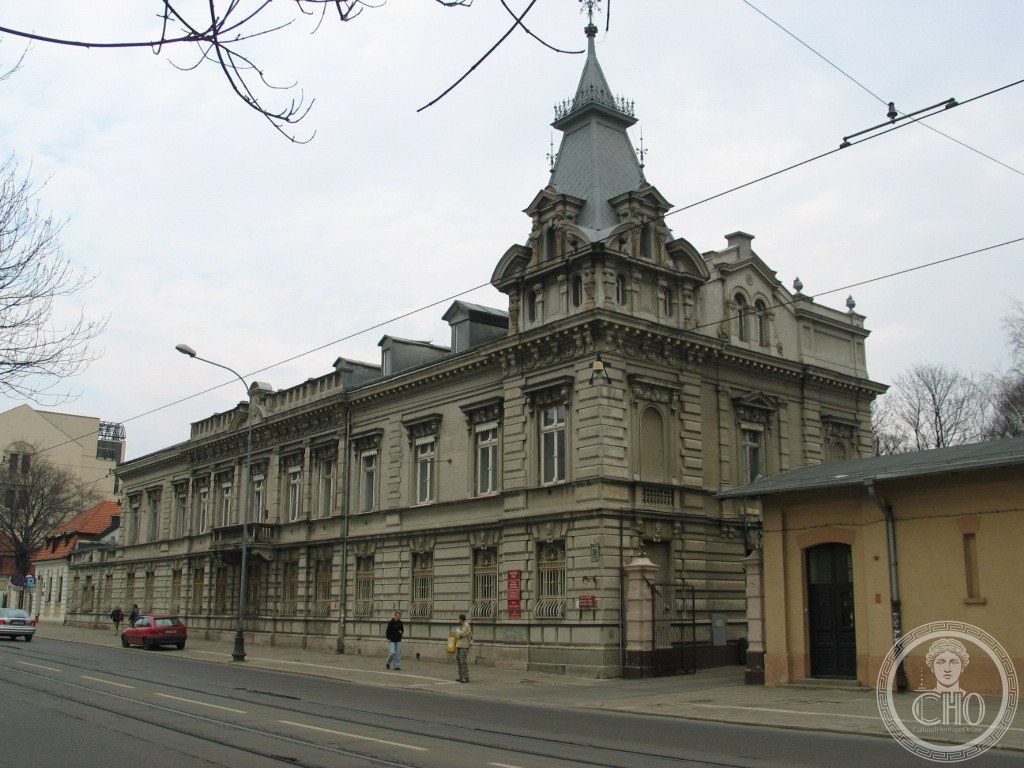
The town palace of Łódź’s “Cotton King”, fitted out by craftsmen from Venice, Berlin and Dresden — and now, fittingly, Poland’s only museum of film.
At a glance
Karol Scheibler’s Palace stands on Plac Zwycięstwa — once the Water Market — in Łódź, beside the first of the factories that made him the city’s “Cotton King”. Built from the 1850s and enlarged later, the neo-Renaissance brick palace was the town residence of the greatest industrialist in nineteenth-century Łódź, its interiors fitted by craftsmen from Venice, Berlin and Dresden. Since 1986 it has housed the Museum of Cinematography, the only museum of its kind in Poland — an apt home in the city of the famous Łódź Film School.
Key facts
- Location: Plac Zwycięstwa, Łódź, Poland
- Built: from the 1850s, enlarged later; neo-Renaissance, brick
- For: Karol Scheibler (1820–1881), Łódź’s “Cotton King”
- Interiors: tiled stoves, oak panelling, a Turkish smoking room, the city’s first electric lift
- Now: the Museum of Cinematography (since 1986)
- Collection: over 70,000 items, including some 20,000 film posters
History
Karol Scheibler arrived in Łódź in the 1850s and built, within a generation, the largest industrial empire in the whole Kingdom of Poland — mills, spinning works and the Księży Młyn estate that housed his workers. Łódź called him the Cotton King, and his town palace, raised on the Water Market beside his first factory, was meant to look the part.
Built from the 1850s and extended later in the century, the brick palace took a neo-Renaissance form. Inside, Scheibler imported the work of craftsmen from Venice, Berlin and Dresden: tiled stoves, dark oak panelling, a Turkish smoking room, and the first electric lift in Łódź. It was the private face of the empire whose public face was the red-brick mills outside.
The Scheibler fortune did not survive the twentieth century intact, but the palace did. In 1986 it became the Museum of Cinematography — the only one in Poland — a choice that suits Łódź, long the centre of Polish film and home to its celebrated film school. The collection now runs past seventy thousand items, from twenty thousand film posters to early projectors and cameras.
What you see
Outside, the palace is a restrained neo-Renaissance block of brick and stone on Plac Zwycięstwa, grand but not flamboyant. The richness is within: the panelled rooms, tiled stoves and the smoking room survive, and the old residence now frames the film collection rather than competing with it.
The museum fills the rooms with the history of cinema — posters, cameras, projectors and optical toys — so a visit reads the building twice: as a cotton baron’s house and as Poland’s memory of film.
Practical information
- The palace is the Museum of Cinematography; check the museum for opening times and tickets
- Easy to combine with the Księży Młyn estate and the Scheibler family mausoleum
- Allow about an hour to ninety minutes
- Łódź is Poland’s film city; the museum suits an interest in cinema as much as architecture
Getting there
The palace is on Plac Zwycięstwa, in the south-eastern part of central Łódź, near the Księży Młyn district. From Piotrkowska Street and the centre it is a short tram ride; Łódź lies about 130 km south-west of Warsaw by train.
Nearby
- The Księży Młyn industrial estate
- Herbst Palace (a branch of the Museum of Art)
- Piotrkowska Street
Sources
- Zabytek.pl — National Heritage Board of Poland (NID)
- Museum of Cinematography, Łódź
- Łódź city tourism (lodz.travel / visitlodz)
- Architectural registers
Find it on the map
See this place and what’s around it →📷 Become a Cultural Heritage Online photographer
Share your photos of places: they stay published under your name as the author. The more they're seen, the more you get noticed — and soon a contest will reward the most appreciated photos.
Log in or sign up free to add a photoIs this page about you?
This page is read by travellers and heritage enthusiasts who find it on Google. Tell us how you are connected to this place and we will take it from there.