
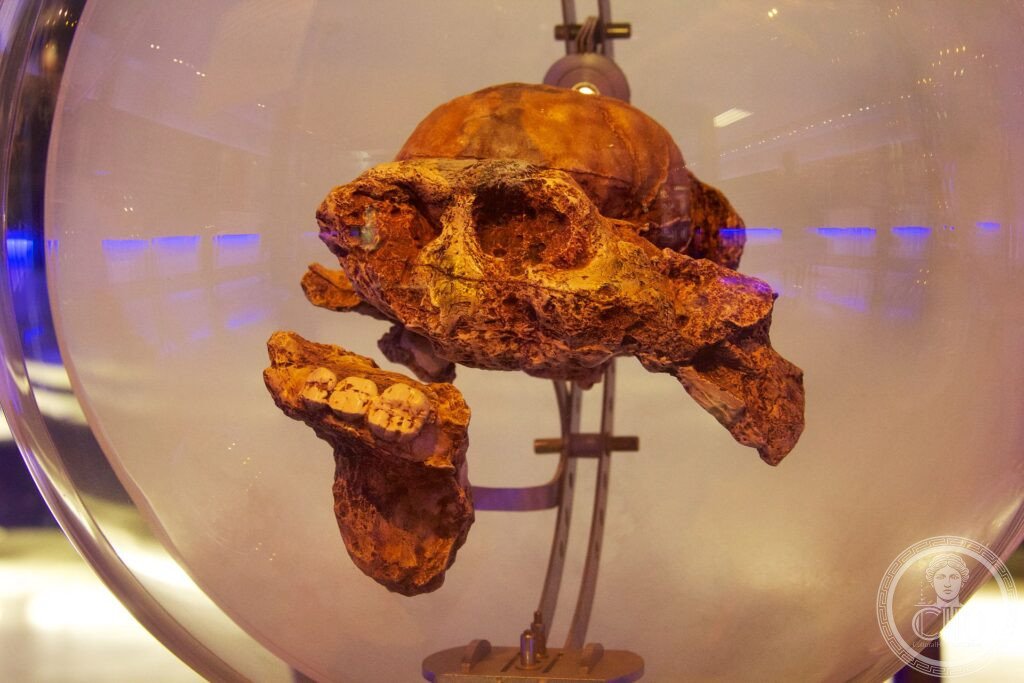
In a system of limestone caves north-west of Johannesburg some of the most important hominid fossils on the planet have been found: skulls and skeletons of Australopithecus who lived millions of years ago. The Cradle of Humankind holds the traces of the first steps of the road that leads to us.
At a glance
The Cradle of Humankind, a complex of limestone caves north-west of Johannesburg in South Africa, is one of the richest sources in the world for the fossils of early human ancestors. Sites such as Sterkfontein have yielded famous specimens of Australopithecus — including the skull nicknamed “Mrs Ples” and the near-complete skeleton “Little Foot” — spanning millions of years of human evolution. Inscribed by UNESCO in 1999, it is central to the story of where humanity began.
Key facts
- UNESCO: World Heritage since 1999 (Fossil Hominid Sites of South Africa)
- Human origins: one of the world’s richest stores of early-human fossils
- Sterkfontein: the most famous of the fossil-bearing caves
- “Mrs Ples”: a celebrated Australopithecus skull found here
- “Little Foot”: a near-complete early-hominin skeleton
- Millions of years: a long record of human evolution
History
The caves of this region, formed in ancient dolomitic limestone, acted as natural traps in which the bones of animals — and of early human relatives — accumulated over millions of years. From the 1930s, fossil hunters at Sterkfontein and neighbouring sites began to recover remains of Australopithecus, transforming understanding of human origins and confirming Africa as the birthplace of humankind.
Discoveries have continued ever since, from the famous “Mrs Ples” skull to the painstakingly excavated “Little Foot” skeleton and remains of later hominins. The cluster of sites, inscribed by UNESCO in 1999 and since extended, remains one of the world’s most important windows onto the deep human past.
What you see
At Sterkfontein, guided tours descend into the caves where the fossils were found, among chambers, pools and the excavation sites. The nearby Maropeng visitor centre tells the story of human evolution, and original and replica fossils — like the cranium displayed here — bring the discoveries to life.
The sense of standing where our distant ancestors lived and died gives the Cradle of Humankind its power.
Practical information
- Sites: Sterkfontein caves and the Maropeng visitor centre
- Time needed: half a day to a day
- Note: an easy day trip from Johannesburg or Pretoria
- Setting: in the province of Gauteng
Getting there
The Cradle of Humankind is about 50 km north-west of Johannesburg, in Gauteng province, South Africa, reached by road. GPS (Sterkfontein): 25.93° S, 27.73° E.
Nearby
- Johannesburg — the great city to the south-east
- Pretoria — the administrative capital nearby
- Maropeng — the official visitor centre of the site
Sources
- UNESCO World Heritage Centre — “Fossil Hominid Sites of South Africa” (ref. 915)
- Maropeng / Sterkfontein official site — official body
- Encyclopaedia Britannica — Sterkfontein; Australopithecus
Find it on the map
See this place and what’s around it →📷 Become a Cultural Heritage Online photographer
Share your photos of places: they stay published under your name as the author. The more they're seen, the more you get noticed — and soon a contest will reward the most appreciated photos.
Log in or sign up free to add a photo