

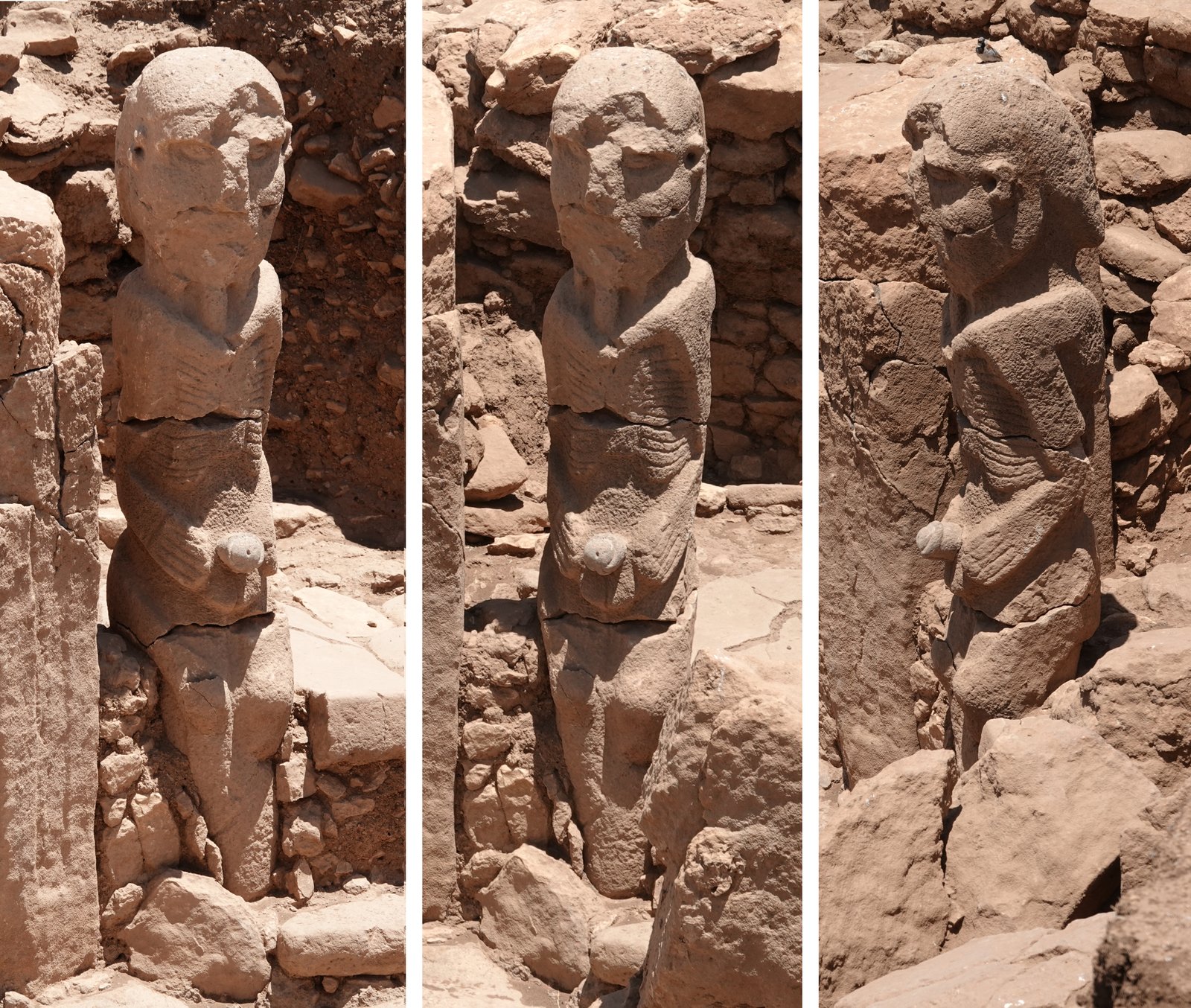
A sister complex to Göbekli Tepe but potentially older — an active excavation reshaping everything we thought we knew about the origins of civilisation.
At a glance
Karahan Tepe is a Pre-Pottery Neolithic sanctuary complex located 35 km southeast of Göbekli Tepe in the Taş Tepeler region of southeastern Anatolia, Turkey. Covering approximately 325,000 m² — larger than Göbekli Tepe — it was documented in 1997 but systematic excavation only began in 2019 under Prof. Necmi Karul of Istanbul University. It is now considered the most important of approximately 12 Neolithic temple complexes identified in the region. Radiocarbon dating places its earliest phases at c. 9600–9000 BC, potentially predating Göbekli Tepe main building phases.
Key facts
- Location: Taş Tepeler region, Şanlıurfa Province, southeastern Turkey
- Dates: c. 9600–8200 BC (Pre-Pottery Neolithic A/B)
- Area: Approximately 325,000 m² — larger than Göbekli Tepe
- Discovery: Documented 1997; systematic excavations from 2019
- Lead excavator: Prof. Necmi Karul, Istanbul University, Taş Tepeler Project
- Key feature: Cut-rock pillar room with ~250 phallus-shaped columns carved from bedrock
- Status: Active excavation — one of the most intensively excavated prehistoric sites on earth
History
Karahan Tepe was first documented in 1997 when a local shepherd noticed unusual stone formations and archaeologist Eyüp Bucak recorded the surface finds. For over two decades it remained unstudied, overshadowed by the global sensation of Göbekli Tepe 35 km to the northwest. The breakthrough came in 2019 when Prof. Necmi Karul of Istanbul University began systematic excavation as part of the Taş Tepeler Project — an initiative now tracking approximately 12 Neolithic complexes across the Harran Plain and surrounding hills of southeastern Anatolia.
Radiocarbon dates from the site suggest the earliest construction phases may be contemporaneous with — or slightly earlier than — Göbekli Tepe oldest layers, pushing monumental ritual architecture back to approximately 9600 BC, several thousand years before the adoption of agriculture in the region. This confirms that the impulse to build permanent monumental structures preceded, rather than followed, the Neolithic Revolution — a finding of extraordinary consequence for how we understand the relationship between religion, community, and the origins of settled life.
The 2021–2022 excavation season produced a dramatic discovery: a life-sized human head and torso sculpted in stone, the figure appearing to emerge from the bedrock floor as if inserted up to the shoulders — the head, neck and shoulders visible, the rest swallowed by the rock. Three-dimensional faces carved into column surfaces at the site are among the oldest known portrait sculptures in human history. A separate artisanal production zone for carved stone vessels suggests Karahan Tepe combined ritual, social, and craft functions in ways that complicate simple temple-site readings.
What you see
The defining structure at Karahan Tepe is the pillar room — a chamber carved directly into natural bedrock. From its floor and walls emerge approximately 250 stone columns of distinctly phallus-shaped form, arranged in dense rows. Nothing comparable exists anywhere else in the prehistoric world. Some columns bear three-dimensional carved faces; others carry animal reliefs. Unlike Göbekli Tepe circular enclosures with paired T-shaped pillars, Karahan Tepe does not follow the same formal vocabulary, suggesting the two sites — despite proximity and apparent contemporaneity — had distinct ritual traditions.
A separate open area is interpreted as a production zone, with evidence of stone-vessel carving and tool manufacture. The most celebrated portable find — a 2.3-metre anthropomorphic statue showing a figure with both hands clasping a phallus, adorned with a V-shaped collar and incised markings — is now housed at the Şanlıurfa Archaeology Museum. The combination of monumental architecture, portrait sculpture, and artisanal production at a single site is without precedent in the Pre-Pottery Neolithic.
Practical information
Karahan Tepe is an active excavation site and access for general visitors is limited. The site is open to the public during the summer excavation season (typically July–September) when guided visits may be possible. Check with the Şanlıurfa Museum of Archaeology for current access conditions before visiting. The sculptures and portable finds are displayed year-round at the Şanlıurfa Archaeology Museum in the city centre.
Getting there
Karahan Tepe lies approximately 46 km southeast of Şanlıurfa, near the village of Yağmurlu in Tektek Mountains Provincial Park. No public transport serves the site. From Şanlıurfa, hire a car or book a guided tour — several operators offer combined Göbekli Tepe and Karahan Tepe day trips. The drive takes 45–60 minutes on secondary roads. Şanlıurfa GAP Airport has direct flights from Istanbul and Ankara.
Nearby
- Göbekli Tepe — 35 km northwest; the Neolithic sanctuary that redefined understanding of prehistoric religion
- Şanlıurfa Archaeology Museum — houses key finds from Göbekli Tepe and Karahan Tepe including the anthropomorphic sculptures
- Çarahantepe, Gürcütepe, Harbetsuvan Tepesi — other Neolithic complexes within 30–50 km, part of the same Taş Tepeler civilisation
Sources
- Karul, N. (2021). “Karahan Tepe: New Pre-Pottery Neolithic Research in the Taş Tepeler Region.” Anatolica XLVII.
- Turkish Ministry of Culture and Tourism — Taş Tepeler Project (tas-tepeler.gov.tr)
- Şanlıurfa Archaeology Museum — official site documentation
- UNESCO World Heritage Centre — Göbekli Tepe nomination dossier (comparative context)
- Wikipedia contributors. “Karahan Tepe.” Wikipedia, The Free Encyclopedia.
Find it on the map
See this place and what’s around it →📷 Become a Cultural Heritage Online photographer
Share your photos of places: they stay published under your name as the author. The more they're seen, the more you get noticed — and soon a contest will reward the most appreciated photos.
Log in or sign up free to add a photo