

The Wreck That Changed History
In the spring of 1900, a group of Greek sponge divers sheltering from a storm near the small island of Antikythera — wedged between Crete and the southern Peloponnese — dived on what turned out to be the largest ancient shipwreck ever found in Greek waters. The vessel, a large Roman-era merchant ship, had sunk approximately 60–70 BC while carrying a cargo of extraordinary luxury goods: bronze and marble statues, fine glassware, silver coins, ivory furniture fittings, and amphorae. The Greek government organised a salvage operation that recovered dozens of statues and thousands of objects over the following months.
Among the corroded bronze lumps brought up from the seabed was an unprepossessing mass of oxidised metal. It sat in the National Archaeological Museum in Athens for two years before anyone paid it particular attention. When archaeologist Spyridon Stais noticed it had cracked open during drying and revealed gear-wheel teeth, it set off a chain of investigation that would span 120 years and fundamentally alter our understanding of ancient Greek technological achievement.
The Antikythera Mechanism: World’s First Computer
The Antikythera Mechanism — named for the island where the wreck was found — is an analogue computing device of extraordinary sophistication, built from at least 30 interlocking bronze gear systems housed in a wooden case approximately the size of a shoebox. Modern X-ray analysis and CT scanning (most recently by University College London in 2021) has identified 82 surviving fragments from what was originally a far more complete machine, with gear trains that calculated and displayed:
- The position of the Sun and Moon in the zodiac on any given date
- The phase of the Moon
- Predictions of solar and lunar eclipses using the 223-month Saros cycle
- The Metonic calendar (a 19-year cycle reconciling solar and lunar years)
- The positions of the five planets known to antiquity — Mercury, Venus, Mars, Jupiter, Saturn
- The four-year cycle of the Greek Panhellenic Games, including the Olympics
Nothing of comparable mechanical complexity is known from any civilisation on Earth until the appearance of European cathedral clocks in the 14th century AD — a gap of 1,400 years. The device demonstrates that ancient Greek engineers had mastered differential gearing and epicyclic calculation at a level that was not rediscovered in the Western world until the Renaissance.
How It Was Built and Who Made It
The mechanism was built around 150–100 BC, most likely in Rhodes or Corinth, based on the dialect of the inscriptions on its casing and the style of its astronomical calculations. Rhodes was the intellectual centre of the ancient Mediterranean in this period, home to the philosopher and polymath Posidonius — who is described by the Roman orator Cicero (writing close to the period of the shipwreck) as having constructed a similar device demonstrating the movements of the heavenly bodies.
The UCL team’s 2021 reconstruction model, the most complete attempt yet, reveals a front face showing the zodiac and Egyptian calendar, and a back face with two large spiral dial systems — one for eclipse prediction (the Saros dial) and one for the Metonic calendar. The precision of the gearing required extraordinary skill: some gear teeth are less than 1.5 mm across. The craftsman who built this device had no workshop manuals, no precision machine tools, and no predecessors in the known archaeological record. The mechanism appears to have emerged, fully formed, from a tradition of practical astronomy that otherwise left almost no material trace.
The Shipwreck Cargo
The Antikythera wreck was no ordinary merchant vessel. Its cargo — bronze statues of athletes, philosophers, and mythological figures; marble sculptures; luxury glassware; fine ceramics; silver coins from Pergamon and Ephesus — suggests a ship carrying high-value plunder or commissioned works, possibly in the context of the Roman conquest of the Greek east. The coins date the sinking to approximately 60–70 BC. The ship itself was large, estimated at 40–50 metres in length.
Among the statues recovered is the famous “Antikythera Youth” — a bronze figure of a young athlete, arguably one of the finest surviving ancient Greek bronzes — now in the National Archaeological Museum in Athens. The philosopher’s head, the “Philosopher,” and numerous marble figures also came from the wreck. The cargo may represent looted art being shipped to Rome; this was a period of aggressive Roman acquisition of Greek masterworks.
Renewed Excavations: The ARGO Project
After the original 1900–1901 salvage, the wreck lay undisturbed until 1976, when Jacques Cousteau conducted a brief survey. Systematic underwater archaeology returned in 2017 with the Antikythera Shipwreck Project, led by Brendan Foley of Lund University and using an underwater robot (ARGO) to survey the seafloor at depths of 50–60 metres. The project has recovered additional bronze and marble fragments, a bronze arm, a human skeleton (from which ancient DNA has been extracted), and evidence that the wreck field extends over a much larger area than previously known.
The 2022 season recovered a sculpted marble bull’s head — a further indication that the cargo included high-quality sculpture beyond what was raised in 1901. Researchers estimate that only a fraction of the wreck’s contents have been recovered. The site remains one of the most scientifically productive ancient wrecks in the Mediterranean.
The Mechanism in Context: What It Tells Us
The Antikythera Mechanism raises profound questions about what else may have existed in the ancient world that left no material trace. Ancient texts describe various mechanical devices — water organs, automata, artillery mechanisms — but the Mechanism is the only complex ancient machine to have survived. Its existence suggests that the technological capacity of Hellenistic Greek civilisation was far higher than the surviving evidence implies. The “Dark Ages” of mechanical technology that followed the fall of Rome may represent not a failure to invent but a failure of preservation.
The mechanism is also a reminder of how contingent archaeological knowledge is: had the sponge divers not sheltered near Antikythera in 1900, had the corroded bronze lump been discarded rather than kept, had Stais not noticed the gears — the machine would have remained on the seabed, and our understanding of ancient technology would be correspondingly impoverished.
Visiting Antikythera and the Mechanism
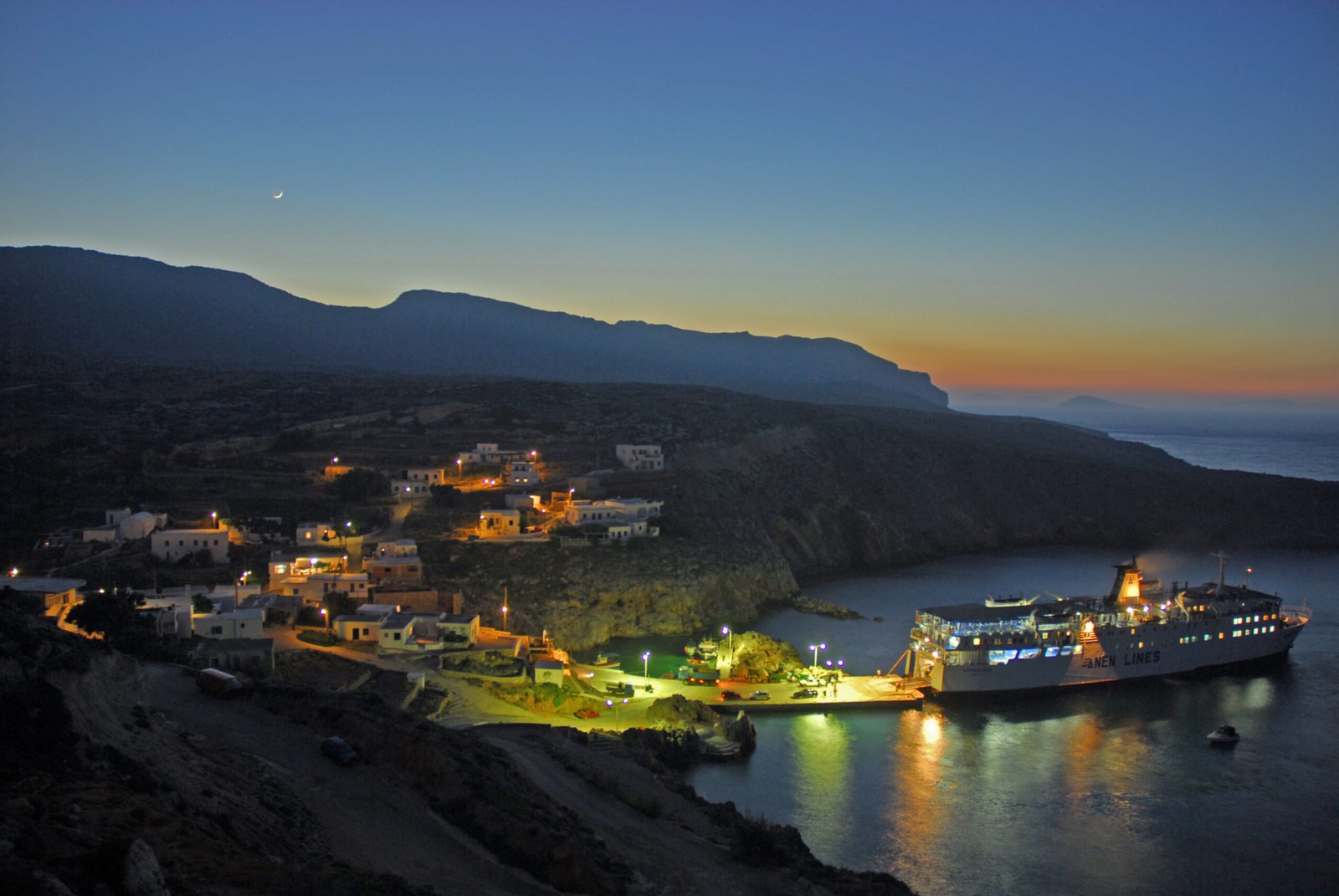
The island of Antikythera is accessible by ferry from Piraeus (Athens) and Kissamos (Crete), though service is infrequent and the island has very limited tourist infrastructure — a small permanent population and minimal accommodation. The island itself is wild and dramatic; the wreck site lies off the northwest coast in approximately 55 metres of water, not accessible to recreational divers.
The Antikythera Mechanism itself, along with the statues and objects from the wreck, is displayed at the National Archaeological Museum in Athens (Patission 44, Exarchia). The museum’s dedicated display includes original fragments, high-quality replicas, and an explanatory video reconstruction of the mechanism’s function. This remains the essential destination for anyone wishing to understand the device; the island is for those who want to stand near the sea where history was sleeping.
Find it on the map
See this place and what’s around it →📷 Become a Cultural Heritage Online photographer
Share your photos of places: they stay published under your name as the author. The more they're seen, the more you get noticed — and soon a contest will reward the most appreciated photos.
Log in or sign up free to add a photo