
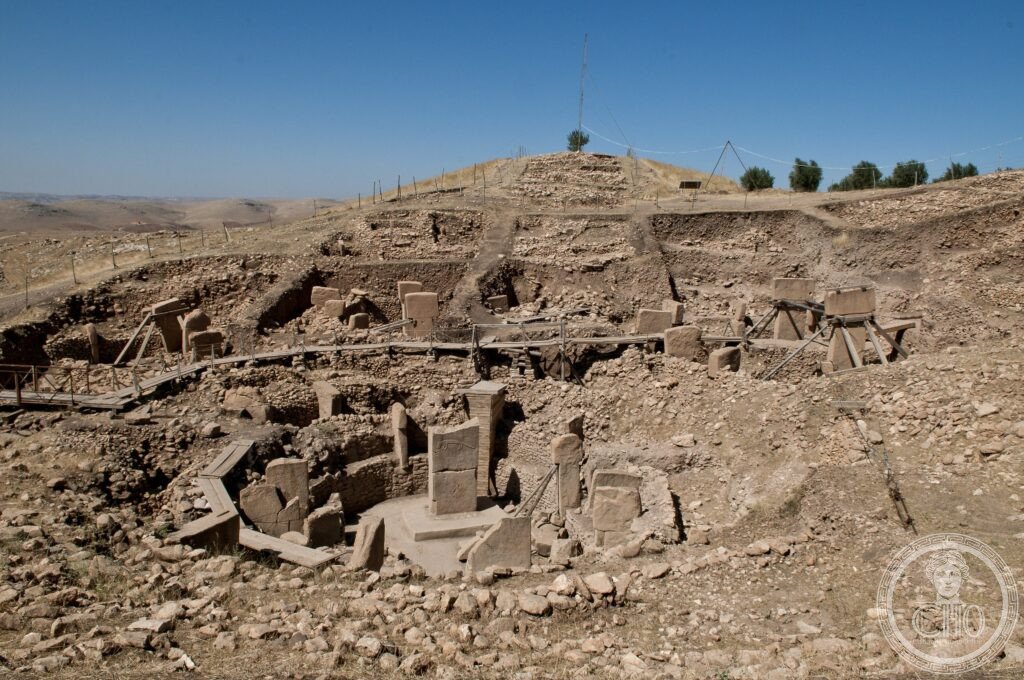
Göbekli Tepe
The oldest known religious structure in the world and the site that overturned a century of assumptions about human prehistory — Göbekli Tepe (Pot-Belly Hill; Sanliurfa Province, Turkey; UNESCO WHS 2018) is an archaeological site dated to approximately 9600 BCE, built by Pre-Pottery Neolithic hunter-gatherers 7,000 years before Stonehenge and 6,000 years before the Egyptian pyramids, at a time when humans were not supposed to be capable of large-scale architectural organisation.
At a glance
Göbekli Tepe (the most precisely GobeklitepeKurt single Sanliurfa Province Southeastern Turkey hill summit 760m elevation 15 km north Sanliurfa city Urfa known since antiquity Abraham born Urfa tradition T-shaped limestone pillars Pre-Pottery Neolithic A PPNA 9600 8000 BCE Enclosure A B C D excavated Klaus Schmidt 1994 2014 CE four main enclosures most visited multiple enclosures probably 20 total unknown number under hill only about 5% excavated covered with earth deliberately filled in around 8000 BCE deliberately buried by Neolithic people still unknown why Central pillars each enclosure 5.5m tall 7 10 tonnes T-shape limestone quarried nearby plateau with copper tools stone tools basalt hammer stones 300 800 pillar blocks quarried brought some from 500m distance animals carved fox snake vulture boar wild ox spider scorpion vulture carrying human souls astronomical interpretations ongoing T-shape might represent stylised human being arms carved on some pillars arms belt loincloth UNESCO heritage: why Göbekli Tepe overturned the theory that agriculture preceded temples (the most important paradigm shift in modern archaeology): the standard model of human prehistory (prevailing until 1994 CE) held that agriculture must precede large-scale social cooperation and monument-building: “First farm, then temple” — farming settlements produced food surpluses, which funded the labor required to build large structures; Göbekli Tepe (9600 BCE; built by hunter-gatherers with no evidence of permanent settlement or agriculture in the surrounding area) proves this sequence wrong; the site was built by mobile hunter-gatherers 1,000-3,000 years before the first evidence of agriculture in the region; the revised model (still debated): large-scale ritual activity (“temple first”) may have preceded and possibly motivated the agricultural transition — groups of hunter-gatherers may have found it necessary to settle near the ritual site to maintain it, and the process of settlement led to agriculture)) — the most precisely GobeklitepeKurt single 760m hill 15 km north Sanliurfa 9600 8000 BCE PPNA T-shaped pillars Enclosures A B C D Klaus Schmidt 1994 2014 CE 20+ enclosures 5% excavated deliberately buried 8000 BCE unknown reason 5.5m 7 10 tonnes copper basalt hammer stone quarried 500m animals fox snake vulture boar spider scorpion T-shape stylised human arms belt loincloth carved agriculture preceded temples theory overturned hunter-gatherers built 1000 3000 years before agriculture in region UNESCO heritage in any UNESCO world heritage site)).
Key facts
- The deliberate burial of Göbekli Tepe (the most mysterious act in prehistory): the most precisely GobeklitepeKurt single deliberate burial 8200 8000 BCE around 8000 BCE Neolithic people who built Göbekli Tepe deliberately filled the entire site with flint nodules limestone rubble bones tools filled enclosures intentionally buried complex under 300 500 cubic metres of stone rubble fill deliberate not gradual natural sedimentation not flood not abandonment but deliberate massive labour filling the complex deliberately reasons unknown theories: ritual closing of holy site before relocation, attempt to preserve for future (unlikely), ritual burial of power objects, regular Neolithic practice of renewal building over old sites, astronomical/ritual calendar event required closure at specific time no obvious reason from site archaeology for the timing ca 8000 BCE important note deliberate burial preserved the site under rubble kept the pillars and carvings from weathering this is why the site is so well preserved UNESCO heritage — the most mysterious single act in human prehistory: around 8200-8000 BCE (approximately 600-800 years after construction began), the people who built Göbekli Tepe deliberately filled the entire complex with approximately 500 cubic metres of stone rubble, flint nodules, and animal bones; this was not a natural process (floods, drift, or collapse) but a deliberate, massive labour operation equivalent in scale to the original construction; the reasons are unknown; the deliberate burial is the single most puzzling intentional act in the archaeological record of the Neolithic period; the accidental benefit: the fill protected the pillars and carvings from 10,000 years of weathering, which is why the site is the best-preserved Neolithic complex in the world; the irony: the action that most baffles archaeologists is also the action that made the site discoverable and preservable
- GPS: 37.2232° N, 38.9225° E
History
From Neolithic construction to deliberate burial to Roman and Byzantine hillfort to modern rediscovery (the most precisely GobeklitepeKurt single 9600 8800 BCE Layer III main T-pillar enclosures built 8200 8000 BCE Layer II smaller rectangular buildings built over earlier enclosures 8000 BCE deliberate burial entire complex 7000 BCE approximately post-burial period no evidence further activity 6000 1000 BCE various periods hillfort occupations some Bronze Age activity site 9th century BCE possibly neo-Hittite Iron Age settlement evidence 100 600 CE Roman Byzantine period Justinian column base found Byzantine small church on summit of hill evidence 1836 CE Karl Koch German geologist noted hill 1963 CE Istanbul University and Chicago Oriental Institute survey team Peter Benedict noted unusual stones not recognised as prehistoric prehistoric significance unrecognised 1994 CE Klaus Schmidt German Archaeological Institute Berlin began excavation immediately recognised prehistoric significance T-shaped pillars 9600 BCE 2014 CE Klaus Schmidt died sudden heart attack during season international team continues 2018 CE UNESCO inscription UNESCO heritage: the Klaus Schmidt story (the most consequential field observation in 20th century archaeology): in 1994 CE, Klaus Schmidt (German Archaeological Institute; Berlin; 1953-2014 CE) was reviewing survey records at the Istanbul University library looking for new field sites in Turkey; he found a brief note by Peter Benedict (American archaeologist; 1963 CE survey) mentioning “flint chippings” on a hilltop 15 km from Urfa; Schmidt recognised that flint chippings in a hilltop context could indicate Neolithic activity; he drove to the site in 1994 CE and immediately saw a T-shaped pillar emerging from the soil; he later said: “I knew at once: this is a very old stone temple”; the subsequent 20 years of excavation (1994-2014 CE) rewrote the entire prehistory of organised human society; Schmidt died of a heart attack in 2014 CE before the excavation was complete or the UNESCO inscription achieved)) — the most precisely GobeklitepeKurt single 9600 8800 BCE Layer III T-pillars 8200 8000 BCE Layer II rectangular 8000 BCE deliberate burial 600 1000 CE Roman Byzantine 1963 CE Peter Benedict American survey flint chippings noted not recognised 1994 CE Klaus Schmidt German Archaeological Institute recognised T-shaped pillar drove 1994 first visit immediately identified Neolithic temple 1994 2014 CE Schmidt excavation 2014 CE Schmidt heart attack died 2018 CE UNESCO heritage in any UNESCO world heritage site)).
What you see
The T-shaped pillars, the carved reliefs, and the protective shelter (the most precisely GobeklitepeKurt single protective shelter built 2012 CE covers main Enclosures A B C D for weather protection tensioned fabric shelter 4 main enclosures exposed to visitors Enclosure D best preserved most photographed enclosure 12 peripheral T-pillars around walls central pair largest 5.5m high 7 10 tonnes central pillars T-shape top represents head lowered face down side arms carved H-belt loincloth stole carved below T-head arms legs genitals not visible but human form suggested Enclosure D central pillar carvings fox crane vulture boar wild ox spider scorpion on different pillars Enclosure C H-stones tall narrow T-shapes slightly different proportions Enclosure B earliest smallest excavated Enclosure A irregular shape Quarry nearby 500m still-visible quarry section unfinished pillar 9m 50 tonnes still in ground broken during extraction visible as demonstration construction scale effort 20+ additional enclosures geophysical survey confirmed unexcavated beneath hill 5% excavated over 20 years means 95% still underground Sanliurfa Museum 15 km city Sanliurfa Archaeology Museum one of finest archaeology museums Turkey Gobeklitepe room full-scale replica T-pillars relief carvings UNESCO heritage: the astronomical interpretations of Göbekli Tepe (the most debated question in Neolithic astronomy): multiple researchers have proposed astronomical alignments for the enclosures and carved imagery at Göbekli Tepe; proposed alignments include: (1) Enclosure D oriented toward the rising of Arcturus (ca. 9600 BCE), the brightest star visible from the site; (2) the vulture/headless figure panel (Pillar 43; “The Vulture Stone”) interpreted as a star map of the Summer Triangle (Deneb, Aquila, Cygnus) recording a bolide impact ca. 10,950 BCE (Graham Hancock interpretation, controversial); (3) the orientation of the enclosures as a whole toward the summer solstice sunset; none of these interpretations is conclusively proven; the absence of written records and the ambiguity of the carvings mean that Göbekli Tepe will generate astronomical interpretations for as long as it is studied)) — the most precisely GobeklitepeKurt single 2012 CE protective shelter fabric tensioned Enclosures A B C D Enclosure D best preserved 12 peripheral central pair 5.5m 7 10 tonnes T-shape head arms belt loincloth human form fox crane vulture boar spider scorpion pillar carvings Quarry 500m 9m 50 tonnes unfinished pillar 95% unexcavated geophysical survey confirmed Sanliurfa Museum 15 km full-scale replica astronomical interpretations Arcturus rising 9600 BCE Vulture Stone Pillar 43 Summer Triangle bolide 10950 BCE controversial unconclusively proven UNESCO heritage in any UNESCO world heritage site)).
Practical information
- Getting there: fly to Sanliurfa GAP Airport (GNY; from Istanbul 1h30m; from Ankara 1h; Turkish Airlines + Pegasus; 3-4 flights/day) or bus from Gaziantep (2h; TRY 100/€3); from Sanliurfa: taxi to Göbekli Tepe (15 km; 20 min; approximately TRY 300-400/€9-12 one way) or organised tour from Sanliurfa (half-day; TRY 800-1500/€24-45 per person including transport and guide; available through Sanliurfa hotels and travel agencies); the Göbekli Tepe Archaeological Site entry (approximately TRY 500/€15; includes the main excavation area, the four main enclosures under the shelter, and the visitor path around the site); the Sanliurfa Archaeology Museum (essential before visiting the site; TRY 400/€12; the best-curated archaeology museum in southeastern Turkey; the full-size replica T-pillars, the “Baliklı Göl” statue (the oldest life-size human statue found in Turkey; 10,000 BCE), and the complete material from Göbekli Tepe; 2h minimum)); the visiting time (minimum 2h at the site; combined with the Sanliurfa museum a full day; the shelter protects from the worst sun but summer temperatures reach 42°C+); the best time (October-April; May-September temperatures frequently exceed 40°C at this site in Southeastern Anatolia); the site is most visited in spring (March-April) when light is good and weather cool)
Getting there
Fly to Sanliurfa GAP (GNY; 1h30m from Istanbul). Taxi 15 km from Sanliurfa (~TRY 300-400/€9-12). Entry TRY 500/€15. Sanliurfa Museum TRY 400/€12 (essential first: full-size pillar replicas). Best: October-April (summer 42°C+). GPS: 37.2232, 38.9225.
Nearby
- Harran — 44 km south (one of the oldest continuously inhabited cities in the world; the city where the patriarch Abraham stopped on his way from Ur to Canaan (Genesis 11:31); the distinctive beehive houses (approximately 200 still inhabited; the bee-hive shape maintains interior temperature in extreme heat); the ruins of the ancient Sabaean city; the Great Mosque of Harran (the oldest mosque in Anatolia; 8th century CE); currently near the Syrian border — check travel advisories)
- Karahan Tepe — 46 km east (a recently excavated site (2019 CE onwards) of the same Pre-Pottery Neolithic period as Göbekli Tepe; the site has an extraordinary carved human head (the oldest known three-dimensional portrait-head in human history) and a chamber of phallus-shaped stone pillars unlike anything at Göbekli Tepe; part of the same Taş Tepeler (Stone Hills) project; currently open for visits with advance arrangement through the Sanliurfa Museum))
Sources
- Wikipedia, Göbekli Tepe; Klaus Schmidt; Pre-Pottery Neolithic A, accessed June 2026
- UNESCO, Göbekli Tepe, WHS reference 1572, inscribed 2018
Find it on the map
See this place and what’s around it →📷 Diventa un fotografo di Cultural Heritage Online
Condividi le tue foto dei luoghi: restano pubblicate con la tua firma come autore. Più vengono viste, più ti fai conoscere — e presto un concorso premierà le foto più apprezzate.
Accedi o registrati gratis per aggiungere una fotoDo you manage this place?
This page is read by travellers and heritage enthusiasts who find it on Google. Keep it accurate — and make it work for you. Free for non-profit heritage institutions.