
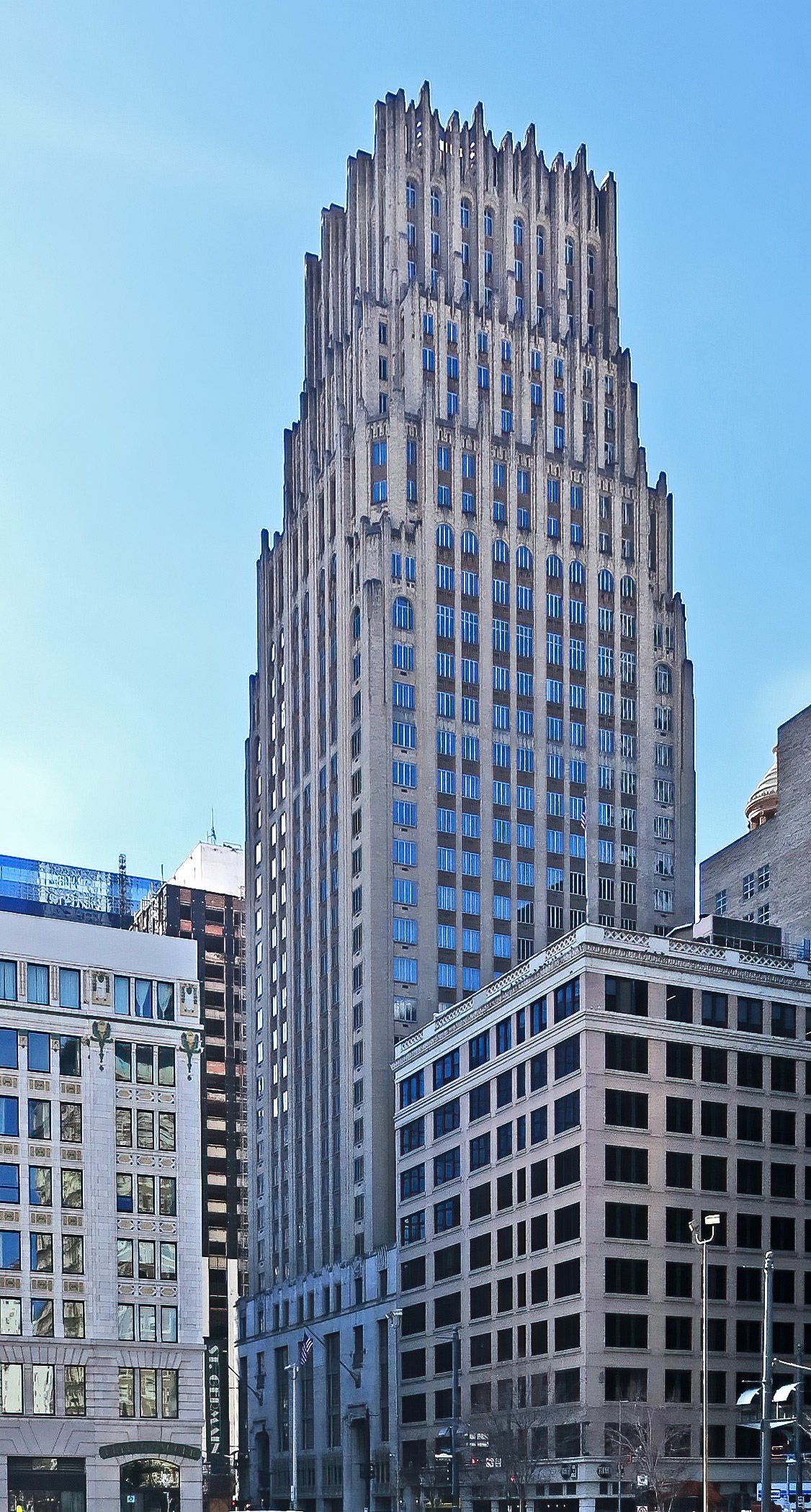
Houston’s dominant skyscraper for thirty years after its 1929 completion, this 37-story Art Deco tower designed by Alfred Charles Finn, Kenneth Franzheim, and J.E.R. Carpenter topped the city’s skyline until 1963 — its stepped massing and Mayan-influenced ornament modeled on Eliel Saarinen’s celebrated Chicago Tribune Tower competition entry, listed on the National Register in 1983 and designated a City of Houston Landmark in 2003.
At a glance
The JPMorgan Chase Building stands at 712 Main Street in downtown Houston, Texas. Completed in 1929 as the Gulf Building — headquarters of Gulf Oil Corporation’s Houston operations — the 37-story, 430-foot tower was the tallest building in Texas from its completion until 1963, when it was surpassed by One Shell Plaza. Designed by Alfred Charles Finn in association with Kenneth Franzheim and J.E.R. Carpenter, the building employs stepped Art Deco massing and Mayan-influenced ornament modeled on Eliel Saarinen’s second-place entry in the 1922 Chicago Tribune Tower competition. Listed on the National Register of Historic Places in 1983 and designated a City of Houston Landmark in 2003, it was given its current name after JPMorgan Chase acquired the building.
Key facts
- Built: 1929
- Style: Art Deco / Art Moderne
- Architects: Alfred Charles Finn (principal); Kenneth Franzheim; J.E.R. Carpenter
- Stories: 37
- Height: 430 feet (131 m)
- Tallest in Texas: 1929–1963
- Original tenant: Gulf Oil Corporation
- NRHP listed: 1983
- City of Houston Landmark: 2003
- Address: 712 Main Street, Houston, Texas
- GPS: 29.75889, −95.36361
History
Gulf Oil Corporation commissioned its Houston headquarters in the late 1920s at the height of the American skyscraper boom, choosing Alfred Charles Finn — a leading Houston architect who had already designed several of the city’s major buildings — as principal designer, working with Kenneth Franzheim and J.E.R. Carpenter. The trio modeled the building’s stepped massing directly on Eliel Saarinen’s celebrated 1922 entry in the Chicago Tribune Tower competition: a design that, though it finished second to the Gothic Revival winner by Hood and Howells, was widely considered the most influential contribution to American skyscraper aesthetics of the decade. The tower’s pyramidal crown, ornamental program of Mayan-inflected geometric carving, and its crisp setback silhouette made it immediately Houston’s most important building and the visual reference point for the city’s growing downtown.
From 1929 to 1963, when One Shell Plaza took the title, the Gulf Building was the tallest structure in Texas — thirty-four years of visual dominance over a city that was transforming from a regional port into an international energy capital. After Gulf Oil’s corporate reorganization in the post-war decades, the building passed through several owners; it was listed on the National Register of Historic Places in 1983, recognizing its architectural and historical significance. In 1989, Texas Commerce Bank initiated one of the most extensive privately funded historic preservation projects in Houston’s history to restore the building’s exterior and public spaces. Designated a City of Houston Landmark in 2003 — the same year as several other key historic downtown buildings — the tower now carries the name of its current principal tenant, JPMorgan Chase.
What you see
The building’s exterior articulates the Art Deco skyscraper formula at its most assured: a limestone-clad shaft that rises from a broad base before stepping back at multiple levels toward the pyramidal crown, each setback registering a subtle change in the ornamental program and allowing natural light to reach the street below. The Mayan-inflected carvings — geometric interlaced patterns derived from pre-Columbian building traditions rather than European classical sources — distinguish the building from the Gothic Revival towers that dominated American corporate skyscraper design in the same decade. This deployment of indigenous American motifs in a high-rise context was not unique to Houston; it appeared in New York’s Chanin Building and Nebraska’s State Capitol in the same years, but Finn’s execution is among the most consistent in its application of the ornamental vocabulary across all elevations.
At street level, the main lobby on Main Street preserves the material vocabulary of the 1929 original: bronze metalwork, ornamental terrazzo, and the refined geometric language of Art Deco commercial interiors at their most formal. The building’s relationship to the street — a continuous frontage along Main Street with the entrance framed in articulated stone surrounds — reflects the 1920s architectural convention that a corporate headquarters was also a civic monument, addressed to the public life of the city as much as to its tenants.
Practical information
- The exterior is freely accessible from Main Street in downtown Houston at all times.
- The building is an active office tower; lobby access may be restricted to tenants and visitors with appointments.
- The Main Street corridor connects to Houston’s METRORail Red Line and to the city’s tunnel system linking downtown blocks.
Getting there
The JPMorgan Chase Building is at 712 Main Street in downtown Houston, Texas. George Bush Intercontinental Airport (IAH) is approximately 23 miles north; Houston Hobby Airport (HOU) is approximately 10 miles southeast. Houston’s METRORail Red Line serves downtown with multiple stops; the Central Station Main at Main Street and Bell Street stop is approximately 2 blocks south. By car, Interstate 45 (the Gulf Freeway) and Interstate 10 both serve downtown Houston with multiple exits.
Nearby
- Rice Hotel (1913; 1928 expansion) — Houston’s historic grand hotel at Main Street and Texas Avenue, where three US presidents stayed; converted to residential use in the 1990s, approximately 1 block north
- Harris County Civil Courts Building (1910) — Beaux-Arts courthouse at Congress and Fannin, one of Houston’s earliest civic monuments, approximately 3 blocks east
- Tranquility Park — the city’s main downtown park, designed to commemorate the Apollo 11 moon landing, with distinctive fountains and earth mounds, approximately 2 blocks north of the building
Sources
- Wikipedia: “JPMorgan Chase Building (Houston)”
- National Register of Historic Places, listed 1983
- City of Houston Landmark designation, 2003
- Carol McMichael Reese: “Building the Texas Century,” in Texas Architect, 2001
- Wikimedia Commons: The_Gulf_Building_Houston_Texas.jpg, CC BY-SA 3.0, i_am_jim
Find it on the map
See this place and what’s around it →Record researched and written by Luigi De Marchi for Cultural Heritage Online, 2026.
📷 Become a Cultural Heritage Online photographer
Share your photos of places: they stay published under your name as the author. The more they're seen, the more you get noticed — and soon a contest will reward the most appreciated photos.
Log in or sign up free to add a photoIs this page about you?
This page is read by travellers and heritage enthusiasts who find it on Google. Tell us how you are connected to this place and we will take it from there.