
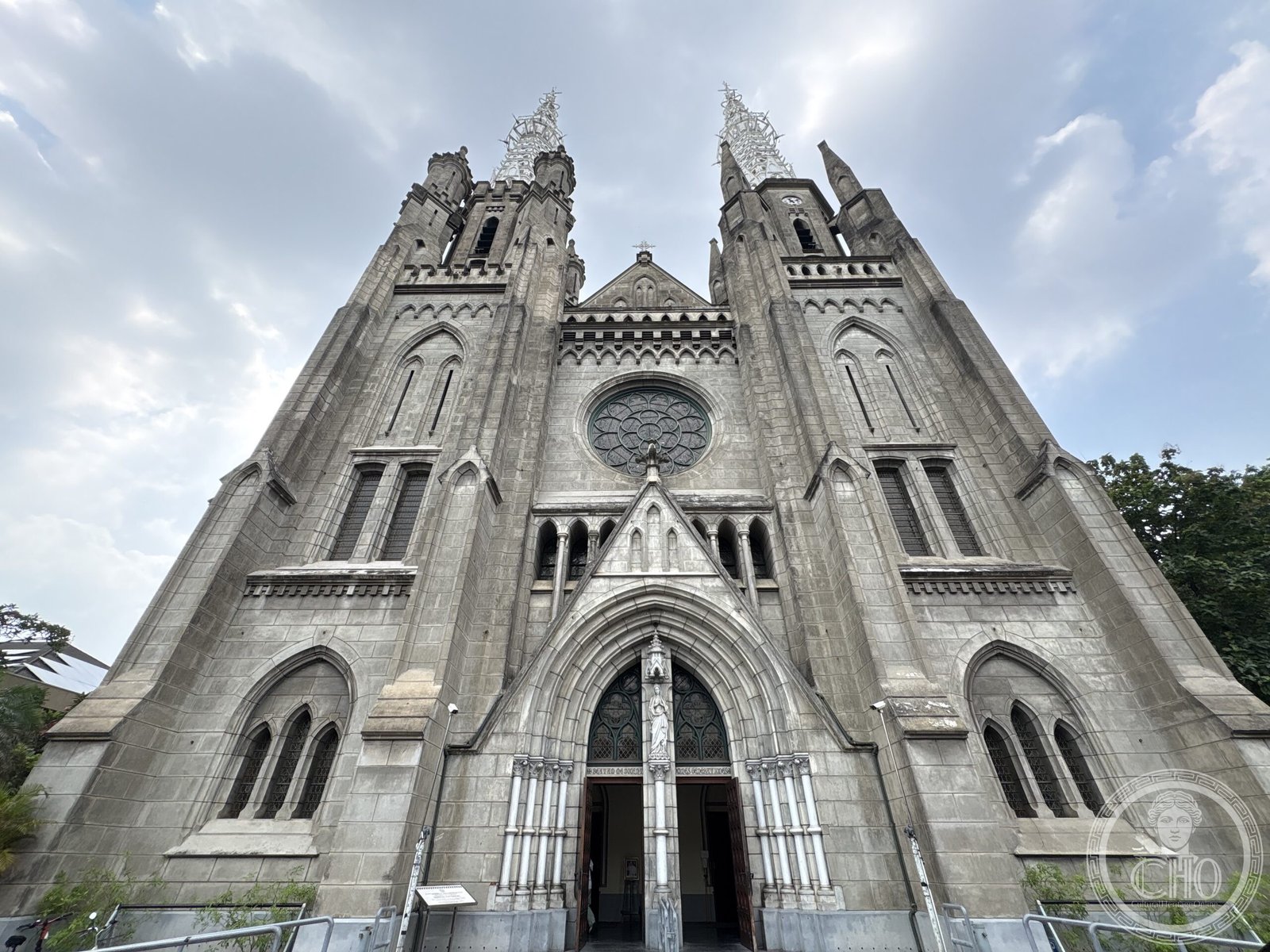
On Jalan Katedral, in the centre of Jakarta, the cathedral of the Assumption of the Blessed Virgin Mary is the seat of the Catholic archdiocese of Jakarta. A first church on the same site, opened on 6 November 1829, collapsed through structural weakness on 9 April 1890. The present building was rebuilt between 1891 and 1901 to a neo-Gothic design by the Dutch Jesuit and architect Antonius Dijkmans, trained under Viollet-le-Duc and Cuypers. After an interruption for want of funds, the work was taken up and completed by the architect Marius J. Hulswit, who simplified the design, replacing some structural elements with cast iron. The consecration took place on 21 April 1901 at the hands of Monsignor Edmundus Sybrandus Luypen. The three towers, two twin spires of sixty metres, called the «Tower of David» and the «Ivory Tower», and a central spire of forty-five metres named «Angelus Dei», rest on steel frames and unreinforced masonry, not up to modern seismic standards. That is why they have been monitored since 2017 with accelerometers and inclinometers, although no concrete risk of collapse is documented. The archdiocese of Jakarta, erected as apostolic prefecture of Batavia on 8 May 1807 according to most sources, and raised to metropolitan archdiocese on 3 January 1961, has been led by Cardinal Ignatius Suharyo Hardjoatmodjo since 2010. According to Indonesian sources he tendered his resignation on reaching the canonical age limit in 2025, but Pope Francis is said to have asked him to stay in office until 2027. Indonesia, the largest Muslim-majority nation in the world, officially recognises six religions within its State ideology Pancasila, Catholicism among them. In 2020-2021 the «Terowongan Silaturahmi» was built, an underground tunnel twenty-eight metres long that links this cathedral directly to the Istiqlal Mosque, the largest in Southeast Asia, standing right opposite. Conceived both as a symbol of interfaith harmony and as a practical solution for sharing car parks on the respective feast days, the tunnel was publicly praised by Pope Francis on 5 September 2024, during his visit to the mosque. The day before, on 4 September 2024, the same pope had visited this cathedral, meeting there about one thousand two hundred Indonesian bishops, priests, religious and catechists. Before him, Paul VI came in December 1970 and John Paul II in October 1989, although for the latter a specific visit inside the cathedral building is not confirmed. On 24 December 2000 this cathedral was among the five churches of Jakarta targeted by a coordinated series of attacks on Christian places of worship across Indonesia, which caused eighteen to nineteen deaths in the country in all.
About the Cathedral
Jakarta Cathedral, formally the Cathedral of the Assumption of Our Blessed Virgin Mary into Heaven, is the seat of the Archdiocese of Jakarta. Rebuilt in neo-Gothic style after its predecessor collapsed in 1890, it was consecrated in 1901 and stands directly across from Istiqlal Mosque, Southeast Asia’s largest.
Key facts
- 9 April 1890: predecessor church collapses; current neo-Gothic cathedral consecrated 21 April 1901.
- 8 May 1807: Catholic jurisdiction in Jakarta erected as the Apostolic Prefecture of Batavia.
- 2020–2021: “Tunnel of Friendship” built, directly connecting the cathedral to Istiqlal Mosque.
- 24 December 2000: cathedral targeted in a coordinated nationwide bombing of Indonesian churches.
- 4–5 September 2024: Pope Francis visits the cathedral, then praises the tunnel at Istiqlal Mosque the next day.
- Previous papal visits: Paul VI (1970), John Paul II (1989).
History
Rebuilt after its predecessor’s structural collapse in 1890, Jakarta Cathedral has stood since 1901 as a neo-Gothic landmark in the world’s largest Muslim-majority nation, one of six religions officially recognized under Indonesia’s Pancasila state ideology. In 2021 it became physically linked to its neighbor, Istiqlal Mosque, by an underground “Tunnel of Friendship” built explicitly as a symbol of interfaith harmony — a gesture Pope Francis publicly praised during his September 2024 visit, which included a stop at the cathedral itself the day before he toured the mosque.
What you see
A neo-Gothic facade rises between twin openwork iron spires nicknamed the “Tower of David” and “Tower of Ivory,” each 60 meters tall, flanking a rose window above a triple-arched entrance, with a third central spire, “Angelus Dei,” rising 45 meters behind.
Practical information
- Opening hours: generally open daily outside services; check current hours before visiting.
- Address: Jalan Katedral No. 7B, Pasar Baru, Sawah Besar, Central Jakarta, Indonesia.
Getting there
The cathedral stands in central Jakarta, directly across the street from Istiqlal Mosque. GPS: 6°10′09″S, 106°49′59″E.
Nearby
- Istiqlal Mosque — Southeast Asia’s largest mosque, connected to the cathedral by the underground Tunnel of Friendship.
Sources
- Wikipedia — “Jakarta Cathedral,” “Roman Catholic Archdiocese of Jakarta,” “2000 Indonesia bombings”
- GCatholic.org and Catholic-Hierarchy.org — Archdiocese of Jakarta records.
- Vatican.va — official transcript of Pope Francis’s 4 September 2024 address at Jakarta Cathedral.
- Vatican News, USCCB, Crux — coverage of the Tunnel of Friendship and Pope Francis’s 2024 visit to Istiqlal Mosque.
- GeoSIG — structural engineering case study on the cathedral’s seismic monitoring.
Find it on the map
See this place and what’s around it →📷 Become a Cultural Heritage Online photographer
Share your photos of places: they stay published under your name as the author. The more they're seen, the more you get noticed — and soon a contest will reward the most appreciated photos.
Log in or sign up free to add a photo