
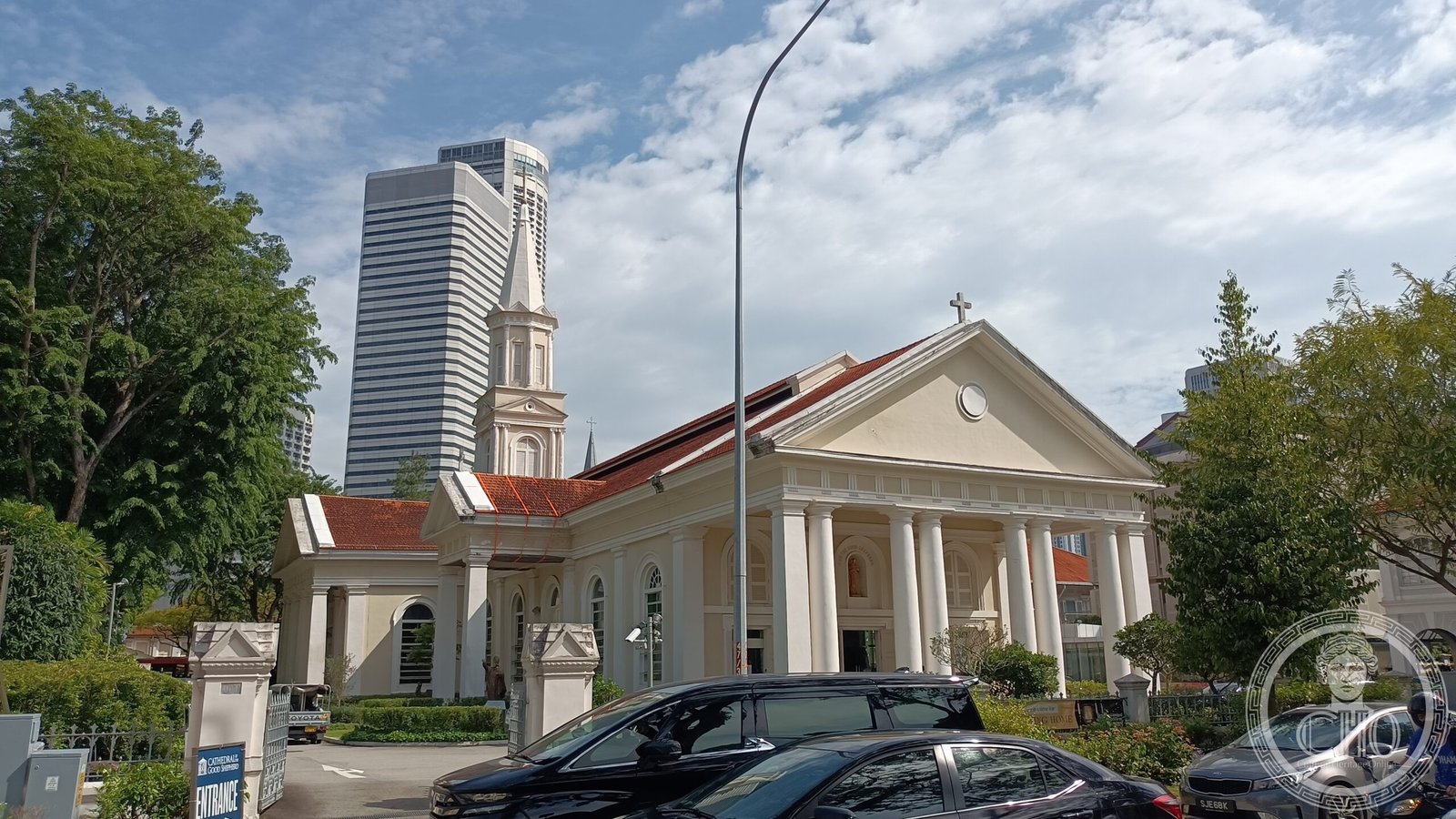
On Queen Street, in the heart of Singapore, the Cathedral of the Good Shepherd is the seat of the Catholic archdiocese of Singapore. A first temporary chapel of wood and attap was built in 1832-33 through public subscription. The foundation stone of the present building was laid on 18 June 1843 and the church was blessed on 6 June 1847 by Father Jean-Marie Beurel, to a design chiefly by the architect Denis Lesley McSwiney, with the spire the work of Charles Andrew Dyce, modelled on that of St Andrew’s, designed by John Turnbull Thomson. Unlike the nearby Anglican Cathedral of St Andrew, built with convict labour from the Bras Basah penal colony, the plot occupied by the Cathedral of the Good Shepherd was expressly excluded from the area set aside for public works using convicts, according to the National Library of Singapore. The nave was enlarged in 1888, the year the building was raised to cathedral status with the revival of the diocese of Malacca. The full consecration, however, took place only on 14 February 1897, after the debts incurred for the enlargement had been paid off. The archdiocese of Singapore, split from the archdiocese of Malacca-Singapore on 18 December 1972, is today led by Cardinal William Goh Seng Chye, archbishop since 2013 and the first Singaporean cardinal in history, made a cardinal by Pope Francis in 2022. Singapore is among the most religiously diverse states in the world: according to the 2020 census, Catholics make up around six to seven per cent of the resident population, about two hundred and twenty thousand people, within an overall population with a Buddhist majority and sizeable Muslim, Taoist and Hindu minorities. The government actively manages interreligious harmony through the Maintenance of Religious Harmony Act, in force since 1992, which allows administrative restrictions against anyone inciting religious hatred or mixing religion and politics. Pope John Paul II visited Singapore for about five hours on 20 November 1986, celebrating a mass at the national stadium before around seventy thousand people, in an organising committee led by the cathedral rector, Father Robert Balhetchet. Whether the pope actually entered the cathedral building on that occasion is not documented. Pope Francis visited Singapore on 11-13 September 2024, the first papal visit to the country in thirty-eight years, and Singaporean faithful gathered in the cathedral to follow the events, though a personal visit by him to the building is not confirmed. During the Japanese occupation, after the fall of Singapore in February 1942, the cathedral was used, according to parish sources, as an emergency hospital and refuge. The building has been a national monument since 28 June 1973.
About the Cathedral
The Cathedral of the Good Shepherd, on Queen Street in central Singapore, is the seat of the Archdiocese of Singapore. Its cornerstone was laid in 1843, and the church was blessed in 1847, one of Singapore’s oldest surviving buildings.
Key facts
- 18 June 1843: foundation stone laid; church blessed 6 June 1847.
- Unlike neighboring St Andrew’s Cathedral (Anglican), this cathedral’s site was expressly excluded from the convict-labor construction zone.
- 1888: elevated to cathedral status; formally consecrated 14 February 1897.
- 18 December 1972: Archdiocese of Singapore erected, split from Malacca-Singapore.
- 2022: Archbishop William Goh Seng Chye made Singapore’s first-ever cardinal.
- 28 June 1973: declared a National Monument.
History
Built in the 1840s in one of colonial Singapore’s few plots specifically spared from the convict-labor public-works program that built its Anglican neighbor St Andrew’s Cathedral, the Good Shepherd survived the Japanese occupation of 1942-45 serving, according to parish accounts, as an emergency hospital and refuge. It rose to cathedral status in 1888 and full consecration in 1897, and now stands as the seat of Cardinal William Goh, Singapore’s first-ever cardinal, in a city-state managing one of the world’s most religiously diverse populations under active government policy.
What you see
A cream neoclassical facade rises behind a white Ionic-columned portico and a round oculus window beneath the pediment, topped by a tall white spire modeled on that of St Andrew’s Cathedral, with red-tiled roofing throughout.
Practical information
- Opening hours: generally open daily outside services; check current hours before visiting.
- Address: 4 Queen Street, Singapore 188533.
Getting there
The cathedral stands on Queen Street in Singapore’s Museum Planning Area. GPS: 1°17′45″N, 103°51′05″E.
Nearby
- St Andrew’s Cathedral — Singapore’s Anglican cathedral, built with convict labor, a short distance away.
Sources
- Wikipedia — “Cathedral of the Good Shepherd,” “Religion in Singapore,” “Maintenance of Religious Harmony Act,” “William Goh”
- National Library Board Singapore (BiblioAsia) — “Convict Labour in Colonial Singapore”
- GCatholic.org and Catholic-Hierarchy.org — Archdiocese of Singapore records.
- Vatican.va — Pope John Paul II’s 20 November 1986 homily in Singapore.
- history.catholic.sg — cathedral parish history.
- Vatican News — overview of the Church in Singapore ahead of Pope Francis’s 2024 visit.
Find it on the map
See this place and what’s around it →📷 Become a Cultural Heritage Online photographer
Share your photos of places: they stay published under your name as the author. The more they're seen, the more you get noticed — and soon a contest will reward the most appreciated photos.
Log in or sign up free to add a photo