
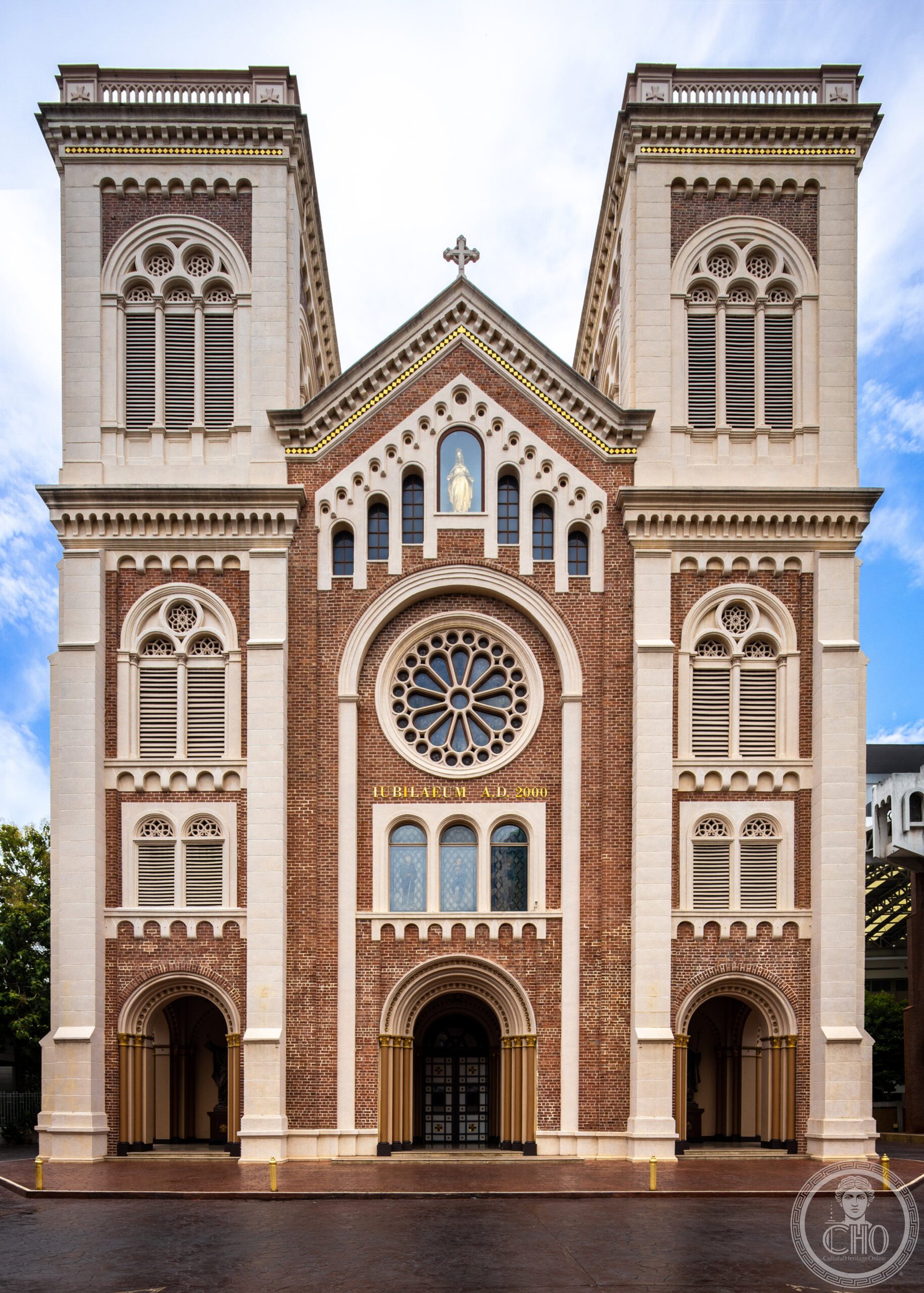
On Oriental Avenue, in the Bang Rak district, a short way from the Chao Phraya river, the Assumption Cathedral is the seat of the Catholic archdiocese of Bangkok. The Catholic presence in Siam precedes the arrival of the French by a century: as early as 1553-54 two Portuguese Dominicans, Girolamo della Croce and Sebastiano de Cantù, founded three parishes at Ayutthaya with about fifteen hundred converts, before both were killed in 1569. Siam became an apostolic vicariate in 1662, entrusted in 1669 to the Foreign Missions of Paris. A treaty signed at Lopburi on 10 December 1685 between King Narai and Louis XIV allowed Catholic missionaries to preach throughout the kingdom, before the period ended in persecution and the imprisonment of Bishop Laneau. The first church on the present site was requested in 1809 by the French missionary Father Pascal and completed in 1821 under the reign of Rama II, financed largely by the Teochew Catholic businessman Low Khiok Chiang. The name of the architect is not documented. The present building, in Romanesque Revival style with two brick bell towers, was rebuilt between 1910 and 1919 on the initiative of the rector Father Colombet, who commissioned a French architect whose name is not recorded, and was consecrated on 15 August 1919 by Bishop René Perros. According to some sources, nearby buildings were damaged by Allied bombing in 1942, with consequences for the cathedral as well, although this detail comes from a single source. The archdiocese of Bangkok, erected as the apostolic vicariate of Siam in 1662 and raised to a metropolitan archdiocese on 18 December 1965, is led today by Archbishop Francis Xavier Vira Arpondratana, installed in the early part of 2025. Catholics in Thailand are estimated at about three hundred and eighty-eight thousand people, less than one per cent of the population of an overwhelmingly Buddhist country. According to the chronology kept by the cathedral, three generations of the Thai royal family have visited it: King Ananda Mahidol, together with the future king Bhumibol, then a prince, on 4 May 1946; the princesses Soamsawali and Bajirakitiyabha in 1995; and the then crown prince Vajiralongkorn, today King Rama X, in 2002. Pope John Paul II, visiting Thailand on 10-11 May 1984, and Pope Francis, on 22 November 2019, are both said to have come to this cathedral according to its official chronology, although this detail has not been found in an independent primary Vatican source. The Bang Rak district, where the cathedral stands, grew between the late nineteenth and the early twentieth century as the main foreigners’ quarter and commercial hub of Bangkok, home to the Portuguese and Chinese Catholic communities alongside European consulates and legations.
About the Cathedral
Assumption Cathedral, in Bangkok’s Bang Rak district near the Chao Phraya River, is the seat of the Archdiocese of Bangkok. The current Romanesque Revival building, the second on the site, was rebuilt 1910–1919 and consecrated on 15 August 1919.
Key facts
- 1553–54: Portuguese Dominican missionaries found Catholic parishes at Ayutthaya, the first Catholic presence in Siam.
- 10 December 1685: Treaty of Lopburi between King Narai and Louis XIV permits Catholic missionaries to preach throughout Siam.
- 1821: first church on this site completed under King Rama II.
- 15 August 1919: current Romanesque Revival cathedral consecrated by Bishop René Perros.
- 18 December 1965: Archdiocese of Bangkok elevated to metropolitan status.
- Visited across three generations by the Thai royal family, and by Popes John Paul II (1984) and Francis (2019).
History
Catholicism reached Siam nearly a century before French missionaries arrived, when Portuguese Dominicans founded parishes at Ayutthaya in the 1550s — both were later killed. French Catholic influence grew under a 1685 treaty between King Narai and Louis XIV before persecution set in, and the modern cathedral, rebuilt in brick Romanesque style by 1919, has since drawn visits from three generations of the Thai royal family in a nation that remains overwhelmingly Buddhist, with Catholics still under one percent of the population.
What you see
A red-brick Romanesque Revival facade rises between twin square bell towers flanking a central rose window, with a statue of the Virgin Mary in a pediment niche above the entrance and “IUBILAEUM A.D. 2000” lettering added during a millennial restoration.
Practical information
- Opening hours: generally open daily outside services; check current hours before visiting.
- Address: 23 Oriental Avenue, Bang Rak district, Bangkok, Thailand.
Getting there
The cathedral stands in Bangkok’s Bang Rak district, near the Oriental Hotel and the French Embassy. GPS: 13°43′23″N, 100°30′54″E.
Nearby
- Bang Rak district — Bangkok’s historic foreign quarter, home to former European consulates and trading houses.
Sources
- Wikipedia — “Assumption Cathedral, Bangkok,” “Roman Catholic Archdiocese of Bangkok,” “Catholic Church in Thailand,” “Bang Rak district”
- GCatholic.org and Catholic-Hierarchy.org — Archdiocese of Bangkok records.
- Vatican News, America Magazine — coverage of Pope Francis’s 2019 visit to Thailand.
- tour-bangkok-legacies.com — cathedral construction history.
Find it on the map
See this place and what’s around it →📷 Become a Cultural Heritage Online photographer
Share your photos of places: they stay published under your name as the author. The more they're seen, the more you get noticed — and soon a contest will reward the most appreciated photos.
Log in or sign up free to add a photo