
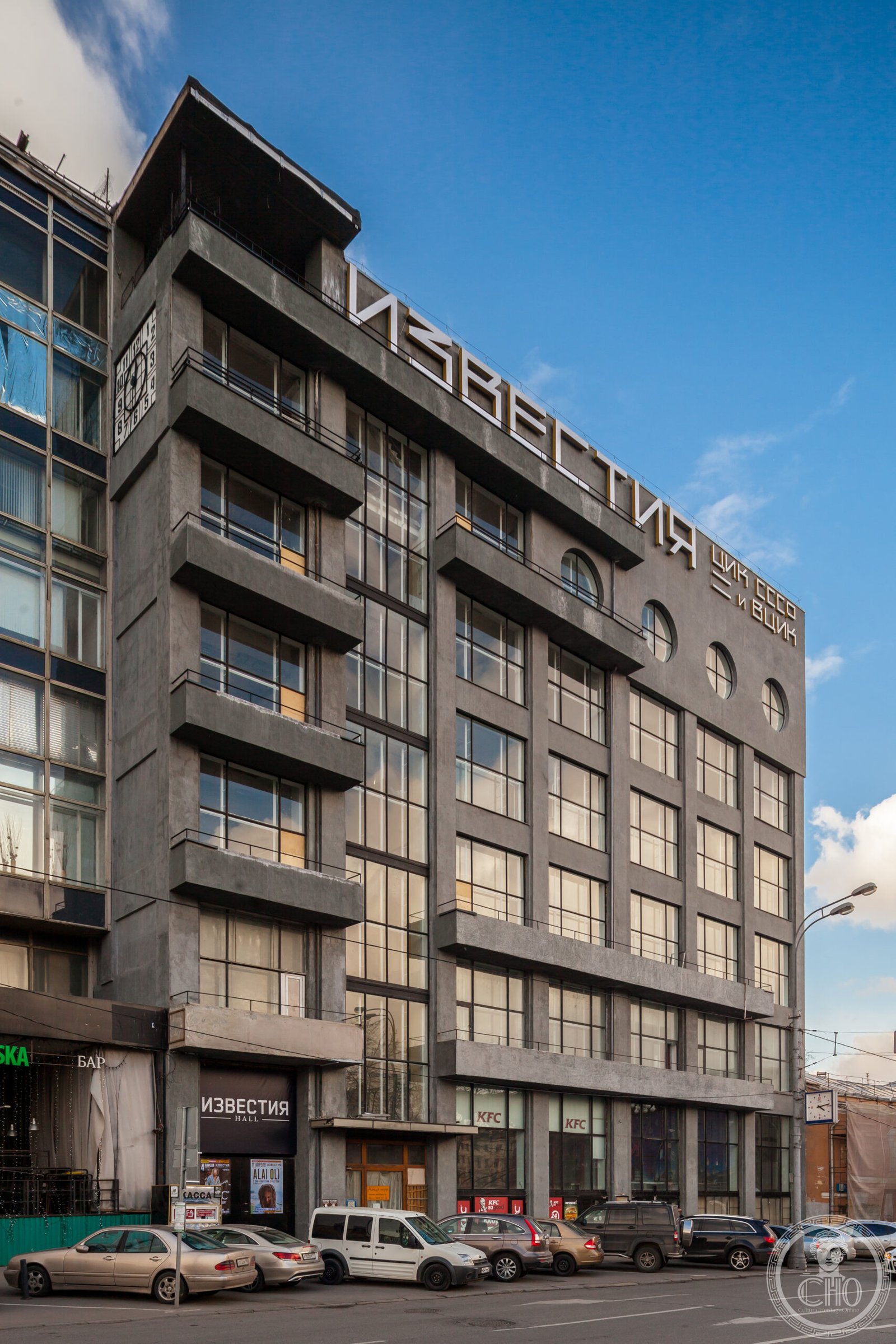
The Izvestia Building is a landmark of Soviet Constructivist architecture built in 1925–1927 to house the headquarters of Izvestia, one of the USSR's principal state newspapers. Designed by the father-and-son architects Grigori and Mikhail Barkhin on Pushkinskaya Square in central Moscow, the building translates the energy and purpose of the Soviet press into a taut concrete and glass facade — rational, monumental, and unmistakably modern for its era.
At a glance
- Type
- Newspaper headquarters / office building
- Period
- 1925–1927
- Style
- Soviet Constructivism
- Location
- Pushkinskaya Square, Tverskaya Street, Moscow, Russia
- Coordinates
- 55.7659° N, 37.6055° E
- Architect(s)
- Grigori Barkhin, Mikhail Barkhin; structural engineer A. F. Loleyt
Overview
The Izvestia Building was commissioned as the purpose-built home of one of Soviet Russia's most powerful newspapers. Located at Pushkinskaya Square — a symbolic centre of Moscow's public life — the building had to project authority and modernity in equal measure. Grigori Barkhin, working with his son Mikhail, responded with a compact but forceful composition: a reinforced concrete frame clad in pale render, a grid of large industrial windows, and a corner tower that gives the building a decisive urban presence at the head of the square.
History
Izvestia (meaning “News” or “Notices”) was founded in 1917 as the official organ of the Soviet government and became one of the two main state newspapers of the USSR alongside Pravda. By the mid-1920s it required a permanent headquarters commensurate with its importance. The Barkhin building, completed in 1927, served as the paper's home for decades. A larger companion building was constructed on the adjoining plot in 1977. After the dissolution of the Soviet Union, Izvestia became an independent newspaper; the complex on Pushkinskaya Square remains in use for media and office purposes today.
Architecture & Design
Soviet Constructivism developed in the USSR in the 1920s as a parallel modernist movement to Western Art Deco, though with a fundamentally different ideology. Where Art Deco drew on luxury, craft tradition, and decorative abstraction, Constructivism declared that beauty resided in function, structure, and industrial production. The Izvestia Building exemplifies this credo: its facade is a disciplined grid of large glazed openings in a concrete frame, expressing the rhythmic repetition of a printing operation within. A cylindrical staircase tower at one corner adds dynamic contrast. The building avoids historical ornament entirely, asserting that modernity itself was the appropriate language for a revolutionary state institution.
Cultural significance
The Izvestia Building occupies a doubly symbolic position in Moscow's cityscape: it faces Pushkinskaya Square, long a gathering point for public life and literary culture, and it once housed the voice of the Soviet state. Architecturally, it is one of the cleaner and more resolved examples of Constructivist office design, demonstrating how the movement could produce dignified civic buildings beyond the more theatrical experiments of Melnikov and others. It is a protected cultural heritage monument and a standard reference point in histories of twentieth-century Russian architecture.
Visiting today
The Izvestia Building is a working office complex and is not open to the public. The original 1927 Constructivist facade is freely visible from Pushkinskaya Square at any time. The square itself is a lively public space with a monument to Alexander Pushkin, cafes, and direct access to Tverskaya Street. The building is easily combined with visits to other central Moscow landmarks.
Getting there
The nearest Metro station is Pushkinskaya / Tverskaya / Chekhovskaya — three lines converge at this interchange in the heart of Moscow, less than 2 minutes' walk from the building. The address is Pushkinskaya Square, Tverskaya Street 18, Moscow. The area is a major transit hub well served by bus and trolleybus routes.
Sources & resources
Find it on the map
See this place and what’s around it →Record researched and written by Luigi De Marchi for Cultural Heritage Online, 2026.
📷 Become a Cultural Heritage Online photographer
Share your photos of places: they stay published under your name as the author. The more they're seen, the more you get noticed — and soon a contest will reward the most appreciated photos.
Log in or sign up free to add a photoIs this page about you?
This page is read by travellers and heritage enthusiasts who find it on Google. Tell us how you are connected to this place and we will take it from there.