
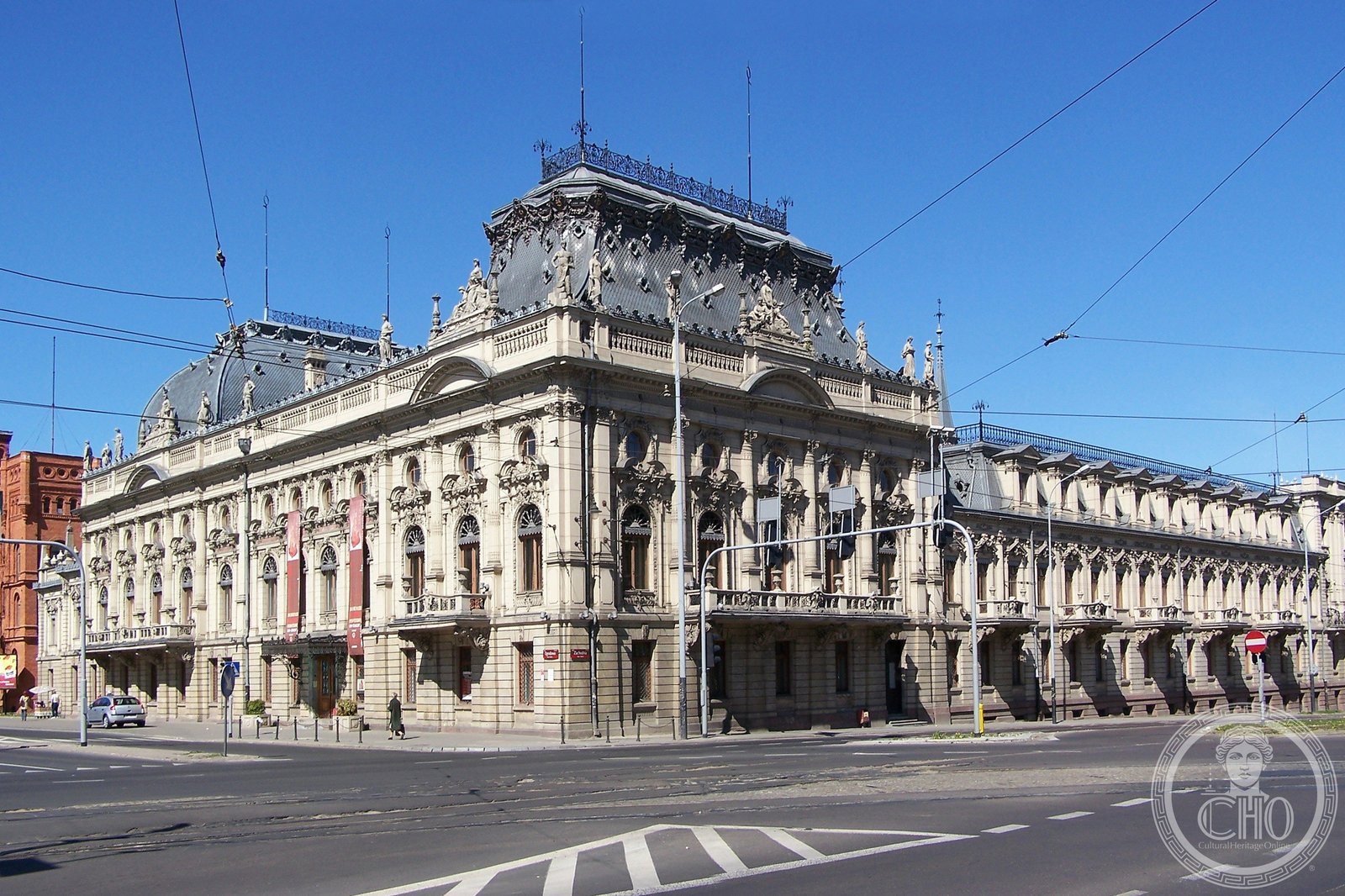
The Louvre of Łódź — a cotton baron’s neo-Baroque palace built right against his red-brick mill, made to out-dazzle every rival on the street, now the city museum.
At a glance
The Izrael Poznański Palace stands on Ogrodowa Street in Łódź, the textile boomtown that nineteenth-century industry turned from a village into Poland’s second city. The cotton magnate Izrael Poznański enlarged it between 1888 and 1903 into a vast neo-Renaissance and neo-Baroque residence — Łódź calls it “the Louvre” — set directly against his enormous brick spinning mill, today the Manufaktura complex. The architect Hilary Majewski worked from French models; Adolf Zeligson later added more. Since 1975 the palace has held the Museum of the City of Łódź.
Key facts
- Location: Ogrodowa 15, Łódź, Poland
- Built: enlarged 1888–1903, for the cotton industrialist Izrael Poznański (1833–1900)
- Architects: Hilary Majewski, then Adolf Zeligson
- Style: neo-Renaissance and neo-Baroque, with early Art Nouveau detail
- Nickname: “the Louvre of Łódź”
- Now: Museum of the City of Łódź (since 1975), beside the Manufaktura complex
History
Łódź barely existed in 1820. Within seventy years cheap land, water and the tariffs of imperial Russia had turned it into one of Europe’s great textile cities, a place of red-brick mills and the palaces of the men who owned them. Izrael Poznański (1833–1900) was among the greatest of these “cotton kings”: he took over his father’s business and built it into an empire of spinning, weaving and workers’ housing.
The palace grew with the fortune. From 1888 Poznański had the architect Hilary Majewski rebuild and extend an earlier house on Ogrodowa Street into a residence on a French scale — neo-Renaissance and neo-Baroque, domed and sculpted, with allegories of industry over the windows. Adolf Zeligson continued the work, which reached its final form around 1903, after Poznański’s death. Inside lay a ballroom, a hall of mirrors and a glass-roofed winter garden; the point was display, set deliberately against the dark mill next door.
After 1945 the factory and palace passed to the state; since 1975 the building has housed the Museum of the City of Łódź. The mill beside it, once the largest in the city, reopened in 2006 as Manufaktura, a cultural and shopping quarter — so palace and factory, the two halves of the Poznański story, can still be read together.
What you see
The palace presents a long, ornate front to Ogrodowa Street: two storeys of neo-Renaissance and neo-Baroque stonework under tall domes, with carved figures personifying industry and commerce. It is deliberately more lavish than its neighbours — a statement of arrival by a man who had made everything he owned in a single lifetime.
Inside, the museum keeps the grand rooms: the mirrored ballroom, the stair halls and the winter garden, restored to their late-nineteenth-century opulence. Beside the palace rises the red brick of the former mill, now Manufaktura; the contrast between the two is the real subject of a visit.
Practical information
- The palace is the Museum of the City of Łódź; check the museum for opening times and tickets
- Easy to combine with the adjoining Manufaktura complex in the former Poznański mill
- Allow 1.5 to 2 hours for the palace and its surroundings
- Łódź makes an easy stop between Warsaw and Wrocław
Getting there
The palace is on Ogrodowa Street, on the northern edge of central Łódź, beside the Manufaktura complex. Łódź lies in central Poland, about 130 km south-west of Warsaw and well connected by train; from the main stations (Łódź Fabryczna, Łódź Widzew) the centre is a short tram ride or walk.
Nearby
- Manufaktura, the former Poznański cotton mill
- Piotrkowska Street, Łódź’s historic main artery
- The Jewish Cemetery and the Poznański mausoleum
Sources
- Museum of the City of Łódź (Muzeum Miasta Łodzi)
- Łódź city tourism (lodz.travel)
- City of Łódź — “Monument of History” guide
- Architectural and heritage registers
Find it on the map
See this place and what’s around it →📷 Become a Cultural Heritage Online photographer
Share your photos of places: they stay published under your name as the author. The more they're seen, the more you get noticed — and soon a contest will reward the most appreciated photos.
Log in or sign up free to add a photoIs this page about you?
This page is read by travellers and heritage enthusiasts who find it on Google. Tell us how you are connected to this place and we will take it from there.