
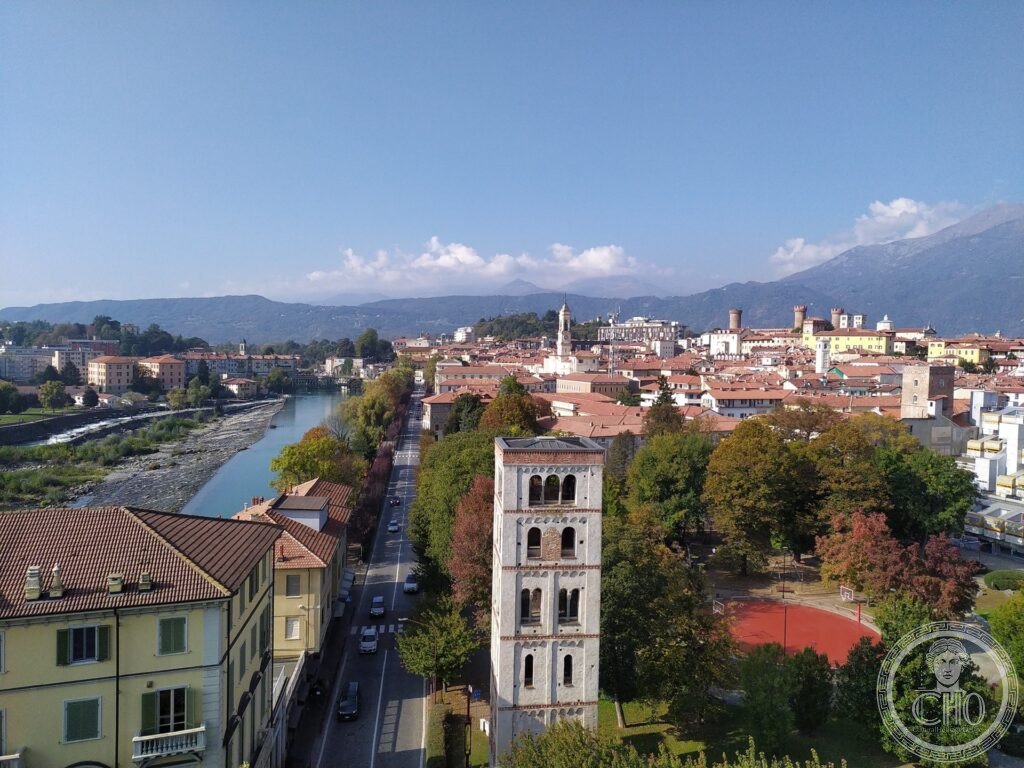
UNESCO inscribed Ivrea in 2018 as “Ivrea, industrial city of the 20th century” (ref. 1538). It is the only modern city on the World Heritage List recognized above all for the quality of its industrial and social architecture. Adriano Olivetti commissioned the factories, the workers’ housing estates, the cultural institutions and the service buildings between 1930 and 1960. Together they are the most complete surviving realization of one idea: that a factory could be a community, not a machine for production.
At a glance
Ivrea sits in the province of Turin, Piemonte, and was inscribed by UNESCO in 2018 (ref. 1538) as “Ivrea, industrial city of the 20th century”. The reason is the urban ensemble built by the Olivetti company under Adriano Olivetti’s leadership, from 1938 to 1960. WHC criterion iv calls it “an outstanding example of the development of a modern industrial town”.
The inscription covers approximately 1 km² of the city, south of the historic centre. It takes in the main factory complex, ICO, Industria Costruzione Officine, built from the 1930s to the 1960s and designed by Luigi Figini and Gino Pollini among others. It takes in the Via Jervis residential districts, the workers’ housing estates, designed by 50 different architects including Figini and Pollini, Ignazio Gardella, Annibale Fiocchi and Luciano Lenti. It takes in the Olivetti social services: the Asilo Nido, the Centro Sociale, the Mensa aziendale, the Centro Studi and the Biblioteca. And it takes in the Olivetti cultural buildings: the Istituto Professionale Olivetti and the Centro Servizi Sociali.
The ensemble is unique because Adriano Olivetti insisted that every building, from the factory floor to the workers’ kindergarten, should be designed to the same quality standards and by the best architects of the day.
Key facts
- The ICO factory (1930-1968, Figini and Pollini among others): The main Olivetti factory complex, ICO, Industria Costruzioni Olivetti, was expanded step by step from 1930 to 1968. Its landmark is the administrative and technical building by Figini and Pollini (1940, extended 1959-1963), a glass-curtain-wall structure on pilotis. It preceded the International Style factory buildings of postwar Europe by more than a decade. Other factory buildings include the Olivetti Centro Meccanografico (1954, Figini and Pollini), the Servizi Sociali building (1955, Ignazio Gardella) and the Mensa aziendale, the company canteen (1953-1959), which seated 1,500 workers and had an interior designed with the same care as a public restaurant.
- The Via Jervis housing districts (1940-1960): Adriano Olivetti’s master plan for the workers’ housing called for 50 different architects to design individual blocks along the Via Jervis corridor, south of the factory. He wanted 50 because he believed architectural monotony, the uniform housing estate, was socially destructive. The result is a sequence of housing blocks, each architecturally distinct, unified by consistent landscaping, gardens and setbacks. The architects include Figini and Pollini, Annibale Fiocchi, Luciano Lenti, Ignazio Gardella, Eduardo Vittoria and Luigi Vietti.
- Adriano Olivetti (1901-1960): Adriano was the son of Camillo Olivetti, who founded the company in 1908, and he took over its management in 1938. His social vision was set out in his 1945 manifesto “L’ordine politico delle Comunità” (The Political Order of Communities). It held that the factory should be the nucleus of a democratic community, with cultural and social services given to workers as a matter of right, not charity. Under Adriano, Olivetti became the patron of Italian design culture: the Lettera 22 typewriter of 1950, designed by Marcello Nizzoli, won the Museum of Modern Art Compasso d’Oro prize and is in MoMA’s permanent collection.
- Lettera 22 and Olivetti design: The Lettera 22 portable typewriter (1950, designed by Marcello Nizzoli) and the Lettera 32 (1963, designed by Hans von Klier) are among the most celebrated industrial design objects of the 20th century, in the MoMA permanent collection and holders of the Compasso d’Oro award. The Museo Olivetti in Ivrea shows typewriters, adding machines and early computers made in the factory between 1908 and 1990.
- UNESCO: 2018, ref. 1538.
- GPS: 45.4686, 7.8749 — Google Maps (Olivetti factory, Via Jervis, Ivrea).
History
Ivrea was a small Roman military colony (Augusta Praetoria Salassorum, modern Aosta, is nearby) that became a modest medieval market town on the Dora Baltea river. Camillo Olivetti founded the typewriter company in 1908, in a garden shed, at first making metre-sticks and later the M1, Italy’s first typewriter, in 1911. The company remained a small artisanal operation under Camillo. It was Adriano who turned it into the sociological experiment inscribed by UNESCO: he took over in 1938, deeply influenced by the garden-city movement, the English Arts and Crafts tradition and the social democratic ideas of Adriano De Gasperi’s circle. Adriano died suddenly in 1960 on a train. The company survived him until 1990, when the typewriter and office-machine market collapsed in the face of personal computers, but the urban ensemble he created survives intact.
What you see
The Ivrea UNESCO circuit is best covered in a 4-hour walking tour. Start at the Museo Olivetti, Via Jervis 11; admission is required. Its permanent collection has typewriters, adding machines, the Elea 9003 mainframe and original Nizzoli design models. Then walk south along Via Jervis, the housing corridor: look for the architectural variety of the individual blocks and the consistent quality of the landscaping. Then turn back toward the factory, at Via Jervis 77. The exterior of the ICO complex is visible from the street, and the building to look for is the 1940 administrative block by Figini and Pollini, with its curtain-wall facade. Next is the Asilo Nido, Via Jervis 60, exterior only: this was the workers’ daycare centre, a circular building on pilotis and one of the finest pieces of Italian rationalist architecture. Then the Centro Studi, Via Jervis 60, exterior visible.
The historic centre of Ivrea, with the cathedral and the Castello di Ivrea, is 15 min on foot north of the factory district, and is worth visiting for the contrast.
Gallery
Practical information
- Museo Olivetti: Via Jervis 11, Ivrea. Open Tuesday-Sunday, 10:00-18:00; admission about €5. The museum also runs walking tours of the factory district, in Italian and English; book in advance.
- Storico Carnevale di Ivrea: Ivrea’s Carnival runs in January-February and is one of the oldest in Italy. Its centrepiece is the “battaglia delle arance”, the orange-throwing battle: opposing teams throw oranges at each other from carts and on foot. The festival takes over the factory district and the historic centre for three days in the week before Ash Wednesday. If you are visiting in February, book accommodation months in advance.
- Practical note: Ivrea is a working-class city, not a tourist destination. The Olivetti UNESCO site is visited mainly by architecture professionals and design enthusiasts. The restaurants and bars are local-oriented, with no tourist menus, which is one of the attractions.
Getting there
Via Jervis 11 (Museo Olivetti), Ivrea (TO), Piemonte. GPS 45.4686, 7.8749. By train: Trenitalia from Turin Porta Nuova (45-60 min regional); from Milan, change at Turin. From Ivrea station, the Olivetti factory district is 15 min on foot south (Via Torino → Via Jervis). By car: from Turin, SS26 north or A5 north-east to Ivrea (55 km, 45 min); from Milan, A4 west to Turin then SS26 or A5 (160 km, 1h45).
Nearby
- Torino — 55 km south-west; the Palazzo Madama (UNESCO 2011 — Savoy Residences, ref.823), Mole Antonelliana, Lingotto Fiat (ex-factory now a cultural centre by Renzo Piano, with a rooftop oval test-track), and the Museo Nazionale del Cinema (the largest film museum in Europe).
- Aosta e la Valle d’Aosta — 40 km north-west; the Roman city of Augusta Praetoria (the finest collection of Roman urban archaeology in northern Italy: triumphal arch, theatre, forum, city walls); Valle d’Aosta skiing and hiking.
- Lago d’Ivrea (Chiaverano) — 5 km east; a glacial lake popular for windsurfing and summer swimming; the Dora Baltea river below Ivrea is one of Italy’s principal whitewater kayaking destinations (international competitions held regularly).
Sources
- UNESCO: whc.unesco.org/en/list/1538..
- Wikipedia EN: Ivrea industrial city of the 20th century..
- Olivetti, Adriano: L’ordine politico delle Comunità, 1945.
- Museo Olivetti: museolivetti.it..
Find it on the map
See this place and what’s around it →Historical events at this place (2)
📷 Become a Cultural Heritage Online photographer
Share your photos of places: they stay published under your name as the author. The more they're seen, the more you get noticed — and soon a contest will reward the most appreciated photos.
Log in or sign up free to add a photo