
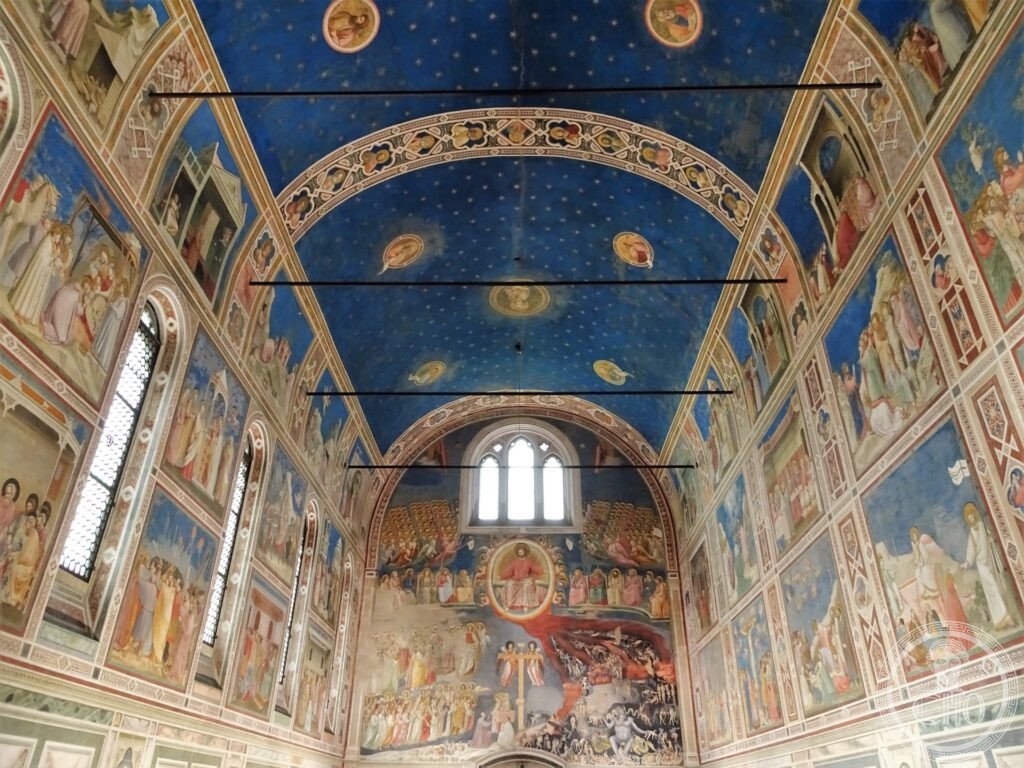
Padova Urbs Picta was inscribed in 2021 under the serial title “Padua’s fourteenth-century fresco cycles”. One medium-sized city holds the highest concentration of major 14th-century painted cycles in the world: nine ensembles commissioned between 1302 and 1397 that together map the entire arc of the Trecento revolution in European painting, from Giotto’s breakthrough at the Scrovegni Chapel (the first time an artist had given painted figures the psychological weight and spatial conviction of real human beings) to the encyclopaedic theological programmes of Giusto de’ Menabuoi at the Baptistery and Altichiero at the Oratory of San Giorgio.
At a glance
Padova (province of Padova, Veneto; UNESCO 2021, ref. 1623) was inscribed as “Padua’s fourteenth-century fresco cycles”. A serial property of 9 components: (1) Cappella degli Scrovegni (Giotto, 1304-1306). (2) Palazzo della Ragione (various masters, 1315-1425; the largest secular painted hall in medieval Europe). (3) Baptistery of the Cathedral (Giusto de’ Menabuoi, 1374-1378). (4) Basilica of Sant’Antonio (Altichiero and Jacopo Avanzo, 1372-1384). (5) Oratory of San Giorgio (Altichiero and Jacopo Avanzo, 1379-1384). (6) Oratory of San Michele (various, late 14th cent.). (7) Carmine Church (Giusto de’ Menabuoi, c.1370). (8) Ermitani Church (now containing fragments after the 1944 bombing). And (9) Torlonia Palace (secular cycle). The WHC citation notes that the nine cycles “bear witness to a particularly intense period of patronage and production in a single city” and that the Scrovegni cycle in particular represents “a decisive turning point in the history of pictorial art in western Europe.”.
Key facts
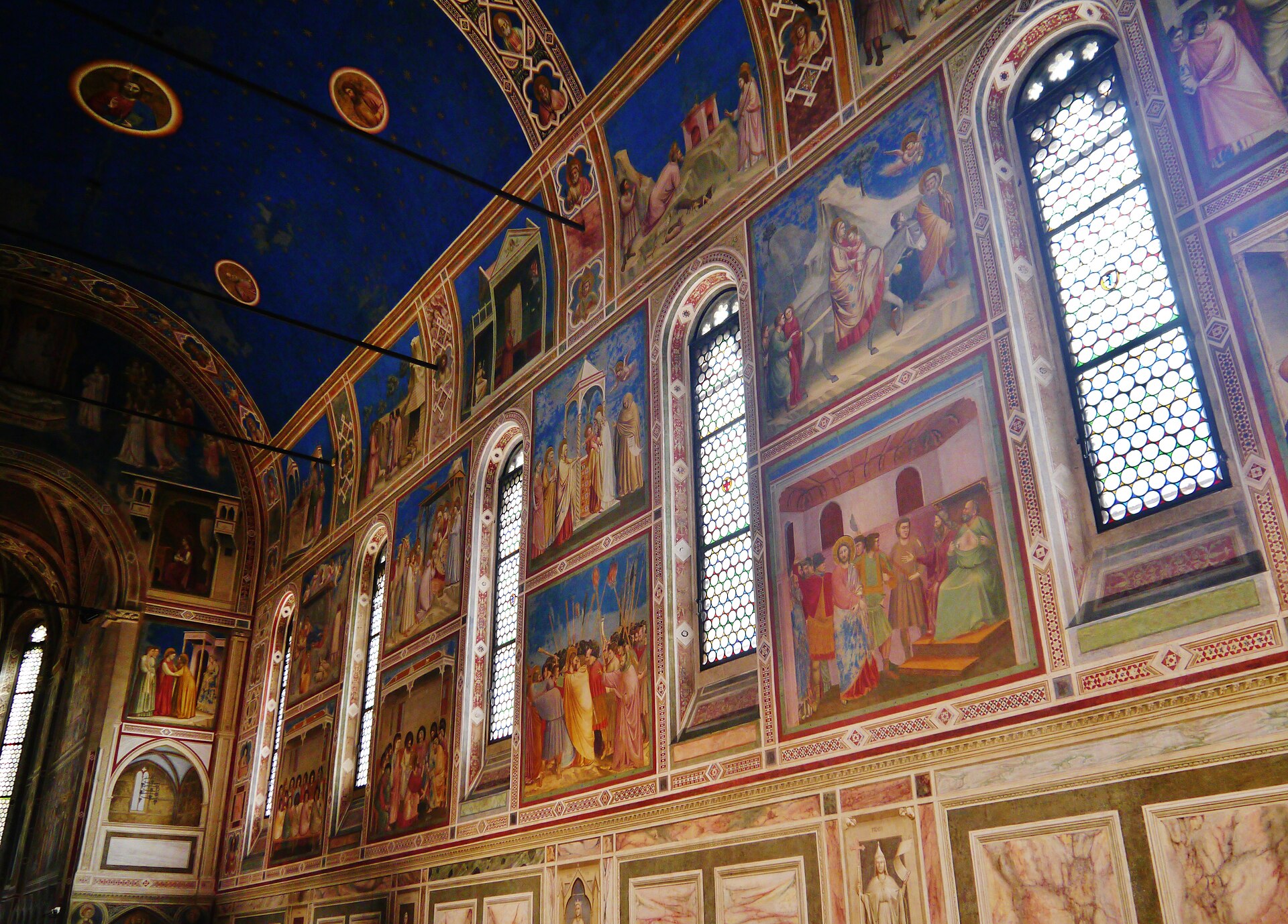
- Cappella degli Scrovegni (1303-1306, Giotto): The chapel was commissioned by Enrico Scrovegni in 1300, built 1303-1305, and painted entirely by Giotto di Bondone between 1304 and 1306 (the three years of uninterrupted work represent the longest continuous campaign Giotto is known to have undertook). The cycle of 39 scenes (divided across three horizontal registers on the nave walls + the triumphal arch + the choir arch + the apse + the west wall Giudizio Universale) covers the lives of Joachim and Anna, the life of the Virgin, and the life and Passion of Christ. The Giudizio Universale on the west wall (approximately 9 m wide × 10 m high) is the largest and most complex composition of the cycle. The blue of the barrel vault ceiling (painted with gold stars in a programme of celestial symbolism) is the most famous single image of the chapel. The total painted surface is approximately 850 m². Visits are limited to 25 people every 15 minutes in a controlled-atmosphere (temperature and humidity-regulated) environment.
- Palazzo della Ragione (1315-1425, secular programme): The Palazzo della Ragione (the medieval civic court of Padova) is the largest medieval fresco hall in the world with approximately 2,500 m² of painted walls (now largely in the repainted version by Niccolò Miretto, 1420-1440, after the 1420 fire destroyed the original Giotto programme). The iconographic programme (an astrological-calendrical-medicinal cycle based on a programme designed by Pietro d’Abano in 1315) is the most complete medieval astrological fresco programme surviving in situ in Europe.
- Battistero del Duomo (Giusto de’ Menabuoi, 1374-1378): The baptistery of Padova cathedral has a complete painted programme by Giusto de’ Menabuoi (an artist from Florence active in Padova from c.1370) on the dome (Christ in Glory surrounded by the celestial hierarchies in a concentric programme — the most complex Byzantine-influenced dome programme in Italian 14th-century painting), the drum (24 scenes from the Old and New Testaments), and the apse (the Vision of the Apocalypse — the only complete 14th-century Apocalypse cycle in fresco in Italy).
- Sant’Antonio e San Giorgio (Altichiero e Jacopo Avanzo, 1372-1384): Altichiero da Zevio and his collaborator Jacopo Avanzo painted two cycles at the Basilica of Sant’Antonio (the Cappella di San Giacomo/Cappella Belludi, 1372-1379) and the adjacent Oratory of San Giorgio (1379-1384). The two cycles represent the highest achievement of Paduan 14th-century painting after Giotto: Altichiero introduces naturalistic landscape settings and crowd scenes of unprecedented complexity.
- UNESCO: 2021, ref. 1623.
- GPS: 45.4119, 11.8795. Google Maps (Cappella degli Scrovegni).
History
Padova was a significant Roman city (founded legend dates it to the Trojan Antenore) and a major medieval commune. The 14th century was Padova’s cultural apogee: the University of Padova (founded 1222, one of the oldest in Europe) attracted scholars from across Europe (Galileo taught here 1592-1610; the first permanent anatomy theatre, 1594, is in the Bo palace), and the wealth of the Carrara signoria (lords of Padova from 1318 to the Venetian conquest in 1405) supported an extraordinary programme of artistic patronage. Enrico Scrovegni, a banker whose family wealth was suspected of usury (his father Reginaldo appears in Dante’s Inferno in the circle of usurers, Canto XVII), commissioned the Cappella degli Scrovegni partly as an act of expiation. He hired Giotto after the artist’s success at Assisi and Rome, and the resulting cycle (1304-1306) established the language that would define Italian painting for the next century. After the Venetian conquest (1405) Padova remained a major cultural centre but the artistic primacy passed to Venice.
What you see
The Padova Urbs Picta circuit requires at least two full days for the nine components. Priority visit: Cappella degli Scrovegni (book weeks in advance for the controlled-atmosphere visit; the 25-person/15-minute limit is strictly enforced; arrive early for the morning slot when the light through the round window at the west end is at its best). Second: Battistero del Duomo (the dome programme by Giusto de’ Menabuoi is best appreciated lying on the floor and looking up — bring a mirror for the high register scenes; no photography rules vary, check current policy). Third: Oratory of San Giorgio and the Sant’Antonio chapels (combined ticket available; the Altichiero cycle at San Giorgio has the most naturalistic landscape backgrounds of any 14th-century Italian fresco programme). Fourth: Palazzo della Ragione (the secular astrological cycle is visible on weekday mornings before tourist groups arrive; look for the 15th-century horse sculpture inside the hall — it was used for jousting practice).
Gallery

Practical information
- Cappella degli Scrovegni: Piazza Eremitani 8, Padova. Advance booking mandatory (+39 049 2010020 or cappelladegliscrovegni.it). Open daily (times vary). Admission ~€15 (includes 15-min preparatory room viewing). BOOK WELL IN ADVANCE. The 25-person slots sell out weeks ahead in peak season.
- Battistero del Duomo: Piazza del Duomo, Padova. Open daily 10:00-18:00. Admission ~€3 (combined ticket with Museo Diocesano).
- Oratorio di San Giorgio + Cappella Belludi (Sant’Antonio): Piazzetta del Santo, Padova. Open daily 9:00-12:30 and 14:30-19:00 (summer), 9:00-12:30 and 14:30-17:00 (winter). Admission ~€3 (combined). Free for Sant’Antonio basilica (the main nave).
- Palazzo della Ragione: Piazza delle Erbe/Piazza della Frutta, Padova. Open Tuesday-Sunday 9:00-19:00. Admission ~€6 (combined ticket with Museo Civico Eremitani + Cappella degli Scrovegni available).
- Padova Card (72h): ~€30, covers Scrovegni Chapel (1 visit) + all other Urbs Picta sites + Musei Civici + bus/tram. Strongly recommended for a two-day circuit.
Getting there
Cappella degli Scrovegni, Piazza Eremitani 8, Padua (PD), Veneto. GPS 45.4119, 11.8795. By train: Trenitalia from Venice S.Lucia (25-30 min Regionale Veloce; very frequent). From Milan (2h Frecciarossa/Frecciargento). From Bologna (1h, Frecciarossa). Padova station is 15 min on foot from the Scrovegni Chapel (Via Cavour → Via Altinate → Piazza Eremitani). By car: from Venice, A4/A27 west (40 km, 30 min). From Milan, A4 east (240 km, 2h30). Padova city centre is a ZTL (limited traffic zone). Use park-and-ride at Parcheggio Prato della Valle (~€1/h; 20 min walk to Scrovegni).
Nearby
- Venezia. 40 km east. (CHO cards: multiple Venice sites). The Basilica di San Marco (11th century, Byzantine), the Doge’s Palace (14th century), and the Grand Canal palaces.
- Verona. 90 km west. (CHO card: Verona UNESCO 2000). The Arena di Verona (30 CE), the Arche Scaligere, and the Piazza delle Erbe.
- Brenta Riviera. 30 km south-east. The sequence of Venetian villas along the Brenta canal (Villa Pisani at Stra, Villa Foscari/Malcontenta by Palladio) navigable by the “Burchiello” boat service from Padova to Venice.
Sources
- UNESCO: whc.unesco.org/en/list/1623.
- Wikipedia EN: Cappella degli Scrovegni.
- Prosdocimi, Luigi: Gli affreschi di Giotto nella Cappella degli Scrovegni, Padova: Il Poligrafo, 2001.
- Cappella degli Scrovegni official: cappelladegliscrovegni.it.
Find it on the map
See this place and what’s around it →📷 Become a Cultural Heritage Online photographer
Share your photos of places: they stay published under your name as the author. The more they're seen, the more you get noticed — and soon a contest will reward the most appreciated photos.
Log in or sign up free to add a photo