
In Roseau, the capital of Dominica, the land on which the cathedral stands was surveyed in 1727. In 1730 Father Guillaume Martel built the first permanent church there, a timber structure of 12 by 5 metres with a stone floor, built to serve the French settlers; the original name, “Église de Notre-Dame du Bon Port du Mouillage de Roseau”, reflects that French origin. A hurricane destroyed the later stone church. Sources place the event inconsistently between 1816 and 1826, with rebuilding either begun in 1840 or completed by 1850. A long campaign of enlargement followed, lasting almost a century: the bell tower in 1855; a wooden ceiling in 1865, cut and installed by Kalinago (Carib) workers using simaruba timber from north-east of Roseau in three months of work; the chapel of St. Joseph with a crypt in 1873; the stone pillars in 1902; and the organ, installed in January 1883. The final consecration is reported inconsistently, between 1916, the year the spire was completed, and 1925, the date of a formal consecration attributed to Bishop James Morris. No source identifies an architect: the construction is repeatedly described as a collective undertaking of the Catholic community, which carried the stones to the site. The cathedral, in Gothic-Romanesque revival style, is built entirely of volcanic rock, inside and out, expressly to withstand earthquakes. The Gothic windows have stained glass in the upper part and wooden shutters in the lower part for ventilation. There is a “squat” bell tower with a large clock, a mahogany pulpit, Victorian pews and interior murals depicting Egypt and Jerusalem. Before the Roman Catholic Relief Act of 1829, only free Black people and people of colour could formally join the Church. The abolition of slavery on 1 August 1834 brought a sharp rise in attendance at mass, prompting the enlargement of the building with new side aisles, while the separate baptismal registers for enslaved people were discontinued on 2 August 1834. The British authorities never requisitioned the cathedral, building instead their own separate Anglican church nearby. The diocese of Roseau was erected on 30 April 1850 by Pope Pius IX, with the parish church raised to cathedral the same year and the first bishop, Michael Monaghan, consecrated on 16 February 1851. The diocese is today a suffragan of the archdiocese of Castries, in Saint Lucia. The painter Agostino Brunias was buried in the Catholic cemetery beside the church in April 1796. The cathedral was damaged by the hurricane of 1863, with a restoration financed through a tax on landowners, and later by Hurricane David in 1979, which damaged the façade and the tower, so much so that the marble baptismal font was moved into the chapel. Hurricane Maria, in September 2017, caused extensive damage to the roof and floors, worsening a restoration already under way since 2013 for earlier structural problems. Work on the roof was substantially completed in July 2019 and finally in February 2020, with the cost rising from an estimate of 3 million pounds in 2016 to around 7 million. The cathedral resumed full activity with the ordination of Bishop Kendrick John Forbes on 25 July 2024, although a report of September 2025 indicates work still in progress on the stained glass, the wooden ceiling and the flooring. No UNESCO inscription or specific confirmed heritage protection for the building is recorded, although Roseau has a historic conservation district of a general nature.
About the Cathedral of Our Lady of Fair Haven
In Roseau, the capital of Dominica, the land on which the cathedral stands was surveyed in 1727, and in 1730 Father Guillaume Martel built the first permanent church, a timber structure roughly 12 by 5 metres with a stone floor, built to serve French settlers; the original name, “Église de Notre-Dame du Bon Port du Mouillage de Roseau,” reflects that French origin. A hurricane destroyed the subsequent stone church — sources disagree on whether this was in 1816 or 1826, with rebuilding either begun in 1840 or completed by 1850. A near-century-long expansion campaign followed: the steeple in 1855, a wooden ceiling in 1865 cut and installed over three months by Kalinago (Carib) workers using simaruba timber, the Chapel of St. Joseph with its crypt in 1873, stone pillars in 1902, and an organ installed in January 1883.
Key facts
- 1730: the first permanent church built to serve French settlers.
- 1855-1902: a near-century expansion campaign adds the steeple, ceiling, chapel and pillars.
- 30 April 1850: the Diocese of Roseau erected, the church elevated to cathedral.
- 1834: emancipation drives a surge in attendance, prompting new side aisles.
- 1979 and 2017: Hurricanes David and Maria cause significant damage.
- 2019-2020: post-Maria roof restoration substantially completed.
History
Rebuilt of volcanic rock specifically to withstand the earthquakes and hurricanes that repeatedly threatened it, the Cathedral of Our Lady of Fair Haven has survived storm damage across nearly three centuries, from an 1863 hurricane through Hurricane David in 1979 to Hurricane Maria’s 2017 destruction, whose restoration only substantially concluded in 2019-2020. Its post-emancipation expansion, when Black and white worshippers reportedly began sharing pews without discrimination, marks the cathedral as a site of genuine social transformation on an island whose religious life long tracked shifting French and British colonial control.
What you see
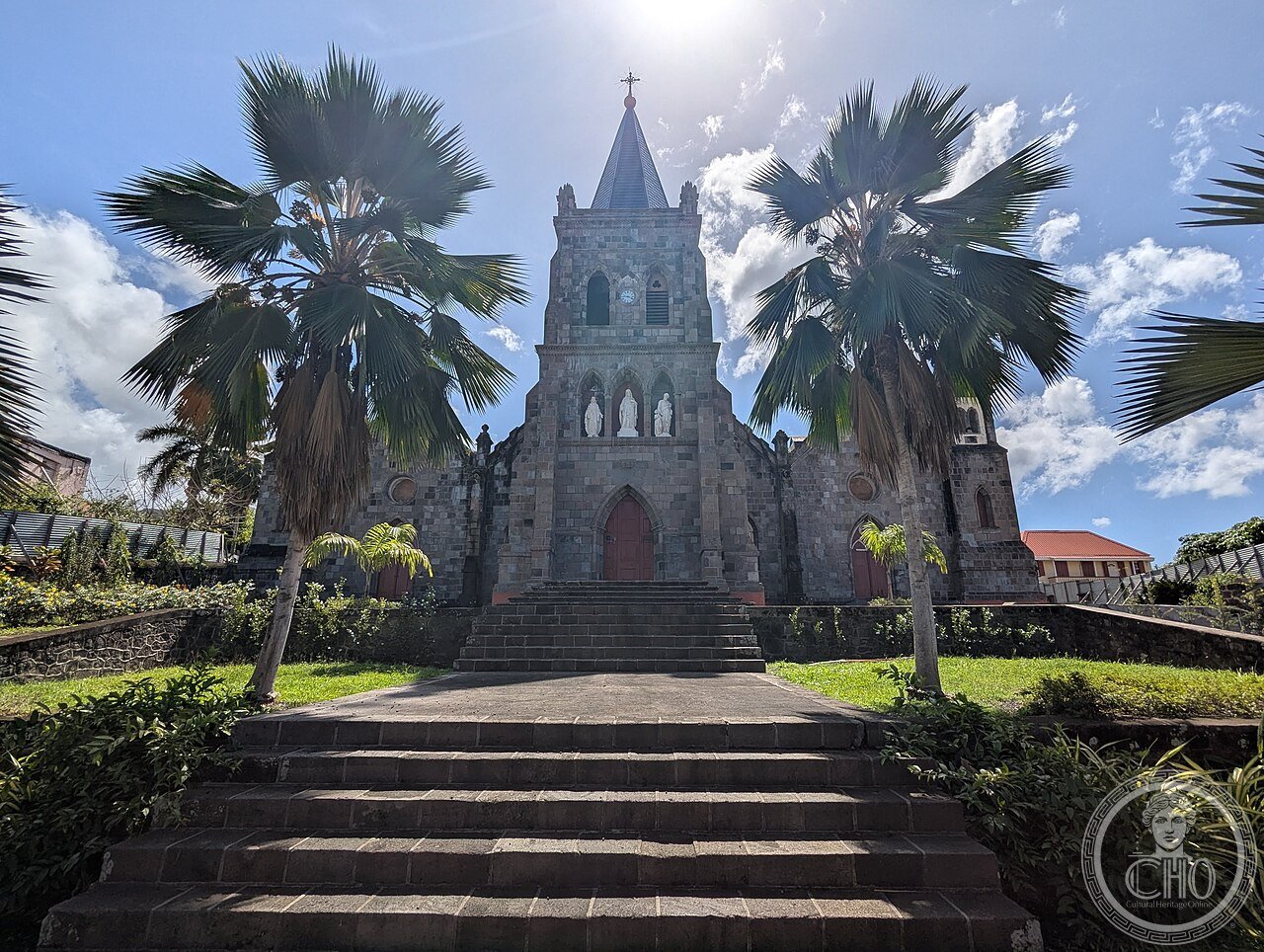
Built entirely of volcanic rock inside and out to resist earthquakes, the cathedral’s Gothic-Romanesque Revival windows carry stained glass above and wooden shutters below for ventilation, beneath a stubby bell tower fitted with a large clock. Inside, a mahogany pulpit, Victorian pews and murals depicting Egypt and Jerusalem furnish a building still being restored following Hurricane Maria, with stained glass reinstallation, a timber ceiling and floor tiling among the work reported ongoing as of September 2025.
Practical information
- Opening hours: generally open daily outside services; check current hours given ongoing restoration work.
- Address: Virgin Lane, southern Roseau, Saint George Parish, Dominica.
Getting there
The cathedral stands on a hill in southern Roseau overlooking the city center, easily reached on foot from downtown. GPS: 15°17′51″N, 61°23′07″W.
Nearby
- Downtown Roseau — the historic city center below the cathedral hill.
Sources
- Wikipedia — “Roseau Cathedral” (en.wikipedia.org).
- Bernard Lauwyck — “The Roseau Cathedral and Catholic and Slave Emancipation” (bernardlauw.wordpress.com).
- Dominica News Online — “More funds needed to complete renovation of Roseau Cathedral”
- Diocese of Roseau — status reports on cathedral renovation (dioceser.wordpress.com).
Find it on the map
See this place and what’s around it →📷 Become a Cultural Heritage Online photographer
Share your photos of places: they stay published under your name as the author. The more they're seen, the more you get noticed — and soon a contest will reward the most appreciated photos.
Log in or sign up free to add a photo