

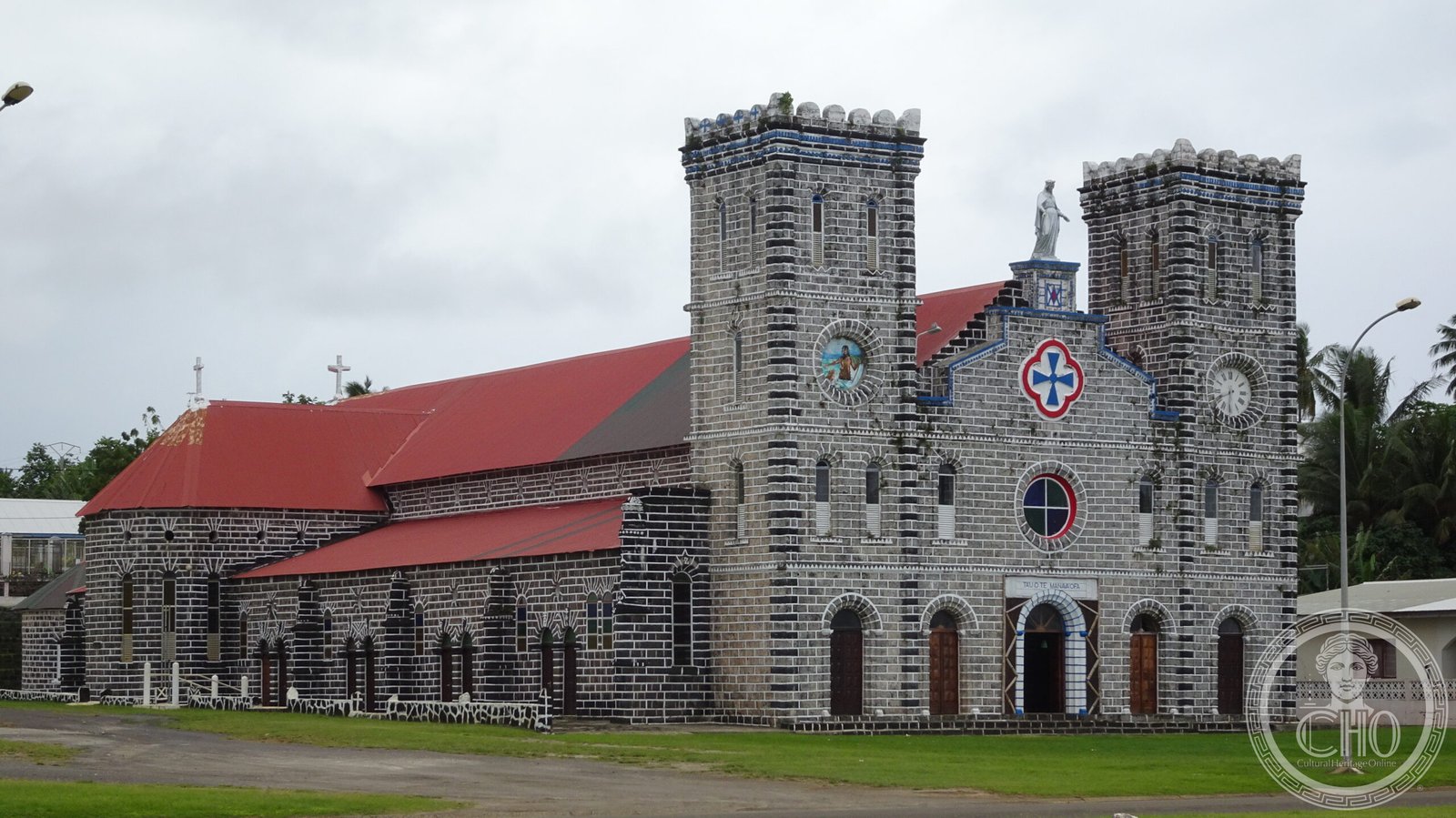
In Mata-Utu, the capital of Wallis and Futuna, Marist missionaries landed in 1837, with Pierre Bataillon on Wallis (Uvéa) and Pierre Chanel on Futuna. On Futuna, evangelization met violent resistance, culminating in the killing of Chanel on 28 April 1841 by the warrior Musumusu, acting for King Niuliki, who feared losing his role as both high priest and sovereign. Chanel is venerated as the “martyr of Oceania”, while Musumusu, who later converted, is said to have asked to be buried outside the church as an act of penance. On Wallis, by contrast, conversion proceeded faster and with the cooperation of the local monarchy. The first stone church was built in 1857-1858 at the instigation of Queen Amelia Tokagahahau Aliki, herself a Catholic convert, while a larger structure was built between 1859 and 1869 with the help of foreign masons brought in by the missionaries. No source identifies an architect: the building is credited to the Marist fathers as an institution, with Queen Amelia as the promoter of the first church, and Father Petelo Hamale directing the great mid-twentieth-century reconstruction, begun on 28 January 1952 and including the addition of two side aisles. The blessing of the completed works took place on 13 August 1959, presided over by the apostolic vicar Alexandre Poncet, and the solemn consecration on 12 August 1962, by the hand of his successor Michel Darmancier. Built of carved volcanic stone, bluish in colour, quarried locally, with interior timber from the forests of Alofi island, the cathedral is about 60 metres long and 20 wide, with a spire 20 metres tall. Two rectangular towers flank the facade, topped by a blue Maltese cross, the same symbol found on the flag of Wallis, a visual fusion of religious and national identity. The building also holds the tombs of the Lavelua, the traditional kings of Wallis, which have replaced the old royal burial site of Niuvalu. The Code of Wallis of 1871, drawn up under the influence of Bishop Pierre Bataillon, made Catholicism the official religion and consolidated the king as the supreme customary authority, while as early as 1842 the Wallisian sovereign had twice asked France for a protectorate. The territory’s Catholic population is today estimated at 99% according to the CIA, or at around 90% (10,242 people out of 11,380 in 2022) according to the French-language Wikipedia diocesan page — a discrepancy not resolved between the sources. The ecclesiastical district was part of the apostolic vicariate of Western Oceania until 1842, then of the apostolic vicariate of Central Oceania, based in Tonga, until 11 November 1935, when Wallis and Futuna became its own autonomous apostolic vicariate. It was raised to the diocese of Wallis-et-Futuna on 21 June 1966 by Pope Paul VI, a suffragan of the archdiocese of Nouméa. No papal visit is documented. Cyclone Evan of 2012 caused widespread damage on Wallis, but no specific damage to the cathedral is confirmed, while recent work on the roof and outdoor areas, reported by sources only partly verifiable, is said to have preceded unspecified July celebrations. The episcopal see is currently vacant, after Monsignor Susitino Sionepoe, bishop since 2018, was named archbishop of Nouméa on 14 January 2025. The diocese is administered provisionally by Monsignor Gábor Pintér, apostolic nuncio for the Pacific. The cathedral is described in tourism sources as a French national monument, though no formal legal classification as a historic monument is confirmed.
About Cathédrale Notre-Dame-de-l’Assomption
In Mata-Utu, the capital of Wallis and Futuna, Marist missionaries landed in 1837, with Pierre Bataillon on Wallis (Uvéa) and Pierre Chanel on Futuna. On Futuna, evangelization met violent resistance, culminating in Chanel’s killing on 28 April 1841 by the warrior Musumusu, acting for King Niuliki, who feared losing his role as both high priest and sovereign — Chanel is venerated as the “martyr of Oceania.”
On Wallis, conversion proceeded faster and with royal cooperation: the first stone church was built in 1857-1858 at the instigation of Queen Amelia Tokagahahau Aliki, herself a Catholic convert, while a larger structure was built between 1859 and 1869 with foreign masons brought in by the missionaries.
Key facts
- 1857-1869: the first stone church and its larger successor built with royal support.
- 1952-1959: a major reconstruction adds two lateral naves under Father Petelo Hamale.
- 12 August 1962: solemn consecration by Bishop Michel Darmancier.
- 1871: the Code of Wallis makes Catholicism the territory’s official religion.
- 21 June 1966: elevated to the seat of the newly created Diocese of Wallis-et-Futuna.
- 2025: the see becomes vacant after Bishop Susitino Sionepoe’s appointment as Archbishop of Nouméa.
History
Built with royal patronage rather than colonial imposition — Queen Amelia herself instigated its first stone incarnation — Notre-Dame-de-l’Assomption reflects how thoroughly Catholicism and Wallisian monarchy fused after 1837, a fusion formalized by the 1871 Code of Wallis and still visible in the cathedral’s blue Maltese cross, matching the territory’s own flag. Its role as burial site for the Lavelua, the traditional kings of Wallis, replacing their ancestral royal cemetery, marks perhaps the clearest physical symbol of that fusion anywhere in the territory.
What you see
Chiseled bluish volcanic stone, quarried locally, and interior woodwork from the forests of Alofi island form a building roughly 60 metres long, its twin rectangular towers topped by a blue Maltese cross matching the Wallisian flag. Inside lie the tombs of the Lavelua, the customary kings of Wallis, a role the cathedral inherited from the island’s earlier royal burial ground at Niuvalu.
Practical information
- Opening hours: generally open daily outside services; check current hours before visiting.
- Address: downtown Mata-Utu, near the Royal Palace, Wallis Island, Wallis and Futuna.
Getting there
The cathedral stands in downtown Mata-Utu overlooking the Wallis lagoon, adjacent to the Royal Palace and easily reached on foot from the town center. GPS: 13°16′58″S, 176°10′24″W.
Nearby
- Palais du Lavelua — the Royal Palace, adjoining the cathedral in central Mata-Utu.
Sources
- French Wikipedia — “Cathédrale Notre-Dame-de-l’Assomption de Mata Utu” and “Diocèse de Wallis-et-Futuna”
- Wikipedia — “Cathedral of Our Lady of the Assumption, Mata-Utu” and “Catholic Church in Wallis and Futuna” (en.wikipedia.org).
- Wikipedia — “Customary kings of Wallis and Futuna”
Find it on the map
See this place and what’s around it →📷 Become a Cultural Heritage Online photographer
Share your photos of places: they stay published under your name as the author. The more they're seen, the more you get noticed — and soon a contest will reward the most appreciated photos.
Log in or sign up free to add a photo