
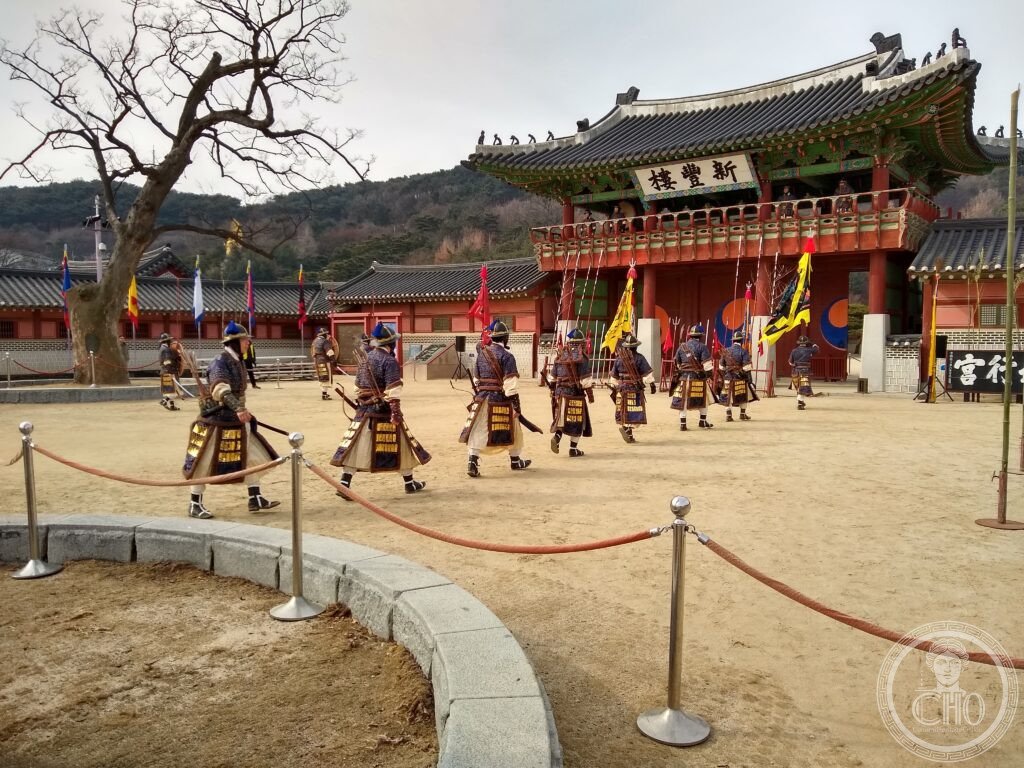
The masterpiece of late Joseon military architecture — a 5.7-km circuit of stone and brick walls encircling the city of Suwon, built in 1794–96 by King Jeongjo and designed by the scholar Jeong Yakyong (later also the pioneer of Korean Silhak practical learning), who synthesised Chinese and Japanese fortress design with Korean construction techniques to create the most scientifically advanced East Asian fortification of the 18th century; unique among Korean fortresses in having been built from a complete, surviving construction manual that recorded every decision.
At a glance
Hwaseong Fortress (Korean: 화성, “Flower Castle”) is a fortress encircling the old centre of Suwon, the capital of Gyeonggi-do Province, South Korea, approximately 30 km south of Seoul. The 5.7-km circuit of walls, gates, watchtowers, and fire-arrow platforms was built in 1794–96 under King Jeongjo (r. 1776–1800), the most intellectually distinguished of the Joseon kings; the project was designed by the polymath scholar Jeong Yakyong (정약용, 1762–1836) who also wrote the Joseon dynasty’s most important works on practical governance (Mokminsimseo), criminal law, and botany; the construction was completed in 28 months, two years ahead of schedule. The fortress was designated a UNESCO World Heritage Site in 1997 as an outstanding example of 18th-century military architecture.
Key facts
- The Uigwe (Construction Manual): the construction of Hwaseong is documented in the Hwaseong Uigwe (화성성역의궤, “Royal Protocol of the Construction of Hwaseong”), a 10-volume set recording every decision made during the construction: the materials used (the quantities of each type of stone, brick, and timber; where they came from), the wages paid to each worker (workers were paid, not conscripted — a significant departure from Joseon precedent), the names of the officials and artisans involved, and the engineering innovations introduced; this document enabled the accurate restoration of the fortress after damage in the Korean War (1950–53).
- Engineering innovations: Jeong Yakyong introduced several innovations in building Hwaseong: a heavy crane and pulley system (the geojunggi, modelled on a description by the Chinese scholar Ji Yun) that allowed large stones to be lifted without forced conscript labour; a combination of stone and fired brick (brick was almost unused in Korean fortifications before Hwaseong); corner bastions (gongsimdon, hollow bastions projecting from the wall to provide flanking fire on enemies who reached the wall base); and concealed embrasures in the gate towers for firing down on attackers at the gate itself.
- Janganmun Gate (North Gate): the largest gate of the fortress (two stories, hip-and-gable roof); the main northern approach to Suwon, facing toward Seoul; the decorated roof (blue-grey ceramic tiles, elaborate coloured dancheong ornamental painting on the wooden brackets) and the two flanking semicircular stone bastions (ongseong) with arrow-loop embrasures are the primary architectural elements.
- Banghwasuryujeong Pavilion: an octagonal pavilion on the western wall of the fortress, built over a water gate where the Suwon stream exits the city through the walls; the most photogenic element of Hwaseong — the pavilion and its reflection in the small reservoir below are the canonical image of the fortress; the pavilion was used for military command observation and is accessible by the wall circuit.
- The reason for building Suwon: King Jeongjo built Hwaseong and the planned city of Suwon (previously an agricultural village) partly for strategic reasons (a new planned city to the south of Seoul), partly as a monument to his father Prince Sado (who was killed in 1762 by Jeongjo’s grandfather King Yeongjo — murdered by being shut in a rice chest in a struggle over succession within the court), whose tomb was relocated to a hillside adjacent to Suwon; the fortress was also intended as an eventual alternative capital, though Jeongjo died in 1800 before this plan was realised.
- Heritage: UNESCO World Heritage Site, Hwaseong Fortress, inscribed 1997.
- GPS: 37.2854° N, 127.0130° E.
History
The decision to build Hwaseong was made by King Jeongjo in 1793, shortly after the relocation of Prince Sado’s tomb to the Hwasan mountain (near the new city of Suwon); the combination of filial piety (honouring the dead father) and political strategy (creating a new power centre outside Seoul, where the factional court politics of the old capital had entangled Jeongjo throughout his reign) drove the project. Jeong Yakyong (then in his early thirties, already known as one of the outstanding intellects of the Silhak scholarly movement) was commissioned to design the fortress; he spent a year studying Chinese and Japanese military architecture before producing his design.
The construction was completed in 1796; the city that grew within the fortress walls became an important regional centre. The fortress was damaged during the Korean War (1950–53), particularly the gates and several of the tower structures; the Uigwe construction manual enabled the faithful restoration of the damaged elements in the 1970s–1990s, ensuring that the restored sections are historically accurate (not modern interpretations). The UNESCO inscription in 1997 was partly a recognition of the exceptional quality of this documentation and restoration, which set a standard for East Asian heritage conservation.
What you see
The full circuit of the fortress walls (5.7 km, 48 structures: 4 main gates, 2 secret gates, 4 command posts, 5 beacon towers, 4 angle towers, 10 bastions, 2 water gates, and the Janganmun and Paldalmun main gates) takes approximately 2–2.5 hours on foot at a comfortable pace; the circuit is mostly accessible (some steep sections at the northern hill; the eastern and western walls are flat); the wall walk is entirely unobstructed and gives clear views of the Suwon city beyond and the green hills to the north (with Hwasan mountain and the tomb of Prince Sado visible). The circuit is best walked clockwise starting at the Janganmun (North Gate), proceeding along the north wall (hilltop section with the broadest views), down the east wall, to the Banghwasuryujeong Pavilion (south-west), and returning via the west wall.
The interior of the fortress walls is now the old centre of Suwon city (commercial and residential), with the Hwaseong Haenggung (the temporary royal palace where King Jeongjo stayed on visits, now a cultural centre with a museum and traditional performances) as the primary monument within the walls. The fortress is fully walkable year-round but most beautiful in spring (cherry blossoms, March–April) and autumn (coloured foliage, mid-October to early November).
Practical information
- Admission: KRW 1,000 (approximately €0.70) for the fortress wall circuit (token fee; no ticket checking at most entry points); the Hwaseong Haenggung (temporary palace) charges KRW 1,500; both open daily 9 am–6 pm (walls open 24 hours); the fortress is within easy walking distance of Suwon Station and Suwon City Hall.
- Getting there: Suwon is 30 km south of Seoul and on the Seoul metropolitan area subway network; take Seoul Metropolitan Subway Line 1 (Gyeongbu Line) from Seoul Station to Suwon Station (approximately 40 minutes; trains every 5–10 minutes); from Suwon Station, the Janganmun (North Gate) is approximately 20 minutes by foot through the city centre or 10 minutes by taxi; KTX express trains (from Seoul Station or Incheon Airport station) also stop at Suwon Station (10 minutes from Seoul).
- Combining with Seoul: Hwaseong Fortress is the best half-day excursion from Seoul; combine with the Joseon Royal Tombs at Yungneung and Geolleung (UNESCO WHS 2009, 10 km from Suwon), which include the tomb of Prince Sado (the father whose death motivated the construction of Hwaseong), for a full day of Joseon heritage south of Seoul.
Getting there
Seoul Metropolitan Subway Line 1 from Seoul Station to Suwon (40 min). From Suwon Station, 20 min walk or 10 min taxi to the North Gate. GPS: 37.2854, 127.0130.
Nearby
- Yungneung and Geolleung Royal Tombs — 10 km west of Suwon; the UNESCO-inscribed royal tombs of the Joseon dynasty (part of the collective inscription of 40 Royal Tombs of the Joseon Dynasty, 2009); Yungneung is the tomb of Prince Sado and his wife Lady Hyegyeong (the mother who witnessed the murder of her husband and wrote the remarkable memoir Memoirs of Lady Hyegyeong); Geolleung is the tomb of King Jeongjo himself (who died in 1800 before he could move the capital to Suwon); visiting these tombs together explains the personal and dynastic significance of Hwaseong Fortress.
- Gyeongbokgung Palace, Seoul — 30 km north of Suwon (40 minutes by subway); the principal Joseon dynasty palace in Seoul, rebuilt in 1867 after 275 years of ruin following the Japanese invasion of 1592; the most visited historical monument in Korea; see the Changing of the Royal Guard ceremony at the Gwanghwamun gate at 10 am and 2 pm (daily except Tuesday).
- Korean Folk Village — 10 km north-east of Suwon; a large open-air folk museum village of traditional Korean architecture (approximately 260 buildings representing different regions and social classes of 19th-century Korea), with live demonstrations of traditional crafts, music, and agricultural techniques; accessible from Suwon by bus; often combined with a Hwaseong visit.
Sources
- Wikipedia, Hwaseong Fortress; Jeong Yakyong; King Jeongjo, accessed June 2026.
- UNESCO, Hwaseong Fortress, WHS reference 817, inscribed 1997.
- Haboush, JaHyun Kim, The Memoirs of Lady Hyegyŏng, University of California Press, 1996 — the primary first-person source on the Joseon court and Prince Sado.
- Cultural Heritage Administration of Korea, Hwaseong Fortress, official guide, 2022.
Find it on the map
See this place and what’s around it →📷 Become a Cultural Heritage Online photographer
Share your photos of places: they stay published under your name as the author. The more they're seen, the more you get noticed — and soon a contest will reward the most appreciated photos.
Log in or sign up free to add a photo