
The finest surviving example of Joseon dynasty royal architecture in Korea — a palace complex set into a forested hillside in central Seoul whose buildings (the Injeongjeon throne hall, the Seonjeongjeon council hall, the Nakseonjae private quarters) are sited in dialogue with the natural landscape rather than imposed upon it, and whose northern Secret Garden (Huwon, 32 hectares of ponds, pavilions, and ancient trees) is the most beautiful Korean garden in existence, designed as a private retreat for the Joseon kings.
At a glance
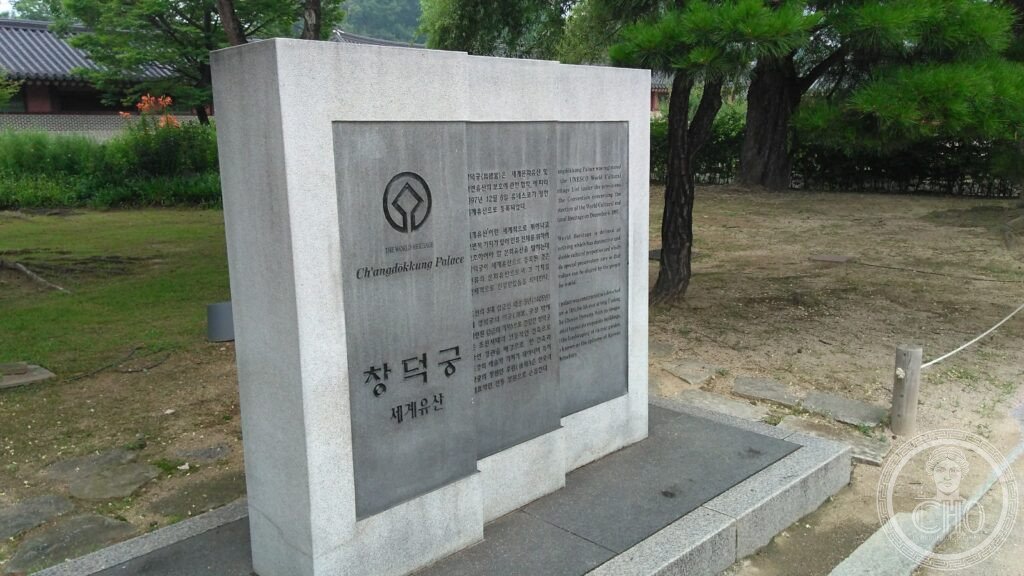
Changdeokgung Palace (Korean: 창덕궁, “Palace of Prospering Virtue”) is a royal palace in the Jongno-gu district of Seoul, South Korea, built in 1405 as the secondary palace of the Joseon dynasty (1392–1897) to complement the principal Gyeongbokgung Palace to the west. The palace covers 45 hectares, of which 32 hectares are the Huwon (Secret Garden, also known as the Rear Garden), a forested landscape of ponds, pavilions, stone bridges, and ancient trees that served as the private retreat of the Joseon kings and queens. Changdeokgung was the most frequently occupied royal residence for much of the Joseon dynasty (particularly after the Japanese invasion of 1592–98 destroyed most of the five palace compounds of Seoul), and the last Joseon king, Sunjong, lived here until his death in 1926. UNESCO inscribed Changdeokgung Palace Complex in 1997.
Key facts
- The Huwon (Secret Garden): the 32-hectare rear garden of the palace complex, closed to the public and known only to the royal family and select officials for most of the Joseon dynasty; the garden has 300 species of trees (including many trees over 300 years old), 28 pavilions, and 3 ponds; the Buyongji Pond (with the Buyongjeong Pavilion, 1707, and the Juhamnu Library — the most photographed spot in the garden) and the Ongnyucheon Stream (a winding brook with carved tablets in the rockface commissioned by King Injo, 1636) are the main areas; the Huwon is the finest example in Korea of the Korean garden principle of integrating architecture with natural terrain rather than imposing symmetrical order upon it.
- Injeongjeon (Throne Hall): the main audience hall of the palace, where the Joseon kings received foreign envoys and conducted major court ceremonies; the building (its current form dates from 1804–05) is raised on a double-tiered stone platform (the woldae); the central paved courtyard is divided into three sections by stone platforms, and the rank of officials at court ceremonies was indicated by the section on which they stood; the interior (open to visitors, unusual for a Joseon throne hall) has a ceiling decorated with two dragons facing each other — the symbol of the king.
- Donhwamun Gate (1412, rebuilt 1609): the main southern gate of the palace; the oldest surviving gate structure of the Seoul palaces; the two-storey hip-and-gable roof building (with a bell formerly used to announce the opening and closing of the city gates) stands at the end of a long forecourt approach.
- Nakseonjae (1847): the private residential quarters of King Heonjong, built for his royal concubine; the most accessible of the palace’s residential buildings; the suites of rooms, with their colourful dancheong (decorative painting on wooden buildings) in muted colours (deliberately less elaborate than the state rooms, reflecting the private scale), open onto a small private garden; the last resident was Yi Bangja, the Japanese-born wife of Crown Prince Euimin, who lived here until 1989.
- The Japanese invasion (Imjin War, 1592–98): the Japanese invasion of Korea under Toyotomi Hideyoshi burned all five palace compounds of Seoul in 1592 (some sources state the palaces were burned by Korean mobs before the Japanese troops arrived, not by the Japanese themselves); Changdeokgung was rebuilt 1607–1610 and became the primary royal residence for most of the remaining Joseon dynasty, partly because the main Gyeongbokgung Palace was left in ruins until 1867.
- Heritage: UNESCO World Heritage Site, Changdeokgung Palace Complex, inscribed 1997.
- GPS: 37.5792° N, 126.9910° E.
History
Changdeokgung was built in 1405 (the 5th year of the reign of King Taejong, the third king of the Joseon dynasty) as a supplementary palace to the already-completed Gyeongbokgung Palace; Taejong preferred it to the main palace, and it served as the primary royal residence through multiple reigns. The palace was burned in 1592 during the Japanese invasion (Imjin Waeran), rebuilt in 1607–10, and has survived largely in its post-1610 form (with subsequent additions and renovations through the 18th and 19th centuries); it is thus the best-preserved of the five Joseon dynasty palace complexes of Seoul, and the one most representative of the mature Joseon royal aesthetic.
The Joseon dynasty (1392–1897, 500 years — the longest-lived dynasty in Korean history) built its capital at Seoul (then called Hanseong) and established a Confucian system of government in which the king consulted a council of scholars (the sarim), performed elaborate ritual ceremonies at the palace and the royal ancestral shrine (Jongmyo, adjacent to Changdeokgung), and maintained a strict hierarchical social order with the Confucian scholarly class (yangban) at the apex. The Huwon reflects the Joseon elite’s aesthetic ideal — learning, nature, retirement from political life — that was central to the Confucian concept of the cultivated gentleman. The last royal family member to live in the palace buildings, Yi Bangja, died there in 1989, making Changdeokgung the most recently inhabited of the Joseon royal palaces.
What you see
Entry to the public areas of the palace (the Injeongjeon courtyard, the Seonjeongjeon council hall, the Huijeongdang, and the Nakseonjae quarters) is included in the standard admission and can be visited freely at any time during opening hours; guided tours in English are available. The Huwon (Secret Garden) requires a timed admission on a separate guided tour (Korean-language tours with 40-50 participants; English tours are offered twice daily, 11:30 am and 2:30 pm, with approximately 10 participants; book in advance online). The best season for the Huwon is autumn (mid-October to early November, when the ginkgo trees turn bright yellow and the maples turn scarlet — the reflection of the coloured foliage in the Buyongji Pond is one of the canonical images of Korean autumn).
The Jongmyo Shrine (royal ancestral temple, a 10-minute walk south-west from the palace) is jointly inscribed as a UNESCO WHS (1995) and should be combined in the same visit; the Jongmyo Jerye (ritual ceremony at the Jongmyo Shrine, held first Sunday of May) is a UNESCO Intangible Cultural Heritage and the most elaborate surviving Confucian ritual ceremony in East Asia.
Practical information
- Admission: KRW 3,000 (approximately €2) for the main palace; KRW 5,000 for the Huwon tour (separate ticket); English Huwon tours at 11:30 am and 2:30 pm, limited to 10 participants — book online at the Cultural Heritage Administration website (cha.go.kr) up to 30 days in advance; the palace is closed Monday; open 9 am–6 pm (March–October) or 9 am–5:30 pm (November–February).
- Getting there: Seoul Incheon International Airport (ICN) is 50 km from the palace; Airport Railroad Express (AREX) from Incheon to Seoul Station (50 minutes; direct trains depart every 30 minutes); from Seoul Station, subway Line 1 or Line 4 to Jongno-3-ga or Anguk (10 minutes); the palace is a 10-minute walk from Anguk station (Line 3); taxis from Incheon to the palace cost approximately 60,000–80,000 KRW (approximately €40–55) and take 70–90 minutes (traffic-dependent).
- Wearing hanbok: visitors who arrive at the palace wearing traditional Korean hanbok (available for rent at several shops near the palace entrance, including Gyeongbokgung Palace and in the adjacent Bukchon Hanok Village) receive free admission to the main palace areas (not the Huwon tour); this practice, introduced by the Cultural Heritage Administration as a means of promoting traditional culture, has become extremely popular; the palace grounds are photogenic year-round but particularly in the hanbok season (spring and autumn).
Getting there
Subway Line 3 to Anguk station, 10-minute walk. From Incheon Airport: AREX to Seoul Station, then Line 1 to Jongno-3-ga (50 min total). GPS: 37.5792, 126.9910.
Nearby
- Gyeongbokgung Palace — 1 km west of Changdeokgung; the principal Joseon dynasty palace (1395, rebuilt 1867 after 275 years in ruins); the Gwanghwamun gate, the Geunjeongjeon throne hall, and the Gyeonghoeru Pavilion (a two-storey pavilion built on an island in the middle of a large rectangular pond) are the major elements; the Changing of the Royal Guard ceremony (at the Gwanghwamun gate, 10 am and 2 pm daily, except Tuesday) is the most popular tourist activity in Seoul; the National Folk Museum of Korea is within the palace grounds.
- Jongmyo Royal Ancestral Shrine — 10 minutes walk south-west of Changdeokgung; the Joseon dynasty ancestral shrine where the spirit tablets of all the Joseon kings and queens are kept and ritual ceremonies are performed; the main shrine hall (the Jeongjeon) is the longest wooden building in Korea (101 metres); UNESCO WHS 1995; UNESCO Intangible Cultural Heritage (the Jongmyo Jerye ritual ceremony, first Sunday of May); usually combined with a Changdeokgung visit.
- Bukchon Hanok Village — immediately east of Changdeokgung; a residential neighbourhood of traditional Korean hanok (wooden courtyard houses) built between 1910 and 1930 as middle-class housing; the steep alley with the view of the hanok rooflines against the Seoul city skyline (with Bugaksan mountain behind) is the most photographed street in Seoul; privately owned and occupied, the neighbourhood is walkable in 1–2 hours.
Sources
- Wikipedia, Changdeokgung; Huwon; Joseon dynasty, accessed June 2026.
- UNESCO, Changdeokgung Palace Complex, WHS reference 816, inscribed 1997.
- Kim Dong-uk, Palaces of Korea, Hollym International, 2006.
- Cultural Heritage Administration of Korea (cha.go.kr), official palace guide, 2023.
Find it on the map
See this place and what’s around it →📷 Become a Cultural Heritage Online photographer
Share your photos of places: they stay published under your name as the author. The more they're seen, the more you get noticed — and soon a contest will reward the most appreciated photos.
Log in or sign up free to add a photo