
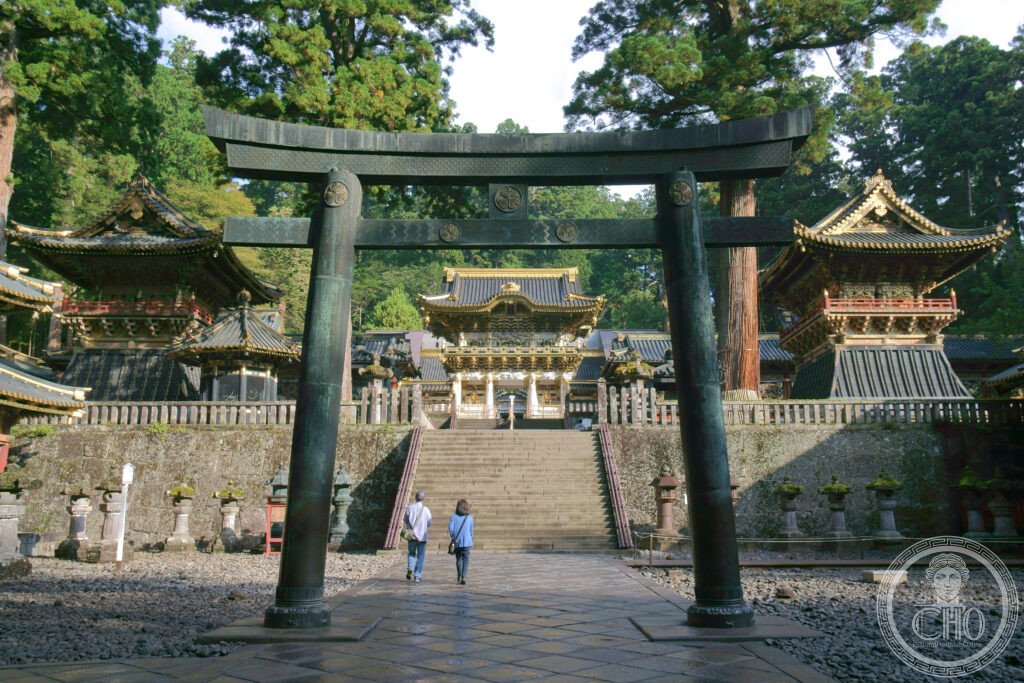
The most extravagantly decorated complex of religious buildings in Japan. A mountain valley in Tochigi Prefecture filled with Shinto shrines and Buddhist temples whose carved and gilded surfaces represent the accumulated patronage of the Tokugawa shogunate over 250 years, centred on the mausoleum of Tokugawa Ieyasu (the Tōshō-gū Shrine), whose Yomeimon gate is covered with 508 carved and gilded figures and is called “the Gate You Could Gaze at for a Day.”.
At a glance
The Shrines and Temples of Nikko are a group of Shinto and Buddhist sacred buildings set in a forested mountain valley in Nikko, Tochigi Prefecture, Japan, approximately 140 km north of Tokyo. The complex consists of three main shrine/temple ensembles (Tōshō-gū Shrine, Rinnō-ji Temple, Futarasan Shrine) totalling 103 buildings, distributed along and above the Daiya River valley. The centrepiece is the Tōshō-gū Shrine (1636, rebuilt from an original of 1617), the mausoleum of Tokugawa Ieyasu (1543–1616), the first Tokugawa Shogun who unified Japan after a century of civil war. The shrine was endowed by the successive Tokugawa shoguns with an extraordinary programme of carved and gilded decoration that has no equivalent in Japanese religious architecture. The natural landscape. Ancient cryptomeria cedars (some over 400 years old, lining the approach road), forested mountains, and autumn-coloured maple groves. Is as important as the buildings. UNESCO inscribed the Nikko complex in 1999.
Key facts
- Yomeimon Gate (陽明門, 1636): the most important single building in the Tōshō-gū complex. A two-storey gate whose every surface (columns, beams, panels, brackets, eaves, and roof supports) is covered with 508 carved and gilded figures: angels, demons, saints, horses, elephants, peony blossoms, phoenixes, chrysanthemums, and clouds. The carvings are in multiple layers and different depths (high relief, middle relief, low relief, and flat carving) in a technical programme that required approximately 1,500 craftsmen and 17 years to execute. The gate is called Higurashimon (“the Twilight Gate”) because a person could gaze at it until dusk without exhausting the imagery. One column is deliberately inverted (pillar with the grain reversed) to prevent the structure from being too perfect and inviting evil spirits.
- The Three Wise Monkeys (Sanbiki no Saru): carved on the stable building (Shinkyūsha) in the Tōshō-gū complex, the three wise monkeys. “See no evil, hear no evil, speak no evil” (mizaru, kikazaru, iwazaru). Have been associated with the Tōshō-gū complex since the 17th century and are among the most reproduced images in Japan. The stable panel (by the sculptor Hidari Jingorō, attributed) shows eight panels of monkeys depicting the stages of a monkey’s life, of which the three-monkey panel is the eighth (showing the adult monkey’s guiding principle).
- The Sleeping Cat (Nemuri-neko): a small carved wooden cat in a sleeping pose, approximately 40 cm wide, set above the Sakashitamon Gate that leads to the inner sanctuary where Ieyasu’s tomb is located. Carved by Hidari Jingorō (attributed), the cat is sleeping in a posture that protects the gate below (a cat that is visibly asleep signals that there are no mice — and therefore no disturbances — in the sacred space). The figure is disproportionately famous in Japan for its small scale. The climb beyond the gate leads to the simple wooden grave marker of Ieyasu, intentionally understated compared to the extravagance of the shrine below.
- Rinnō-ji Temple: the main Buddhist temple of the Nikko complex, founded by the monk Shōdō Shōnin in 766 AD (which established Nikko as a sacred mountain long before the Tokugawa mausoleum). The Sanbutsudō (Three Buddha Hall) houses three large gilded statues of amida Buddha, Senjukannon (the thousand-armed Kannon), and Bato-Kannon (the horse-headed Kannon), each approximately 8 metres tall. The largest gilded wooden sculpture group in Japan.
- The Avenue of Cedars: the approach road (Nikko Suginamiki) from the town of Nikko to the shrine complex is lined with cryptomeria cedars (Japanese cedar, sugi) planted in the 1630s by the daimyo Matsudaira Masatsuna as a tribute to the Tokugawa shogunate. The avenue runs approximately 35 km in total (including branches to other sacred sites in the region) and is the longest cedar-lined road in the world. The trees are now 380–390 years old and up to 40 metres tall. A UNESCO Intangible Cultural Heritage recognition has been applied for.
- Heritage: UNESCO World Heritage Site, Shrines and Temples of Nikko, inscribed 1999.
- GPS: 36.7583° N, 139.5994° E.
History
The sacred landscape of Nikko was established by the Buddhist monk Shōdō Shōnin in 766 AD, who climbed the Nantaisan mountain above Nikko and founded the temple complex that became Rinnō-ji. The mountain and its associated shrines were a pilgrimage destination for Nara and Heian period aristocrats and monks. The transformation into the Tokugawa mausoleum complex began in 1617, when the second shogun Tokugawa Hidetada had the first Tōshō-gū built over the grave of his father Ieyasu (who had died in 1616, and whose shrine designation was established by the imperial court at the request of the Tokugawa family). The current elaborate buildings were commissioned by the third shogun Tokugawa Iemitsu in 1634–36, spending 568,000 ryō (gold coins) and employing an estimated 15,000 craftsmen and artists over two years.
The choice of Nikko for the mausoleum was deliberate: the valley is 140 km north of Edo (Tokyo, the Tokugawa capital), and north is the direction of danger in Chinese geomancy. Placing the mausoleum to the north of the capital in a sacred mountain was meant to protect the city. The Tokugawa shogunate (1603–1868) maintained the shrine with enormous annual endowments. Each shogun was required to visit Nikko in person at least once during his reign. The visits became elaborate processions that were the most public demonstrations of shogunal power. After the Meiji Restoration (1868) ended the shogunate, the Nikko complex was separated into Shinto and Buddhist portions (the forced separation of Buddhism and Shinto, shinbutsu-bunri). Rinnō-ji became a Buddhist temple and Tōshō-gū and Futarasan became Shinto shrines.
What you see
The approach from Nikko town centre to the shrine complex (approximately 20 minutes on foot, or 5 minutes by bus) passes through the cedar avenue and crosses the Shinkyo (Sacred Bridge, a red lacquered arch bridge over the Daiya River; the current bridge dates from 1636, rebuilt on the site of the original 8th-century bridge; an admission of ¥300 is charged to walk on the bridge). The complex itself is entered through the Omotemon (Main Gate) which is itself richly carved. The sequence moves through the Drum Tower and Bell Tower, the Gōjūnotō (Five-story Pagoda), past the Three Wise Monkey stable panels, through the first gate (Omotemon), and into the main inner court with the Yomeimon Gate as its far end.
The experience of the Yomeimon close up (photograph it; then spend 20–30 minutes walking around it examining individual carved panels) should be unhurried. The gate is covered at every scale from the distant silhouette (elaborate layered rooflines and gold-leaf surfaces) to intimate detail (individual faces of the carved figures, the texture of feathers and scales, the depth of the relief). Beyond the Yomeimon is the Karamon Gate (an even more elaborate single-story gate) and the Haiden and Honden (oratory and main shrine hall) where the spirit of Ieyasu is enshrined. The inner area also leads, via the Sleeping Cat gate, to the climb to the actual tomb.
Practical information
- Admission: the Tōshō-gū Shrine charges ¥1,300 (approximately €8). Rinnō-ji charges ¥1,000. Futarasan Shrine is free. A combination ticket covering Tōshō-gū + Rinnō-ji is ¥2,100. The Treasury Museum (separate) is ¥300. The Sleeping Cat passage is ¥500 extra. A full visit to all the main buildings takes 3–4 hours. The complex is open daily 8 am–5 pm (April–October) or 9 am–4 pm (November–March).
- Getting there: Nikko is 140 km north of Tokyo. Tobu Nikko Line from Asakusa Station, Tokyo to Tobu Nikko Station (approximately 2 hours, with limited express “Spacia” or local trains; limited express trains run at convenient times and do not require reservations). JR Nikko Line from Utsunomiya (reached by Shinkansen in 50 minutes from Tokyo) to Nikko Station (45 minutes further). From Nikko Station, bus to Shinkyo Bridge or walk (30 minutes). All-day Nikko bus pass available at Nikko Station.
- Autumn colours: the forested mountains above Nikko are among the finest autumn-colour destinations in Japan. The maple and larch forests turn brilliant red, orange, and yellow from mid-October to mid-November (starting at altitude and moving downhill). Combine the autumn foliage (Irohazaka road, Chuzenji Lake) with the shrine visit for the most complete Nikko experience. The colour peak is typically 20–25 October.
Getting there
Tobu Nikko Line from Asakusa (Tokyo) to Tobu Nikko Station (2h, limited express). Bus or 20-min walk to the shrines. GPS: 36.7583, 139.5994.
Nearby
- Kegon Falls and Lake Chuzenji. 12 km west of Nikko town, reachable by the Irohazaka switchback road (20 minutes by bus). Kegon Falls (97 metres, one of the three most celebrated waterfalls in Japan) drops from the outlet of Lake Chuzenji into the valley below. The observation deck at the base of the falls (reached by a lift, ¥600) gives the fullest view. Lake Chuzenji is a volcanic crater lake at 1,269 metres altitude, formed when Nantaisan erupted and blocked the original valley 20,000 years ago. The lake is the source of Kegon Falls.
- Kinugawa Onsen. 15 km east of Nikko. The nearest onsen (hot spring) resort to Nikko, with a dozen ryokan (traditional Japanese inn) and public bathing facilities along the Kinugawa River. Several theme parks (Tobu World Square, Edo Wonderland) are adjacent. The combination of shrines in the morning and onsen in the evening is the classic Nikko day-and-overnight itinerary.
- Nikkō Tōshō-gū Yayoi Festival. The major annual festival (17–18 May). On 18 May, a procession of approximately 1,000 people in full Edo-period armour, costumes, and horse attendants re-enacts the original procession from Edo Castle to the Tōshō-gū mausoleum when Ieyasu’s remains were transferred to Nikko in 1617. The procession starts at 11 am from the Rinnō-ji Sambutsu-dō and proceeds to the main Tōshō-gū complex.
Sources
- Wikipedia, Shrines and Temples of Nikko. Tōshō-gū. Yomeimon, accessed June 2026.
- UNESCO, Shrines and Temples of Nikko, WHS reference 913, inscribed 1999.
- Arata Isozaki and others, Japanese Temples and Shrines, Heibonsha, 1999.
- Agency for Cultural Affairs, Japan, National Treasures and Important Cultural Properties of Japan, 2023.
Find it on the map
See this place and what’s around it →📷 Become a Cultural Heritage Online photographer
Share your photos of places: they stay published under your name as the author. The more they're seen, the more you get noticed — and soon a contest will reward the most appreciated photos.
Log in or sign up free to add a photo