
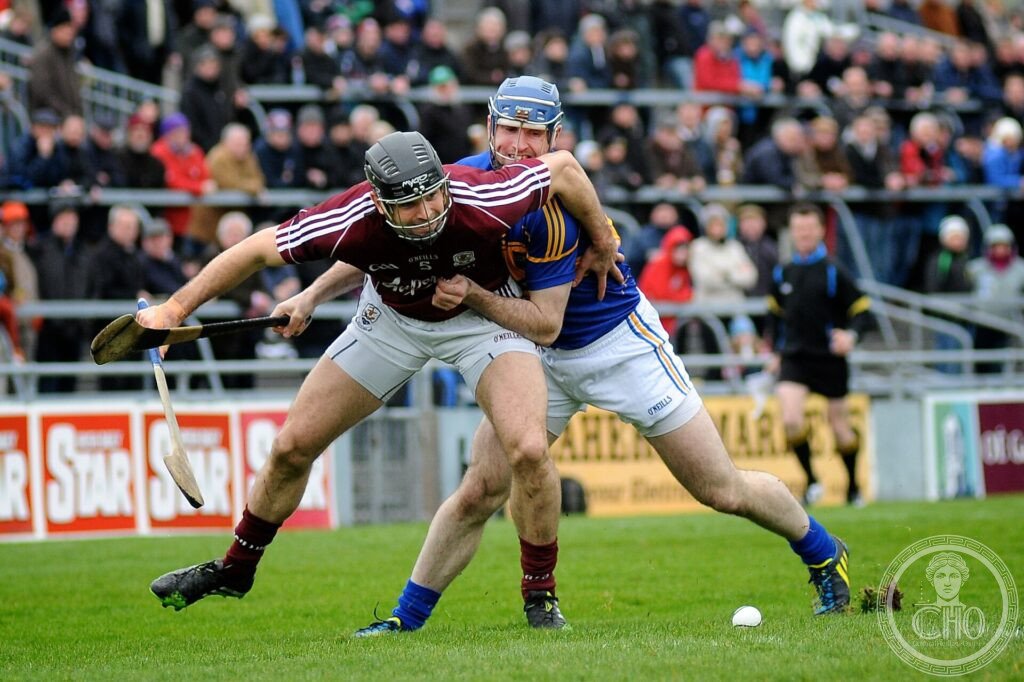
An ancient Gaelic field sport played with ash wood sticks and a small leather ball, hurling is among the fastest and most dynamic team games in the world, rooted in Irish identity for over a thousand years.
At a glance
Hurling is a team sport of ancient Irish origin in which players use a wooden stick called a hurley to strike a small ball called a sliotar between goalposts. When played by women, the game is called camogie, sharing the same Gaelic linguistic root. The sport combines precision, athleticism and strategy across a field shared with Gaelic football, drawing players of all ages across Ireland.
Origins & history
Early forms of hurling have been played since at least the Middle Ages, with written references appearing in Irish law tracts from the seventh century. Archaeological evidence dates from the twelfth-century. The first codified rules were published in January 1883 by the Dublin Hurling Club, establishing the modern game. Today the Gaelic Athletic Association (GAA) administers hurling across Ireland and internationally.
The practice
Players wield a hurley—a flat-faced stick crafted from ash wood—to hit the sliotar, a small ball traditionally made of cork and leather. The ball may be caught in the hand and carried for no more than four steps, struck in the air, or struck on the ground. It can also be kicked or slapped with an open hand for passing.
A player carrying the ball beyond four steps must bounce or balance the sliotar on the stick’s end in a move called a solo, and may handle the ball only twice while in possession. Shoulder-to-shoulder charges are permitted when a player is in possession or playing the ball. Since 2010, all players wear mandatory plastic helmets with faceguards; no other protective padding is standard.
Scoring follows a dual system: striking the ball over the crossbar scores one point, while striking it under the crossbar into the net scores three points.
Cultural significance
Hurling occupies a central place in Irish cultural identity and sporting life. CNN ranked the All-Ireland Senior Hurling Championship final second among ten sporting events that must be seen live, after the Olympic Games and ahead of the FIFA World Cup and UEFA European Championship. A 2024 survey found hurling to be the favourite sport of 25% of Irish people.
The sport has inspired art, music, film and literature. It has been called the fastest field sport in the world, and continues to embody Irish heritage and community pride across generations.
Key facts
- Countries: Ireland
- Anchor heartland: Kilkenny, Ireland (52.65185, −7.25391)
- UNESCO ICH reference: 01263
- Companion sport for women: Camogie (camógaíocht)
- Governing body: Gaelic Athletic Association (GAA)
Where to experience it
Hurling is played and watched throughout Ireland, with Kilkenny serving as the heartland of the sport. The All-Ireland Senior Hurling Championship, the sport’s premier competition, draws large crowds and televised audiences. Local clubs and county teams across Ireland offer opportunities to watch both club and championship-level hurling year-round.
Sources & resources
Find it on the map
See this place and what’s around it →📷 Become a Cultural Heritage Online photographer
Share your photos of places: they stay published under your name as the author. The more they're seen, the more you get noticed — and soon a contest will reward the most appreciated photos.
Log in or sign up free to add a photo