
Hue Imperial Citadel

Hue Imperial Citadel Vietnam Nguyen dynasty Forbidden Purple City Perfume River UNESCO World Heritage
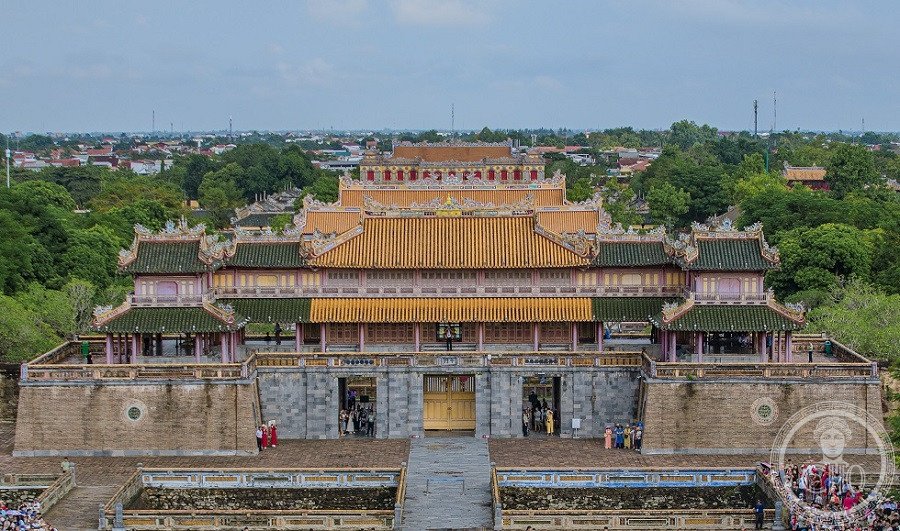
The Ngo Mon Gate (the Noon Gate; the main southern entrance to the Imperial City of Hue; built 1833 CE by Emperor Minh Mang; 57m wide; 5-gate structure; the platform above the gate (the Ngu Phung Pavilion; the Five Phoenix Pavilion) was used for imperial proclamations, including the proclamation of the formation of the Democratic Republic of Vietnam by Emperor Bao Dai’s abdication on August 25, 1945 CE), Hue Imperial Citadel, Hue, Thua Thien Hue Province, Vietnam. UNESCO World Heritage Site 1993. Photo via Wikimedia Commons.
Thua Thien Hue Province, Vietnam · Nguyen dynasty capital 1802-1945 CE; Forbidden Purple City; Royal Tombs on Perfume River; last emperor abdicated 1945 CE; UNESCO WHS 1993

Hue Imperial Citadel

The last imperial capital of Vietnam and the finest example of Vietnamese royal architecture — Hue (Thua Thien Hue Province, Vietnam; UNESCO WHS 1993) was the capital of the Nguyen dynasty (1802-1945 CE), Vietnam’s last royal house, and contains a walled imperial complex modelled on Beijing’s Forbidden City with the Perfume River Royal Tombs stretching for 7 km upstream.

At a glance

Hue Imperial Citadel (the most precisely HueVietnam single Thua Thien Hue Province central Vietnam Hue City UNESCO WHS 1993 Nguyen dynasty 1802 1945 CE Vietnam last dynasty 13 Nguyen emperors Gia Long Minh Mang Thieu Tri Tu Duc Duc Duc Hiep Hoa Kien Phuc Ham Nghi Dong Khanh Thanh Thai Duy Tan Khai Dinh Bao Dai last emperor abdication August 25 1945 CE Ho Chi Minh Democratic Republic Vietnam proclaimed three-tier concentric citadel system: outer Kinh Thanh (Capital Citadel) 37 km2 2.4m wall 10m wide most moat surrounds; Imperial City (Hoang Thanh) 2.4 km2 wall 6m high inner wall; Forbidden Purple City (Tu Cam Thanh) innermost private royal quarters only emperor family servants allowed model Chinese Forbidden City Beijing 1804 1833 CE construction Gia Long Minh Mang emperors Nguyen dynasty modelled themselves on Chinese Qin Shi Huang tradition mandate of heaven Son of Heaven Vietnam emperor first assumed title Emperor not just King because Son of Heaven above Chinese emperor in Vietnamese claim Hue Tet Offensive 1968 CE January 30 February 28 1968 CE North Vietnamese Army and Viet Cong captured Hue 25 days 26 days Vietnam War bloodiest single battle Hue Massacre 3000 5000 civilians murdered by North Vietnamese Army and Viet Cong in mass graves throughout Hue American military retook Hue after 26 days of fighting UNESCO heritage: the Hue Massacre of 1968 and the missing monument (the most suppressed history of the Vietnamese War): during the Battle of Hue (January 31-March 3, 1968 CE; the bloodiest battle of the Vietnam War), North Vietnamese Army (NVA) and Viet Cong (VC) forces occupied Hue for 26 days; during this occupation, NVA/VC forces conducted systematic executions of approximately 3,000-5,000 civilians (the Hue Massacre); victims included government officials, Catholic priests, doctors, teachers, and intellectuals; most were buried in mass graves that were discovered in the months after the battle; the Hue Massacre is rarely discussed in Vietnam (it complicates the official narrative of the war) and there is no official memorial in Hue; the 500+ graves discovered 1969-1970 CE in the vicinity of Hue are the only physical evidence; for foreign visitors, the episode creates a profound moral complexity at what is otherwise a beautiful and peaceful heritage site)) — the most precisely HueVietnam single 1802 1945 CE 13 Nguyen emperors Gia Long Minh Mang Bao Dai abdication 1945 three-tier concentric Kinh Thanh 37 km2 Hoang Thanh Imperial City 2.4 km2 Tu Cam Thanh Forbidden Purple City model Beijing 1804 1833 CE 1968 CE Tet Offensive January 30 February 28 NVA Viet Cong 26 days Hue Massacre 3000 5000 civilians mass graves discovered 1969 1970 CE suppressed Vietnamese official narrative UNESCO heritage in any UNESCO world heritage site)).

Key facts

  • Bao Dai’s abdication (August 25, 1945 CE): the end of 2,000 years of Vietnamese monarchy: the most precisely HueVietnam single Bao Dai 13th last Nguyen emperor 1926 1945 CE August 25 1945 CE Japanese surrender August 15 1945 CE Vietnam power vacuum Ho Chi Minh declared Democratic Republic Vietnam August 19 1945 CE Bao Dai sent telegram Ho Chi Minh I would rather be a citizen of a free country than the king of an enslaved one August 25 1945 CE Bao Dai formally abdicated Ngu Phung Pavilion Five Phoenix Pavilion above Ngo Mon Gate handed imperial seal jade sword symbols imperial power to Tran Huy Lieu Viet Minh representative 2000 years Vietnamese monarchy ended at Ngo Mon Gate Hue Bao Dai became citizen Nguyen Vinh Thuy went to Hanoi advising Ho Chi Minh briefly then to exile France Hong Kong returned South Vietnam 1949 1955 CE French-backed state exiled 1955 CE President Diem ousted him UNESCO heritage — the end of 2,000 years of Vietnamese monarchy at the Ngo Mon Gate: Bao Dai’s abdication (August 25, 1945 CE; on the platform above the Ngo Mon Gate, the main imperial entrance to the citadel) ended the Nguyen dynasty and approximately 2,000 years of Vietnamese monarchy (the legendary first Vietnamese dynasty, the Hong Bang, is traditionally dated to 2879 BCE); Bao Dai read his abdication proclamation and handed the imperial seal and the imperial sword (the two symbols of monarchical authority) to Tran Huy Lieu, the Viet Minh representative; Bao Dai’s words at the moment of abdication: “I prefer to be a citizen of an independent country rather than Emperor of an enslaved one”; the handover was filmed (the footage survives); the Ngo Mon Gate where this happened is the most visited monument in Hue today
  • GPS: 16.4698° N, 107.5796° E

History

From Cham capital to Nguyen dynasty imperial capital to French colonial protectorate to Republic (the most precisely HueVietnam single 1306 CE first mention Hue Chiem Dong Cham territory ceded to Vietnam Tran dynasty 1558 CE Lord Nguyen Hoang governor Nguyen Lords parallel dynasty ruled south Vietnam 1558 1777 CE parallel to Trinh Lords north 1788 CE Tay Son Rebellion unified Vietnam briefly Quang Trung Nguyen Hue leader 1802 CE Nguyen Anh defeated Tay Son founded Nguyen dynasty assumed title Emperor Gia Long 1802 1820 CE first Nguyen Emperor moved capital Hue from Hanoi chose Hue centrally located between north and south 1804 CE construction citadel walls began 1833 CE Minh Mang second emperor expanded built Ngo Mon Gate Forbidden Purple City complete construction 100000 workers soldiers 10 years major construction 1802 1833 CE 1883 CE France captured Hue Treaty of Hue France protectorate Annam Vietnamese emperor retained nominal authority ceremonial Hue remained capital French protectorate Annam 1884 1945 CE 1945 CE Japanese overthrew French during WWII March 9 1945 CE Emperor Bao Dai declared independence from France briefly August 25 1945 CE abdication 1945 1975 CE Vietnam War Hue occupied 1968 CE Tet Offensive 1975 CE fall Saigon South Vietnam 1993 CE UNESCO UNESCO heritage: the court music of Hue (the oldest living music tradition in Vietnam): Nha Nhac (Vietnamese Court Music) was the official music of the Nguyen dynasty imperial court (1802-1945 CE); it combines Chinese court music models with Vietnamese traditional elements; Nha Nhac was performed at all major imperial ceremonies — state banquets, royal births, deaths, coronations, and religious festivals; the tradition was nearly destroyed by the Vietnam War and post-war revolutionary culture; in 2003 CE, UNESCO added Nha Nhac to the Representative List of the Intangible Cultural Heritage of Humanity (one of only three Vietnamese intangible heritages on the UNESCO list); today Nha Nhac is performed regularly at the Hue Royal Theatre (Duyet Thi Duong; the restored imperial theatre inside the Imperial City; originally built 1826 CE; performances at 10 AM daily; approximately VND 150,000/€5.50) — the only way to experience 200-year-old imperial music in its original architectural setting)) — the most precisely HueVietnam single 1306 CE Cham territory 1558 CE Nguyen Lords governors 1802 CE Nguyen Anh Emperor Gia Long defeated Tay Son centrally located Hue 1804 CE walls construction 1833 CE Minh Mang Ngo Mon Forbidden Purple City 100000 workers 10 years 1883 CE France protectorate Treaty Annam 1945 CE Japanese March 9 Bao Dai independence August 25 abdication 1968 CE Tet Offensive Hue Massacre 3000 5000 civilians 1993 CE UNESCO 2003 CE Nha Nhac UNESCO Intangible Heritage Human Nha Nhac Royal Theatre Duyet Thi Duong 1826 CE daily UNESCO heritage in any UNESCO world heritage site)).

What you see

The Ngo Mon Gate, the Thai Hoa Palace, and the Perfume River Royal Tombs (the most precisely HueVietnam single Ngo Mon Gate Noon Gate 1833 CE Minh Mang 57m wide 5 gates imperial colour yellow gate middle emperor only left right noblewomen concubines officials Ngu Phung Pavilion Five Phoenix Pavilion above gate Bao Dai abdication August 25 1945 CE Thai Hoa Palace Supreme Harmony Palace Throne Hall 1805 CE Gia Long rebuilt 1833 CE 80 red columns gold dragon motifs imperial throne audience hall 7 imperial edicts Nine Dynastic Urns cast 1837 Minh Mang 9 bronze urns 2000 kg each engraved mountains rivers regions Vietnam 9 urns 9 Nguyen emperors by then in existence Forbidden Purple City Tu Cam Thanh innermost private imperial quarters destroyed 80% during 1968 Tet Offensive Ngo Mon rebuilt Thai Hoa rebuilt Forbidden Purple City currently ongoing UNESCO restoration Royal Theatre Duyet Thi Duong 1826 CE restored Nha Nhac performances daily 10 AM Perfume River Royal Tombs 7 imperial tombs Mausoleum Minh Mang Khai Dinh Tu Duc Gia Long Thieu Tri Dong Khanh Duc Duc 7 km south Hue perfume river Tu Duc most elaborate 3 lakes 50 structures 16 years construction 1864 1867 CE Khai Dinh most dramatic 1920 1931 CE French-Vietnamese hybrid style concrete European art deco Vietnamese ornamental motifs UNESCO heritage: the Khai Dinh Mausoleum (the strangest monument in Vietnam): the Khai Dinh Mausoleum (1920-1931 CE; 11 years under construction; Emperor Khai Dinh taxed the Vietnamese people 30% additionally to fund it) is a bizarre fusion of French Art Deco architecture with traditional Vietnamese imperial ornamental vocabulary; Khai Dinh was a French collaborator emperor (his reign 1916-1925 CE was the period of deepest French colonial control of Vietnam) and his tomb reflects this confusion of identities — the concrete frame (French construction method), the cement statue of Khai Dinh in full regalia (bronze; inlaid with gold; made in France), and the Vietnamese ceramic mosaic interior (broken Chinese porcelain embedded in cement) create a monument that is simultaneously French, Chinese, Vietnamese, and Art Deco; it is also the smallest and most dramatic of the Hue imperial tombs, perched on a steep hillside 120 steps above the Perfume River)) — the most precisely HueVietnam single Ngo Mon 1833 CE 57m 5 gates Ngu Phung Bao Dai abdication 1945 CE Thai Hoa Palace 1805 CE 1833 CE 80 columns throne room Nine Dynastic Urns 1837 CE Minh Mang 9 bronze 2000 kg each Forbidden Purple City 80% destroyed 1968 CE ongoing UNESCO restoration Royal Theatre 1826 CE Nha Nhac 10 AM daily Perfume River 7 Royal Tombs 7 km Tu Duc 1864 1867 CE Khai Dinh 1920 1931 CE 11 years French Art Deco Vietnamese ceramic mosaic concrete bizarre French collaborator 30% tax UNESCO heritage in any UNESCO world heritage site)).

Practical information

  • Getting there: from Danang: tourist minibus (3h; Hai Van Pass scenic route; approximately US$10-15 with tour companies) or local bus (2h; via expressway; approximately VND 100,000/€3.75; Da Nang-Hue; operates from the Hue bus station) or train (the Reunification Express; 2h30m-3h from Da Nang; approximately VND 100,000-150,000/€4-5.50 for hard seat; the Hai Van Pass coastal railway segment between Da Nang and Hue is the most scenic 30 km of railway in Vietnam); the Imperial City (Hoang Thanh) entry fee (VND 200,000/€7.50; includes access to the citadel, the Thai Hoa Palace, the Nine Dynastic Urns, the Royal Theatre exterior, and the Forbidden Purple City (partially restored)); the Royal Theatre performance (VND 150,000/€5.50; 45 min; Nha Nhac court music; daily 10 AM; the most concentrated cultural experience in Hue); the Royal Tombs (separate entry for each tomb; VND 100,000/€3.75 per tomb; the combined ticket VND 280,000/€10.50 covers Minh Mang, Khai Dinh, and Tu Duc — the three most dramatic; boat on the Perfume River from Hue to the tombs (approximately VND 200,000/€7.50 per boat; 30-60 min by boat vs. 20 min by taxi/xe om motorbike)); the visiting time (half day for the Imperial City alone; a full day for Imperial City + Royal Theatre + 2 Royal Tombs; a full day and a half for the complete UNESCO monument including all 7 tombs); best time (February-April for the Hue Festival (even-numbered years) and Hue Festival of Arts (odd-numbered years)); avoid summer (June-August: 35-40°C+; the rainy season October-December brings flooding))

Getting there

From Da Nang: train 2h30m (VND 100-150k/€4-5.50; Hai Van Pass coastal segment). Imperial City entry VND 200,000/€7.50. Royal Theatre Nha Nhac daily 10 AM (VND 150,000/€5.50). Royal Tombs: Khai Dinh + Tu Duc + Minh Mang combo VND 280,000/€10.50. Best: February-April. GPS: 16.4698, 107.5796.

Nearby

  • Hoi An Ancient Town — 120 km south (UNESCO WHS 1999; the most atmospheric merchant town in Southeast Asia; 15th-19th century CE; the Japanese Covered Bridge (1593 CE); the blend of Chinese, Japanese, Vietnamese, French, and Dutch architecture in a single 1 km2 old town; the Old Town entry fee (VND 120,000/€4.50 for 5 monuments); the night market; the tailor shops; quieter in the mornings; the Cham Island Marine Reserve (30 min by boat; excellent snorkelling))
  • My Son Sanctuary — 130 km south (UNESCO WHS 1999; the most important Cham Hindu temple complex in Vietnam; 4th-13th century CE; the “Valley of Kings” of the Cham Empire; heavily bombed during the Vietnam War (B-52 bombing 1969 CE destroyed the most important towers); what remains (approximately 20 of the original 70+ towers) is still extraordinary as the single most significant Hindu complex in Vietnam outside the influence of Chinese culture))

Sources

  • Wikipedia, Hue; Imperial City, Hue; Nguyen dynasty; Bao Dai; Nha Nhac, accessed June 2026
  • UNESCO, Complex of Hue Monuments, WHS reference 678, inscribed 1993

Hero image: Hue, Thua Thien Hue Province, Vietnam, Wikimedia Commons. Editorial text © Cultural Heritage Online, 2026.

📷 Diventa un fotografo di Cultural Heritage Online

Condividi le tue foto dei luoghi: restano pubblicate con la tua firma come autore. Più vengono viste, più ti fai conoscere — e presto un concorso premierà le foto più apprezzate.

Accedi o registrati gratis per aggiungere una foto
📋 Copy & share on social
Scroll to Top