
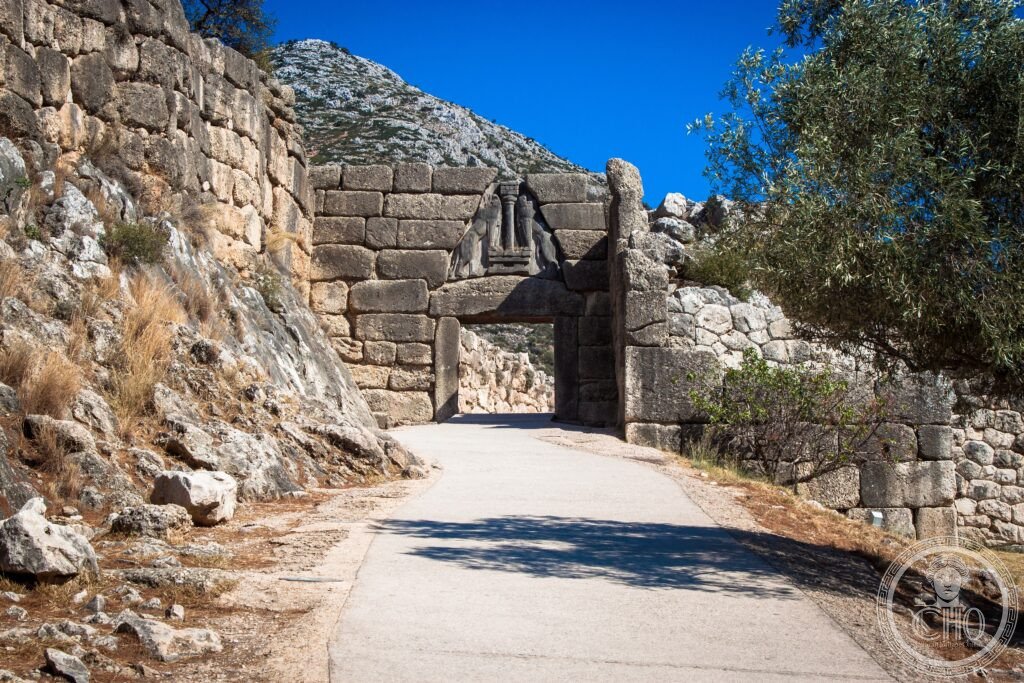
Mycenae gave its name to an entire Bronze Age civilisation and to the legend of Agamemnon. Its Lion Gate, shaft graves and beehive tomb are the physical trace of the palace world that later Greeks turned into the myths of Homer.
At a glance
Mycenae was the dominant citadel of Bronze Age Greece between roughly 1600 and 1100 BCE, and later tradition made it the seat of the legendary king Agamemnon, leader of the Greek forces against Troy in Homer’s Iliad. The site’s massive walls, its Lion Gate and its tholos tombs survive from that palace civilisation.
Excavations here, most famously those of Heinrich Schliemann in 1876, produced gold death masks and grave goods that convinced many at the time that Homer’s account had a real historical basis. Mycenae and neighbouring Tiryns were inscribed together as a UNESCO World Heritage Site in 1999.
Key facts
- Location: Mykines, Argolis Regional Unit, Peloponnese, Greece.
- Period: Bronze Age, roughly 1600–1100 BCE.
- Lion Gate: built around 1250 BCE, its relief is considered the oldest monumental sculpture surviving in Europe; the lintel is a single stone slab 4.9 metres long, weighing an estimated 18–20 tonnes.
- Treasury of Atreus: a tholos (beehive) tomb of around 1250 BCE, with an interior diameter of 14.5 metres and height of 13.4 metres, corbelled in 33 courses of stone without mortar or a keystone.
- UNESCO status: inscribed in 1999 jointly with Tiryns.
- Coordinates: 37.7308° N, 22.7563° E.
History
Mycenae flourished as a fortified palace centre through the Bronze Age, its rulers commanding a trade network attested by Linear B clay tablets recording grain, sheep, chariots and oils. The palace economy collapsed around 1200–1150 BCE amid the wider Bronze Age Collapse, a period associated with drought, the movements of the so-called Sea Peoples, and the destruction of major Mycenaean centres including Tiryns, Pylos and Knossos. Mycenae itself was sacked and burned in this period, and Greece entered several centuries often called a Dark Age, during which the memory of the Bronze Age palaces survived mainly through oral tradition, later crystallised in Homer’s epics.
The city was finally destroyed as a settlement in 468 BCE by its rival Argos and was never rebuilt. In the 2nd century CE the traveller Pausanias visited the ruins and left a description that later proved accurate, including his account of the so-called Tomb of Agamemnon. The site drew renewed attention from travellers such as Edward Dodwell in the earlier 19th century, and a small excavation was carried out by the Greek Archaeological Society in 1874. Heinrich Schliemann’s excavation of 1876 uncovered Grave Circle A, with six shaft graves containing nineteen bodies and gold death masks, among them the one he called the Mask of Agamemnon. Later radiocarbon dating showed the mask predates the Trojan War tradition by some three centuries, closer to 1550 BCE. In 1952 the British architect Michael Ventris deciphered Linear B, showing it to be an early form of Greek used at Mycenae for palace administration rather than literature.
What you see
Visitors approach the citadel along the dromos, the ramp leading to the Lion Gate, still flanked by Cyclopean walls of massive polygonal limestone blocks, in places some five to eight tonnes each, thick enough that later Greek tradition attributed their construction to the Cyclopes. Just inside the gate lies Grave Circle A, the ring of upright stone stelae marking the shaft graves Schliemann opened in 1876. Further into the citadel are the remains of the megaron, the great hall with its central hearth and pillared porch, a plan echoed later in Greek temple architecture, and a stepped underground passage leading to a cistern cut deep below the walls to guarantee water in a siege.
About 500 metres south of the citadel stands the Treasury of Atreus, entered along its own long dromos. The tomb’s corbelled dome remains one of the most striking pieces of prehistoric engineering anywhere in the Aegean, though the two decorated columns that once flanked its doorway are missing: they were removed in 1802 by Lord Elgin, and one now stands in the British Museum, the other in the National Archaeological Museum of Athens. The finds from the shaft graves, including the gold masks and the so-called Cup of Nestor, are displayed in the National Archaeological Museum of Athens rather than at the site itself.
Practical information
- Getting there: regular KTEL Argolida coaches run from Athens’s Kifissos terminal towards the Argolis region, from where Mycenae is reached by local transport or taxi.
- On site: the archaeological site includes the citadel, the Treasury of Atreus and an on-site museum; check the official Greek Ministry of Culture or archaeological site channels for current visiting arrangements.
- Combine with: the site is often visited together with Tiryns, part of the same UNESCO inscription.
Getting there
Mycenae lies in the Argolis region of the Peloponnese and is most commonly reached from Athens by coach to the Argolis area followed by a short onward journey, or by car via the Peloponnese road network.
Nearby
- Tiryns — another Mycenaean citadel with its own Cyclopean walls, inscribed jointly with Mycenae on the UNESCO list.
- Argos — the rival city-state that destroyed Mycenae in 468 BCE.
- National Archaeological Museum, Athens — holds the gold masks, the Cup of Nestor and the Linear B tablets found at Mycenae.
Sources
- UNESCO
- National Archaeological Museum of Athens
- Pausanias
Find it on the map
See this place and what’s around it →
📷 Become a Cultural Heritage Online photographer
Share your photos of places: they stay published under your name as the author. The more they're seen, the more you get noticed — and soon a contest will reward the most appreciated photos.
Log in or sign up free to add a photo