
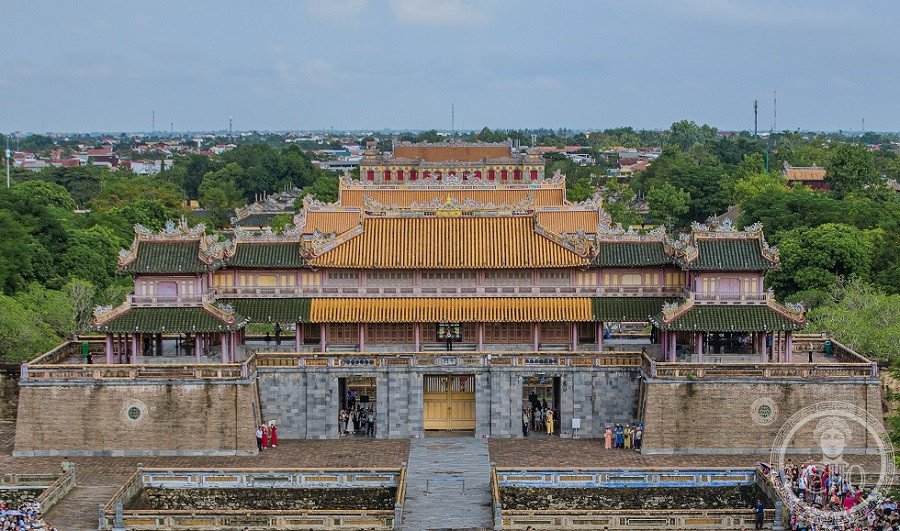
The last imperial capital of Vietnam and the most concentrated ensemble of royal architecture in Southeast Asia. Huế, capital of the Nguyễn dynasty from 1802 to 1945, contains within a few kilometres of river bank the three-layer Imperial City (including the Forbidden Purple City at its centre), seven elaborately landscaped royal mausoleums, Confucian temples, and a court cuisine tradition of such refinement that it has been recognised as a distinct cultural heritage in its own right.
At a glance
The Complex of Huế Monuments (UNESCO WHS 1993; population of Huế city approximately 340,000; located on the Perfume River (Sông Hương; named for the fragrance of flowers drifting downstream from the Ngọc Trản mountain forests in autumn) in Thừa Thiên-Huế Province in central Vietnam) was the imperial capital of the Nguyễn dynasty (the last ruling dynasty of a unified Vietnam; ruled from 1802 to 1945; 13 emperors; the dynasty ended when the last emperor, Bảo Đại, abdicated on 25 August 1945 in favour of Hồ Chí Minh’s Democratic Republic of Vietnam — the most peaceful dynastic abdication in Southeast Asian history). The city was designed by Emperor Gia Long (Nguyễn Phúc Ánh; r. 1802–1820; the founder of the dynasty; the first emperor to unify Vietnam from the northern highlands to the southern delta) and his engineers based on Chinese imperial city models (particularly the Forbidden City in Beijing, which was adapted to Vietnamese geography and aesthetics by orienting the city toward the river and the mountain). The war damage (the Tet Offensive of 1968 (the Battle of Huế; January–March 1968; one of the most intense urban battles of the Vietnam War; the Viet Cong and North Vietnamese Army held Huế for approximately 25 days; the American and South Vietnamese counter-offensive (retaking the city building by building; the most destructive urban battle in Vietnam for heritage; approximately 80% of the city was destroyed or severely damaged; the Imperial City was particularly badly damaged); the ongoing restoration (since 1993 (UNESCO inscription) and especially since 2000; the most ambitious heritage restoration project in Vietnam; many structures have been rebuilt from archival photographs and technical drawings))).
Key facts
- The Imperial City: Vietnam’s Forbidden City. The Imperial City of Huế is built in three layers. The outer one is the Kinh Thành, the Capital City: 10 km of walls, 4 m high and 24 m thick at the base, behind a moat — the most impressive defensive perimeter in Vietnam. The middle is the Hoàng Thành, the Imperial City proper, administrative and ceremonial, 2.5 km around. Its principal entrance is the Ngọ Môn Gate, the most important structure inside and the most photographed in the city, crowned by the Ngũ Phụng Lầu, the Five Phoenix Tower. Here, on 25 August 1945, Bảo Đại abdicated: standing on that pavilion, the last emperor handed his sword and seal to a representative of Hồ Chí Minh’s Provisional Government — the most significant moment in the history of the gate and in the history of Vietnamese monarchy. Beyond it stands the Thai Hoa Palace, Điện Thái Hòa, the “Palace of Supreme Harmony”, the throne room and the most important building of the Imperial City, whose 80 red-lacquered columns, decorated with golden dragons, have long been held the most elaborate lacquerwork ensemble in Vietnam. Outside are the 9 bronze urns, the Cửu Đỉnh, cast between 1835 and 1837 under Emperor Minh Mạng and the most important collection of bronzes in the country: each stands 1.6–2.5 m and weighs 1,300–2,600 kg, decorated with natural, historical and symbolic motifs that together form a complete encyclopaedia of Vietnamese geography, history and culture, and each represents one of the nine emperors of the dynasty. The innermost layer is the Tử Cấm Thành, the Forbidden Purple City, the private quarters of the emperor, his consorts and his concubines. Its chief building is the Can Chanh Palace, the emperor’s working palace, severely damaged in 1947 by French bombing and again in 1968 during the Battle of Huế, and partially reconstructed from historic photographs.
- The Royal Mausoleums: philosophy and landscape made permanent. Each Nguyễn emperor designed his own mausoleum while he lived, and used it as a retreat, a place of meditation and a private garden before it became his grave. There are 7 of them, and what sets them apart from the Ming and Qing imperial tombs of China is that they do not hide in inaccessible mountains: they are woven into the landscape along the Perfume River and reached by boat, and each reflects the character and the taste of the emperor who planned it. The Mausoleum of Minh Mạng, Lăng Minh Mạng, was begun in 1840 and finished in 1843, after his death. It is the most classically beautiful and the most strictly symmetrical, and its sequence — the lake, the bridge, the Honour Courtyard, the Stele Pavilion, the Mausoleum Precinct — is the finest processional arrangement in the complex, set in pine forest: the most aesthetically complete ensemble at Huế. The Mausoleum of Tự Đức, Lăng Tự Đức, was built between 1864 and 1867 while the emperor was alive, and he spent every Thursday there composing poetry, fishing and reading. It is the most romantic and literary of them, with the Lưu Khiêm Lake for boating and the Xung Khiêm pavilion on the water, his favourite place to write. The Mausoleum of Khải Định, Lăng Khải Định, begun 1920 and finished 1931, is the most elaborate and the most divisive: a concrete structure fusing European Baroque with Vietnamese imperial forms, and the most controversial building in the whole complex — a betrayal of Vietnamese architectural tradition to its critics, a creative synthesis to its defenders. Inside, mosaic murals and inlaid work cover every surface of the Thiên Định Palace, the most densely decorated interior in Huế, with the portrait of the emperor in the main chamber among layers of mosaic dragons and phoenixes.
- Huế royal cuisine: the most sophisticated culinary tradition in Vietnam. Huế cuisine — ẩm thực Huế — is the former court cooking of the Nguyễn, the most complex and refined in Vietnam, developed by the royal kitchens over 143 years. Its first characteristic is smallness: the imperial kitchen prepared approximately 50 dishes for a single meal, each served in a small portion for the sake of visual and flavour variety, which is the whole aesthetic of imperial dining. The second is colour — the red of tomato, the green of herbs, the white of rice, the gold of fried onion — used as decoration, because a Huế dish must be beautiful before it is tasted. The third is heat: this is the spiciest regional cuisine in the country, built on the đường red chilli. Bún bò Huế, the beef noodle soup, is the most famous dish of the city: a spicy broth of lemongrass, shrimp paste and chilli, thick round noodles, sliced beef and pork hock, and the garnishes that belong to Huế alone — fresh herbs, banana blossom, lime and chilli. Bánh bèo, the water fern cakes, are the most distinctive small plate: individual dishes of steamed rice cake topped with dried shrimp and spring onion oil, served in sets of 10–16, and named for the resemblance of the cake to the tiny floating leaves of the water fern.
- Heritage: UNESCO World Heritage Site, Complex of Huế Monuments, inscribed 1993.
- GPS: 16.4637° N, 107.5909° E.
History
Before the empire there was Champa: Huế belonged to the Cham kingdom of Amaravati, and the area passed to Vietnamese control during the southward expansion of the Lê dynasty — the Nam Tiến, the “March to the South”, the centuries-long advance at the expense of Champa and later of the Khmer Empire. From 1558 to 1802 the Nguyễn lords governed the southern half of Vietnam as regional rulers under a nominal Lê dynasty, with their capital at Phú Xuân, the site of modern Huế. They fought the Tây Sơn rebellion, 1771–1802, the most violent internal conflict in Vietnamese history before the 20th century: the Tây Sơn briefly unified the country and drove the Nguyễn lord Nguyễn Ánh into exile in Siam and then to the far south. He came back with French support, defeated the Tây Sơn, unified the country — naming it “Việt Nam” for the first time — and took the imperial name Gia Long. The dynasty ran from 1802 to 1945, with 13 emperors. In 1883 France established the Protectorate of Annam and Tonkin, and the Nguyễn emperors became puppet rulers. On 25 August 1945 Bảo Đại abdicated at the Ngọ Môn Gate, ending 143 years of imperial rule. The Vietnam War followed, 1954–1975, with the Tet Offensive of 1968 and the Battle of Huế. UNESCO WHS 1993.
What you see
The Imperial City visit (start at the Ngọ Môn Gate (the Ngũ Phụng Lầu; the view from the top of the gate toward the Flag Tower (Kỳ Đài; the 37-m pole; the most prominent landmark of Huế; built 1807; the Vietnamese flag visible from throughout the city)); the Thai Hoa Palace (the throne room; the Nine Bronze Urns); the Forbidden Purple City ruins and partially reconstructed structures; allow at least 2.5h for the full complex). The river boat to the mausoleums (the traditional approach; dragon boats from the Tòa Khâm wharf; the most atmospheric way to reach the mausoleums (passing the Thien Mu Pagoda on the way; the 7-storey pagoda (Phước Duyên tower; 1844; the most recognised structure on the Perfume River and the emblem of Huế)); the two essential mausoleum visits: Minh Mạng (the most classically beautiful; the pine forest approach; the lake sequence) and Tự Đức (the most atmospheric; the poetic landscape; the boating lake; the most “lived-in” feeling of all the mausoleums)). The Dong Ba Market (the largest traditional market in central Vietnam; the most important place to buy Huế street food — the Bún bò Huế; the bánh khoái (the Huế crispy rice pancake; the smallest and most delicate version of the banh xeo style); the mè xưng (the sesame peanut brittle — the most distinctive Huế sweet)).
Practical information
- Getting there: Phú Bài International Airport (HUI) is 15 km from the centre of Huế, a taxi ride of approximately VND 250,000, USD 10. The city sits on the Reunification Express, Vietnam’s north–south railway, on the main line between Hà Nội and Thành phố Hồ Chí Minh, Saigon. The stretch between Huế, on the Da Nang side, and Đà Nẵng crosses the Hải Vân, the Cloud Pass, on a coastal cliff route that is one of the most scenic train journeys in Asia. The pass stands approximately 500 m above the sea and was once the border between the Cham kingdom to the south and the Vietnamese kingdom to the north; from December to March it is often buried in cloud, which is where the name comes from — Hải Vân, the Cloud Sea Pass. From Hà Nội the Reunification Express takes 13–14h overnight, which is the practical way to come, since you sleep on the train and arrive fresh. From Đà Nẵng it is 2h by express, the usual direction for a day trip from the major Danang resort hotels.
- Timing the visit: the rainy season and the Tết festival. The best months run from March to July, in the dry season; July and August are the hottest, 35–38°C, but manageable, and February to April is ideal — 20–28°C, dry, and the start of the spring festival season. The rains come from September to December. Huế receives approximately 3,000 mm a year, which makes it the rainiest city in Vietnam, and the worst of it falls in October and November, with tropical storms and flooding from the Perfume River: the Imperial City floods and the mausoleums can become unreachable. Tết, the Vietnamese Lunar New Year and the most important festival in the country, falls in January or February, and Huế is the best place to see it. The firecracker tradition is strongest here, the royal Tết ceremonies are re-enacted inside the Imperial City, the flower market, Chợ Hoa Tết, runs along the Perfume River, and on every table is bánh chưng, the square sticky rice cake wrapped in banana leaf — the most sacred Tết food in all of Vietnam, and in its most refined version here.
- Hội An and the Marble Mountains: the best day trip from Huế. Đà Nẵng and Hội An (by car from Huế: the Hải Vân Pass (30 min; the coastal road over the cloud pass; the most dramatic coastal road in Vietnam) to Đà Nẵng (65 km; 1h 30min); Hội An (30 km south of Đà Nẵng; 40 min); the combination (Huế Imperial City + Hải Vân Pass + Hội An Ancient Town = the most culturally dense day in Vietnam and arguably in Southeast Asia)). Hội An Ancient Town (UNESCO WHS 1999; the best-preserved trading port town in Southeast Asia; the 15th–19th century; the Japanese Covered Bridge (Chùa Cầu; 1593; the most photographed structure in Hội An; built by the Japanese merchant community to connect their quarter with the Chinese quarter; the shrine inside the bridge (dedicated to the deity believed to control earthquakes))). The Marble Mountains (Ngũ Hành Sơn; 10 km south of Đà Nẵng; five marble and limestone hills containing Buddhist sanctuaries, caves, and pagodas; the most important Buddhist site near Đà Nẵng; the Am Phu cave (the cave representing the Buddhist hell — the most dramatically decorated cave in the complex)).
Getting there
Phú Bài Airport (HUI; 15 km). Reunification Express train from Hà Nội (13h overnight) or Đà Nẵng (2h). GPS: 16.4637, 107.5909.
Nearby
- Hội An Ancient Town (UNESCO WHS 1999). 110 km south of Huế (2h by car via the Hải Vân Pass). The most completely preserved Southeast Asian trading port. Hội An is the ancient port, the trading post used by Japanese, Chinese, Portuguese, Dutch and later French merchants from the 15th to the 19th century. The most unusual aspect of Hội An’s architecture is that the trading families built houses that were shop, warehouse and home at once, with a narrow facade on the street opening into a long interior courtyard. Most of the old town is Chinese-Vietnamese in style, since the Chinese merchant community was the most important of the late 18th and 19th centuries, while the Japanese bridge, described above, stands for the earlier Japanese period. The town is also the tailoring capital of Vietnam: approximately 500 tailors work in the old quarter, a historically high concentration for a place of approximately 120,000 people. The famous 24-hour suit is the service most marketed to visitors — a suit or a dress made to measure overnight — and the quality varies widely.
- Phong Nha-Kẻ Bàng National Park (UNESCO WHS 2003). 200 km north of Huế (3h by car). The most spectacular cave system in the world. Phong Nha-Kẻ Bàng is the national park of Quảng Bình Province and the most important limestone karst landscape in Asia. Sơn Đoòng, found in 1991 and fully explored in 2009, is the largest cave in the world by cross-sectional area: approximately 150 m wide, 200 m high and 9 km long, with its own ecosystem of jungle vegetation and underground rivers, so vast that clouds form inside it and the single passage could hold a 40-storey skyscraper. Access is extremely limited — approximately 1,000 visitors a year, on a 6-day tour costing approximately USD 3,000, one of the most exclusive nature experiences anywhere. The Phong Nha caves themselves are the accessible ones: a boat tour into the illuminated cavern, the most popular activity in the park, reachable as a day trip from Huế at approximately 3h each way.
- Mỹ Sơn Sanctuary (UNESCO WHS 1999). 130 km south of Huế (2h 30min by car). The most important Hindu temple complex in Southeast Asia outside Cambodia. Mỹ Sơn, the “Beautiful Mountain”, was the principal religious centre of the Cham civilisation — a Southeast Asian people who built a Hindu-Buddhist kingdom on the central coast of Vietnam from approximately the 2nd century CE to the 17th, and whose kingdom was gradually absorbed by the Vietnamese “March to the South”. The temples were built between the 4th and the 13th century CE, and approximately 70 survive in varying states; the most complete is Group B/C, with its decorated red-brick towers set in a circle. The war reached it: Mỹ Sơn served as a Viet Cong base, and the American B-52 bombings of 1969 destroyed several of the finest towers — the most significant war damage done to any heritage site in Southeast Asia. The Cham Museum in Đà Nẵng holds the finest collection of Cham sculpture in the world and is essential preparation for the visit.
Sources
- Wikipedia, Imperial City, Huế. Nguyễn dynasty. Battle of Huế, accessed June 2026.
- UNESCO, Complex of Huế Monuments, WHS reference 678, inscribed 1993.
- Philippe Papin, Histoire de Hanoi, Fayard, 2001 (the most scholarly French-language history of northern Vietnam with essential Nguyễn-era context).
Find it on the map
See this place and what’s around it →📷 Become a Cultural Heritage Online photographer
Share your photos of places: they stay published under your name as the author. The more they're seen, the more you get noticed — and soon a contest will reward the most appreciated photos.
Log in or sign up free to add a photo