

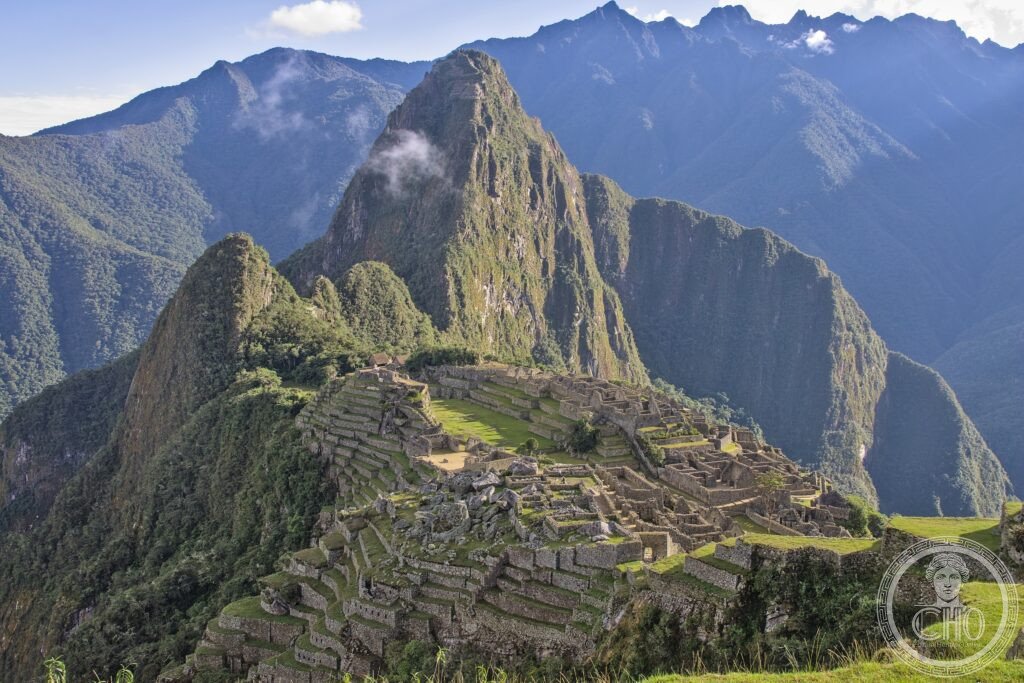
The most visited and most photographed pre-Columbian site in the Americas and one of the most recognisable human constructions on Earth. Machu Picchu, the 15th-century Inca citadel perched at 2,430 metres in the cloud forest above the Urubamba River canyon in Peru, combines some of the most sophisticated dry-stone masonry in history with a dramatic landscape setting that no photograph, however familiar, fully prepares the visitor for on arrival.
At a glance
The Historic Sanctuary of Machu Picchu, UNESCO WHS 1983, is a mixed site, cultural and natural together — one of only 39 such combined inscriptions in the world — covering approximately 32,592 ha. The nearest town, Aguas Calientes or Machu Picchu Pueblo, holds approximately 5,000–8,000 people, and the site lies 75 km north-west of Cusco as the crow flies, 1h 30min by train. It was built approximately 1450 CE at the height of the Inca Empire, Tawantinsuyu, “the four quarters of the world”, the largest empire of pre-Columbian America: at its maximum, about 1527, it reached from southern Colombia to central Chile, approximately 4,000 km north to south, the longest continuous terrestrial empire in the history of the Americas. Its builder was Pachacuti, who turned the Inca state from a regional chieftaincy into a continental empire in approximately 35 years, 1438–1471 — the most rapid imperial expansion in pre-Columbian history. The site appears to have been a royal estate (llaqta) and religious retreat for Pachacuti and his royal lineage (panaca). It was likely inhabited by approximately 300–1,000 people during the Inca period (not a large city, as popularly imagined, but an elite residential and ceremonial complex). The site was abandoned during the Spanish conquest period (c.1572; the Spanish never discovered or destroyed Machu Picchu — the site was simply gradually forgotten by the local population (the Inca Trail leading to it fell out of regular use); the site was rediscovered for the outside world by the Yale historian Hiram Bingham III on 24 July 1911 (the date of his guided tour of the site by the local farmer Melchor Arteaga — Bingham was not the first outsider to know of the site, but his photographs and publications in National Geographic (1913) made Machu Picchu famous worldwide)).
Key facts
- Inca masonry: the most sophisticated dry-stone architecture in the pre-Columbian Americas. The Inca built without mortar, fitting the stones so precisely that in the finest walls a knife blade will not pass between them — which is why Machu Picchu has stood through 575 years of Andean earthquakes without significant structural failure. The stone was quarried on the spot or close by, and the principal quarry is still visible above the urban sector; it was worked with bronze and stone tools, shaped by grinding and pecking rather than cut with sharp instruments. The walls lean slightly inward, typically 2–5% from vertical, which lowers the centre of gravity and improves their resistance to shaking. The doors and niches are trapezoidal, narrower at the top than at the bottom: the most visually distinctive element of Inca architecture and the most structurally efficient shape against earthquakes. At the highest point of the urban sector stands the Intihuatana, Quechua for “hitching post of the sun”, a carved stone pillar that served as a solar observatory for tracking the solstices and the equinoxes. At solar noon on the equinox its shadow falls exactly on the north-south axis, and at the summer solstice — December in the southern hemisphere — it points straight at Salcantay, the most sacred Apus, mountain deity, of this region. It is the only Intihuatana in the whole Inca Empire the Spanish did not deliberately destroy: they systematically destroyed Intihuatanas wherever they found them as instruments of “idolatry”, and Machu Picchu’s survived only because they never found the site.
- The Inca Trail: the most famous trek in South America. The Camino Inca is the most famous multi-day trek in South America and one of the most famous anywhere: a 43-km stretch of the Inca road network, the Qhapaq Ñan, UNESCO WHS 2014, whose 30,000 km made the longest road system in pre-Columbian America. It runs from Ollantaytambo, 2,792 m, to the Sun Gate, Inti Punku, 2,730 m, above Machu Picchu, and its high point is the Dead Woman’s Pass, Warmiwañusqa, at 4,215 m — the hardest section, approximately 4h of climbing on the second day. The classic route takes 4 days and 3 nights, entering the sanctuary through the Sun Gate on the morning of day 4: the most dramatic arrival at Machu Picchu, with the citadel first seen from above at dawn. Permits are capped at 500 a day including guides and porters, which means approximately 200 trekkers, and must be booked 3–6 months ahead for the June–August season; the trail closes in February for maintenance. Porter loads are strictly limited to 20 kg, or 25 kg including a porter’s own gear — the most progressive porter protection in the South American trekking industry. There are alternatives. The Salkantay Trek takes 5 days and crosses the 4,630-m Salkantay Pass beneath the snowfield, through one of the finest mountain landscapes in the Andes: less famous than the Inca Trail and generally reckoned more dramatic. The Lares Trek takes 3–4 days through Quechua-speaking mountain communities and is the most culturally immersive way in.
- The controversy: carrying capacity and the repatriation dispute. Machu Picchu received approximately 1.5 million visitors in 2019, before the pandemic. Its carrying capacity has been estimated at 2,500 people a day, and before caps were introduced it routinely took 5,000–6,000 at peak times. The present regime uses timed entry with three slots a day and a maximum of 4,044 visitors, the cap set in 2021. The other long dispute concerns the objects. Hiram Bingham III removed approximately 47,000 artefacts — mostly ceramics, human remains and bronzeware — on behalf of Yale University between 1911 and 1915, placed there on “loan”. Peru sought their return from 1918 onward, and after 93 years of negotiation Yale and Peru agreed in 2011 to give them all back. The last shipment arrived in 2012, and the collection is now in the Museo Machu Picchu, in the Casa Concha in Cusco.
- Heritage: UNESCO World Heritage Site (Cultural + Natural), Historic Sanctuary of Machu Picchu, inscribed 1983. One of the New Seven Wonders of the World, 2007.
- GPS: 13.1631° S, 72.5450° W.
History
The Inca Empire, Tawantinsuyu, was founded approximately 1400 CE — by Manco Cápac in legend, by Pachacuti in fact, as an imperial state. At its greatest extent, about 1527, it ran from southern Colombia to northern Chile and Argentina: approximately 4,000 km north to south and 900,000 km² of territory, with a population of approximately 10–12 million. It was held together by the mit’a, the labour tax: every household owed the state a set number of days of work each year, used for construction, military service and farming on state land — the most efficient pre-industrial labour-mobilisation system in the Americas. Pachacuti, the 9th Sapa Inca, reigned about 1438–1471 and in approximately 35 years turned a regional chieftaincy around Cusco into an empire the length of South America. Machu Picchu was built early in that reign, approximately 1450 CE, as his private royal estate. It was abandoned about 1572, after the Spanish conquest of 1533 and the execution of the last Inca emperor, Túpac Amaru I: the last inhabitants left approximately 40 years after the conquest, and the Spanish never destroyed the place because they never found it. Hiram Bingham III, the Yale professor, brought it to the outside world on 24 July 1911, and his photographs and publications made the modern Machu Picchu. It became one of the New Seven Wonders of the World in 2007. UNESCO WHS 1983.
What you see
The site divides into two sectors. The agricultural one is all terraces, the most extensive and best preserved in the Inca world, built both to grow crops and to hold the slope. Its engineering is remarkable: 16 fountains, each linked to the next by stone channels, make the finest water management of any Inca site, and the drainage is invisible and extraordinary — the ridge receives heavy rainfall, and the channels still prevent erosion and structural damage after 575 years. The urban sector is the architecturally important half. The Temple of the Sun is the only circular structure here and carries the finest masonry, with a trapezoidal window aligned so precisely that the first rays of the winter solstice sunrise pass through it onto a particular stone in the floor. Above lies the Sacred Plaza, the highest ceremonial space, with the Principal Temple of three walls — the fourth is missing — whose joints are absolutely invisible, the best stonework on the site. Beside it stands the Temple of the Three Windows, three large trapezoidal openings over the urban sector that frame the view which has appeared on every guidebook cover. And at the top, the Intihuatana, the solar observatory pillar described in Key Facts.
Practical information
- Getting there: the only access points are Cusco (the nearest city; 75 km south-east as the crow flies; 3h by train) and Aguas Calientes / Machu Picchu Pueblo (the town at the base of Machu Picchu; no road access to Aguas Calientes — only by train). The train from Cusco (Belmond Hiram Bingham (the most luxurious option; observation carriage; white-glove service; approximately USD 500 round trip; the most indulgent single train journey in South America) or PeruRail Vistadome / Expedition (USD 80–140 round trip; the practical option)). The route from Cusco (the train leaves from Poroy station (15 min from central Cusco by taxi) or from Ollantaytambo station (2h by car from Cusco through the Sacred Valley; the better option for seeing the Sacred Valley sites on the way)). The bus from Aguas Calientes (the 30-min zigzag road from Aguas Calientes to the site entrance; the line for the bus can be long in peak season; the walk up (approximately 1h 30min; very steep; the most physically demanding option but free); the permit (timed entry tickets must be purchased in advance (machu-picchu.gob.pe); slots sell out weeks in advance in July–August; three time slots: 6:00–12:00; 7:00–13:00; 12:00–17:30)).
- Cusco (the essential complement): the Inca capital and the colonial gem of the Andes. Cusco — Qosqo, Quechua for “navel of the world” — was the capital of the Inca Empire and is the cultural capital of Peru, at approximately 3,400 m. The altitude is the hardest adjustment for anyone arriving from sea level, and 1–2 days here before going up to Machu Picchu allow the body to acclimatise: climbing straight from the coast without that pause brings on altitude sickness in a significant share of visitors. Its Plaza de Armas is the most beautiful main square in South America. The Cathedral of 1654 stands on the foundations of the palace of the Inca Viracocha, is the most important church in colonial Peru, and holds the finest collection of Cusco School baroque painting in any single building in the country. The Qorikancha was the Temple of the Sun, the most sacred building of the empire, its walls once sheathed in gold plates: the Spanish raised the church of Santo Domingo directly on its foundations and walls, the most dramatic illustration in the Americas of a colonial church written over an indigenous sanctuary. The earthquake of 1950 damaged Santo Domingo and in doing so exposed the Inca walls beneath, which were then restored.
- The Sacred Valley: the Inca landscape between Cusco and Machu Picchu. The Sacred Valley of the Urubamba runs between Cusco and Ollantaytambo and was the most important agricultural and settlement zone of the empire. The Inca chose it for its microclimate: the valley floor, at approximately 2,800 m, is warm enough for maize, the prestige crop of the elite, while the mountains above, at 4,000+ m, carry the potato and quinoa fields. Pisac is the market town, with the finest Inca hillside fortress in the valley and a Sunday market that is the most colourful indigenous market in the region. Ollantaytambo is the best-preserved Inca town and the only one where people still live in original Inca houses — the kancha, the Inca urban module, rectangular enclosures of dwellings around a central courtyard. Moray is the enigma: concentric circular terraces descending 30 m into the ground, an agricultural laboratory that probably simulated different microclimates for experiment, and the most mysterious Inca structure in the valley.
Getting there
Train from Cusco (Poroy or Ollantaytambo) to Aguas Calientes (1h30–3h), then 30min bus up to the site. Timed entry tickets must be booked well in advance. GPS: -13.1631, -72.5450.
Nearby
- Chan Chan Archaeological Zone (UNESCO WHS 1986). 900 km north of Cusco (near Trujillo, northern Peru; fly from Cusco). The largest pre-Columbian city in South America and the capital of the Chimú Kingdom. Chan Chan (the capital of the Chimú Kingdom (c.900–1470 CE; the largest pre-Inca state in the Andes); the adobe city (the largest pre-Columbian earthen architecture complex in the Americas; approximately 20 km²; 10 royal compounds (ciudadelas)); the construction material (sun-dried adobe bricks; the most vulnerable building material in the world (rain destroys adobe brick directly); Chan Chan is in the Atacama coastal desert where rainfall is effectively zero, which allowed the adobe construction to survive; climate change (increased El Niño rainfall events are damaging the site; UNESCO placed Chan Chan on the Danger List in 1986 — the site has been on the Danger List since the very year of its inscription))).
- Nazca Lines (UNESCO WHS 1994). 450 km south-east of Lima (flight or bus from Lima; the most convenient approach). The most mysterious pre-Columbian earthworks in the Americas. The Nazca Lines (geoglyphs; large figures (a hummingbird, a spider, a monkey, a condor, a human figure, triangles, spirals, and straight lines extending for kilometres) scraped into the pampas desert surface by removing the dark reddish-brown surface stones to expose the lighter yellow ground beneath; created by the Nazca culture (c.100 BCE–800 CE); the function (the most debated question in South American archaeology; the mainstream interpretation: a ceremonial landscape related to water rituals and ancestor worship; the most popular alternative (Erich von Däniken’s “alien landing strip” hypothesis (1968) — rejected by all archaeologists; the most famous pseudo-archaeological claim in modern history))). The viewing (the lines are visible only from the air; the 30-min overflights from Ica or Nazca airports; the most turbulent air due to desert thermals — motion sickness medication is strongly recommended).
- Lake Titicaca. 400 km south-east of Cusco (by train or bus; 7–9h; the Andean Explorer train (PeruRail; Cusco–Puno; the most scenic train journey in Peru)). The highest navigable lake in the world and the mythological birthplace of the Inca civilisation. Lake Titicaca (altitude 3,812 m; 8,372 km² (the largest lake in South America by surface area and volume); the Uros Floating Islands (the floating reed islands (totora reed) constructed and inhabited by the Uros people; the most unusual inhabited landscape in the Americas; the islands are built from layers of cut totora reed (the surface layer is replaced every few months as it decomposes; the islands themselves are anchored to the lakebed by ropes tied to poles); the island communities (approximately 80 islands; approximately 2,000 inhabitants; the tourist traffic (the floating islands are one of the most visited sites in Peru; the commercialisation of the visit has been criticised by anthropologists as replacing traditional culture with a tourist performance)))).
Sources
- Wikipedia, Machu Picchu. Inca Empire. Pachacuti. Inca Trail, accessed June 2026.
- UNESCO, Historic Sanctuary of Machu Picchu, WHS reference 274, inscribed 1983.
- John Rowe, “Absolute Chronology in the Andean Area”, American Antiquity 10(3), 1945 (the foundational chronological study of Inca history).
Find it on the map
See this place and what’s around it →📷 Become a Cultural Heritage Online photographer
Share your photos of places: they stay published under your name as the author. The more they're seen, the more you get noticed — and soon a contest will reward the most appreciated photos.
Log in or sign up free to add a photo