
Historic District of Old Québec
The only walled city in North America north of Mexico and the most completely preserved French colonial settlement on the continent — Québec City, founded by Samuel de Champlain in 1608 on a cliff above the St. Lawrence River, retains its system of stone fortifications, its Upper and Lower Town divided by the cliff, its French-speaking Francophone identity, and the most dramatically situated hotel in North America in the silhouette of the Château Frontenac.
At a glance
The Historic District of Old Québec (UNESCO WHS 1985; population of Québec City approximately 800,000 (the metropolitan area); the capital city of the Province of Québec; one of the oldest cities in North America north of Mexico) was founded by the French explorer Samuel de Champlain on 3 July 1608 (founding date; the most precisely documented foundation date of any major city in Canada) on the Cap Diamant (Cape Diamond) — a cliff rising approximately 98 m above the St. Lawrence River at the narrowest navigable point on the river; the name “Québec” derives from the Algonquin word for “where the river narrows” (Kebec); the city was the capital of New France (the French colonial territory in North America; at its maximum extent (1712) New France stretched from Hudson Bay to the Gulf of Mexico, encompassing approximately 7.2 million km² — the largest colonial territory in the Americas; the French population of New France never exceeded approximately 70,000–80,000; the British North American colonies had a population of approximately 1.5 million — a demographic disparity that made the French position strategically untenable in the long run); the city is the most completely French-speaking major city in the Americas (approximately 95% French as first language in the city; approximately 80% in the metropolitan area); it is the only city in continental North America (other than New Orleans) with a significant French-colonial built environment still intact.
Key facts
- The city walls: the only surviving fortified colonial city in North America — the walls of Québec City (the most completely surviving city wall system in the Americas north of Mexico; total length approximately 4.6 km; the walls were built, extended, and modified over nearly 200 years (the French colonial walls (1690s–1745); the British colonial walls (1760s–1830s; Major General Gother Mann; the most significant engineering achievement in British North American military history; the current walls are primarily British in their present form)); the gates (4 surviving historic gates: Porte Saint-Louis (the most dramatic and the most photographed; the neo-Gothic stone gatehouse designed by Charles Baillairgé in 1878 — the gate is a Victorian reconstruction, not an original colonial structure; the original gate was demolished in 1871 to improve traffic flow; the reconstruction came after public protest); Porte Saint-Jean; Porte Kent; Porte Prescott); the walls are accessible to walkers on a promenade along the top (the most panoramic walk in the city; views of the St. Lawrence to the east and the Grande Allée (the boulevard outside the walls) to the west)
- The Plains of Abraham: the most consequential battlefield in North American history — the Battle of the Plains of Abraham (13 September 1759; the decisive battle of the Seven Years’ War in North America (the French and Indian War in American history; the conflict between France and Britain for control of North America; the most important war in the history of the continent until the American Revolution); the battle (the British forces under General James Wolfe (1727–1759) scaled the cliff of Cap Diamant before dawn (via the Anse au Foulon — a cove west of the city with a path up the cliff that the French had left inadequately guarded; the most consequential security lapse in the history of North America) and drew up on the flat plain above the city; the French commander the Marquis de Montcalm (1712–1759) chose to engage in open battle rather than wait for reinforcements; the British platoon fire (the most disciplined volley fire of the Seven Years’ War; the French columns broke after two volleys; the battle lasted approximately 15–20 minutes; Wolfe was shot three times and died during the battle (the death of Wolfe was immortalised in Benjamin West’s painting “The Death of General Wolfe” (1770) — the most famous historical painting in Canadian history and one of the most influential paintings of the 18th century)); Montcalm was mortally wounded and died the following morning; Québec surrendered on 18 September 1759; the fall of Québec effectively decided the fate of all New France); the Plains of Abraham today (Battlefield Park; the most important historical park in Canada; 108 ha; the finest urban park in the city; free entry; the museum (Musée des Plaines d’Abraham) inside the historic Martello towers (the British-built circular defensive towers that replaced the French field fortifications after 1759))
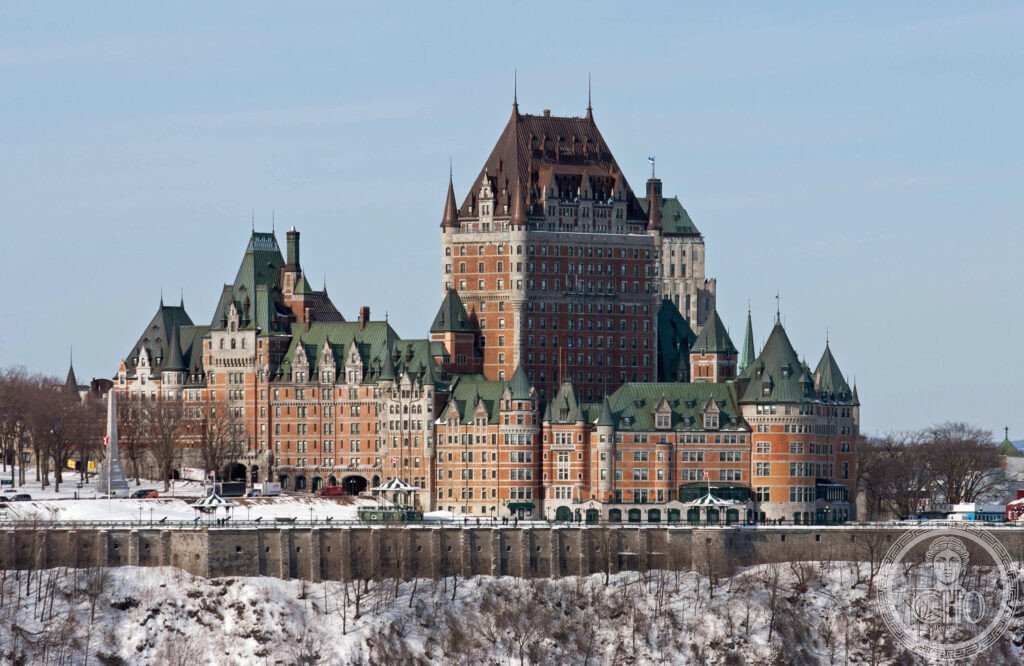
- The Château Frontenac: the world’s most photographed hotel — the Château Frontenac (officially Fairmont Le Château Frontenac; the description in the figcaption covers the architectural history; the wartime use (the Château Frontenac hosted the Quebec Conferences of 1943 and 1944 — the most important Allied wartime planning conferences outside Washington: the 1943 conference agreed the D-Day invasion plan (Operation Overlord); the 1944 conference refined the strategic bombing campaign and discussed the post-war treatment of Germany; participants: Winston Churchill, Franklin D. Roosevelt, William Lyon Mackenzie King (Canadian PM); the conference rooms are still in the hotel); the view (the view from the terrace in front of the hotel — the Dufferin Terrace — is the finest urban viewpoint in Canada; the curved wooden boardwalk (300 m long; named for Governor General Frederick Temple Hamilton-Temple-Blackwood, 1st Marquess of Dufferin and Ava; the toboggan run (Carnaval de Québec; winter; the ice slide that runs from the Terrace to the Rue du Petit-Champlain in Lower Town; the oldest toboggan run in Canada (built by the British garrison in the 18th century for amusement))))
- Heritage: UNESCO World Heritage Site, Historic District of Old Québec, inscribed 1985
- GPS: 46.8139° N, 71.2082° W
History
The founding (3 July 1608; Samuel de Champlain; the permanent settlement of New France; the choice of the Cap Diamant site (the narrowest navigable point on the St. Lawrence; the strategic key to the interior of North America)); New France (1608–1763; the French colonial period; the fur trade (the most economically important industry in New France; the beaver pelt trade with France (the beaver was used for felt hats — the most fashionable headwear in 17th-century Europe; “the beaver felt hat made Canada” — the demand for felt hats in Europe drove the entire economy of New France for 150 years); the Jesuit missionaries (the most important intellectual contributors to early Canadian history; the Jesuit Relations (annual reports sent to Paris by the Jesuit missionaries; the most important primary source for the history of the First Nations of eastern Canada in the 17th century)); the British conquest (1759; Battle of the Plains of Abraham; Treaty of Paris 1763 (France ceded all of New France to Britain)); the British colonial period (1763–1867; the British colonial administration; the Quebec Act (1774; guaranteed the rights of French Canadians to practice Catholicism and maintain French civil law — the most important piece of legislation in the history of Québec; the concession to French-Canadian culture that ensured Québec would remain French-speaking under British rule)); Confederation (1867; Canada became a self-governing Dominion); the francophone independence movement (the Quiet Revolution (La Révolution tranquille; 1960s; the most important social and cultural transformation in Québec history; the shift from a conservative, Catholic, rural Québec to a modern, secular, urban society)); UNESCO WHS 1985.
What you see
The two-level city (Upper Town (Haute-Ville) and Lower Town (Basse-Ville) divided by the cliff): Upper Town (the Château Frontenac (the skyline; the terrace (Dufferin Terrace; the finest urban viewpoint in Canada)); the Citadel (the star-shaped fortress; still an active Canadian military base; the Changing of the Guard (summer; the most ceremonial military tradition in Canada after the Changing of the Guard in Ottawa)); the Cathedral-Basilica of Notre-Dame de Québec (1647; the oldest Catholic church in North America north of the Rio Grande); the Plains of Abraham (Battlefield Park)); Lower Town (Basse-Ville; accessed by the funicular (the oldest funicular in North America; connecting the Dufferin Terrace with the Rue du Petit-Champlain) or by the Breakneck Stairs (Escalier Casse-Cou; the oldest staircase in North America; 59 steps; named because of the risk of slipping on the icy stairs in winter)); the Place Royale (the cradle of French civilisation in North America; the bronze bust of Louis XIV; the Notre-Dame-des-Victoires church (1688; the oldest stone church in Canada)); the Rue du Petit-Champlain (the most photographed street in Québec City; steep cobblestone; lined with artisan shops and cafés; the most Instagram-worthy street in Canada).
Practical information
- Getting there: Jean Lesage International Airport (YQB; 18 km from the Old City; taxi approximately CAD 40; no direct rail service to the airport); the city is best reached by air (Air Canada, Air Transat, WestJet) or by VIA Rail train from Montréal (3h; approximately CAD 50–80; Gare du Palais station (the CPR station designed by Bruce Price (the same architect as the Château Frontenac); one of the finest Châteauesque railway stations in Canada; 5 min walk from Place Royale in Lower Town)); the drive from Montréal (260 km; approximately 2h 30min; the most common approach for self-driving visitors; the route follows the St. Lawrence River for most of the journey)
- The seasonal experience: four dramatically different cities in one year — the four seasons in Québec City (summer (June–August; the most comfortable weather (15–25°C); the most tourists; the Québec City Summer Festival (the largest outdoor music festival in Canada; July; free outdoor concerts on the Plains of Abraham and multiple stages in Old City; the most important summer cultural event in the city); the terrasse season (the outdoor terraces of the Old City are the most animated from late June to early September); autumn (September–October; the maple season; the most spectacular foliage in Canada; the drive along the Côte de Beaupré (east of the city; the road to Sainte-Anne-de-Beaupré basilica) with the maple forests in full October colour is one of the most beautiful drives in North America); winter (December–February; the most distinctive season in Québec City; the Carnaval de Québec (the most important winter festival in the world outside the Rio Carnival; February; the Ice Palace (Palais de Glace; a castle built entirely from ice and snow every year at the Plains of Abraham; the canoe race across the semi-frozen St. Lawrence (the most extreme winter sport in an urban festival worldwide)); the ice slides; the dog-sled tours in the Plains); the spring (March–May; the maple syrup season (sugaring off; the most distinctively Canadian seasonal ritual; the sugar shack (cabane à sucre) experience — a half-day excursion from the city to a traditional sugar shack where maple sap is boiled into syrup in the classic Quebec farmhouse setting))
- French immersion: the only place in North America to be completely immersed in French culture — the French-speaking city (approximately 95% French as first language; the only major city in North America where French is overwhelmingly the language of daily life; the accent (Québécois French is phonologically distinct from European French — the most distinctively North American variant of French; European French speakers can understand Québécois with concentration but may find the accent strong); the cuisine (the most distinctive traditional cuisine in Canada: poutine (French fries, gravy, and cheese curds; the most iconic Québec food; the cheese curds must squeak when fresh; the best poutine in Québec City is served at Chez Ashton (a local chain; the most popular poutine restaurant in the city)); tourtière (the pork and potato meat pie of Québec; traditionally eaten on Christmas Eve after midnight Mass; the most important dish in the Québécois culinary tradition); cretons (a coarse pâté of ground pork cooked with onions and spices; the most distinctive Québec breakfast food)))
Getting there
Jean Lesage Airport (YQB; 18 km). VIA Rail from Montréal (3h). GPS: 46.8139, -71.2082.
Nearby
- Montréal — 260 km south-west of Québec City (2h 30min by car; 3h by VIA Rail train); Canada’s largest French-speaking city and its greatest cosmopolitan metropolis — Montréal (the most European of North American cities; the city that is in North America but is not of North America — the blend of French and English, the café culture, the underground city (the RÉSO — the largest underground pedestrian network in the world (32 km; 80 complexes connected by underground passages; the most practical city infrastructure in a cold-weather city in the world)), the jazz festival (the Festival International de Jazz de Montréal; the largest jazz festival in the world (500+ concerts; 2+ million visitors annually)); Old Montréal (Vieux-Montréal; the historic district; the Notre-Dame Basilica (1829; James O’Donnell; the finest Gothic Revival interior in Canada; the Chapelle Notre-Dame-du-Sacré-Cœur; Leonard Cohen got married here (false: Cohen was not married in Notre-Dame; but he celebrated his Judaism in the synagogue of his grandfather and was deeply connected to the Westmount neighbourhood; the Notre-Dame association is apocryphal)))
- Montmorency Falls — 10 km north-east of Québec City (15 min by car or 30 min by the Réseau Express Métropolitain (REM) light rail when operational); Canada’s highest waterfall outside the western mountains — the Montmorency Falls (Chutes-de-la-Montmorency; 83 m high — 30 m higher than Niagara Falls (though much narrower than Niagara); the sugarloaf (pain de sucre — the cone of ice that builds up at the base of the falls in winter from the freezing mist; a natural phenomenon visible from December through March; the most unusual winter spectacle in the Québec City area); the suspension bridge across the top of the falls (the most dramatic bridge in the Québec region; free access from the park below)); the manor (Manoir Montmorency; the historic house at the top of the falls; now a restaurant; the most dramatic restaurant setting in the region; open year-round)
- Parc national des Grands-Jardins — 100 km north of Québec City (1h 30min by car); the most accessible boreal wilderness from the city — the Grands-Jardins (the national park on the edge of the Canadian Shield (the vast Precambrian rock formation that underlies most of central and eastern Canada; the oldest exposed rock on Earth in some areas)); the caribou (Rangifer tarandus caribou; the woodland caribou; the most visible large mammal in the park; the park is one of the southernmost habitats of woodland caribou in eastern Canada); the hiking (the most spectacular hike: the summit of Mont du Lac-des-Cygnes (979 m; 3h each way; the panoramic view of the Charlevoix landscape (the impact crater; the Charlevoix region is located within the Charlevoix crater — a meteorite impact structure approximately 54 km in diameter and approximately 350 million years old; the most obvious geological feature of the Charlevoix landscape is the circular arrangement of the hills and the Île aux Coudres in the centre of the bay)))
Sources
- Wikipedia, Old Quebec; Château Frontenac; Battle of the Plains of Abraham, accessed June 2026
- UNESCO, Historic District of Old Québec, WHS reference 300, inscribed 1985
- Peter Kalm, Travels in North America (the Swedish botanist’s account of his visit to Québec in 1749 remains the finest description of the city in the French colonial period), 1753
Find it on the map
See this place and what’s around it →📷 Diventa un fotografo di Cultural Heritage Online
Condividi le tue foto dei luoghi: restano pubblicate con la tua firma come autore. Più vengono viste, più ti fai conoscere — e presto un concorso premierà le foto più apprezzate.
Accedi o registrati gratis per aggiungere una foto