
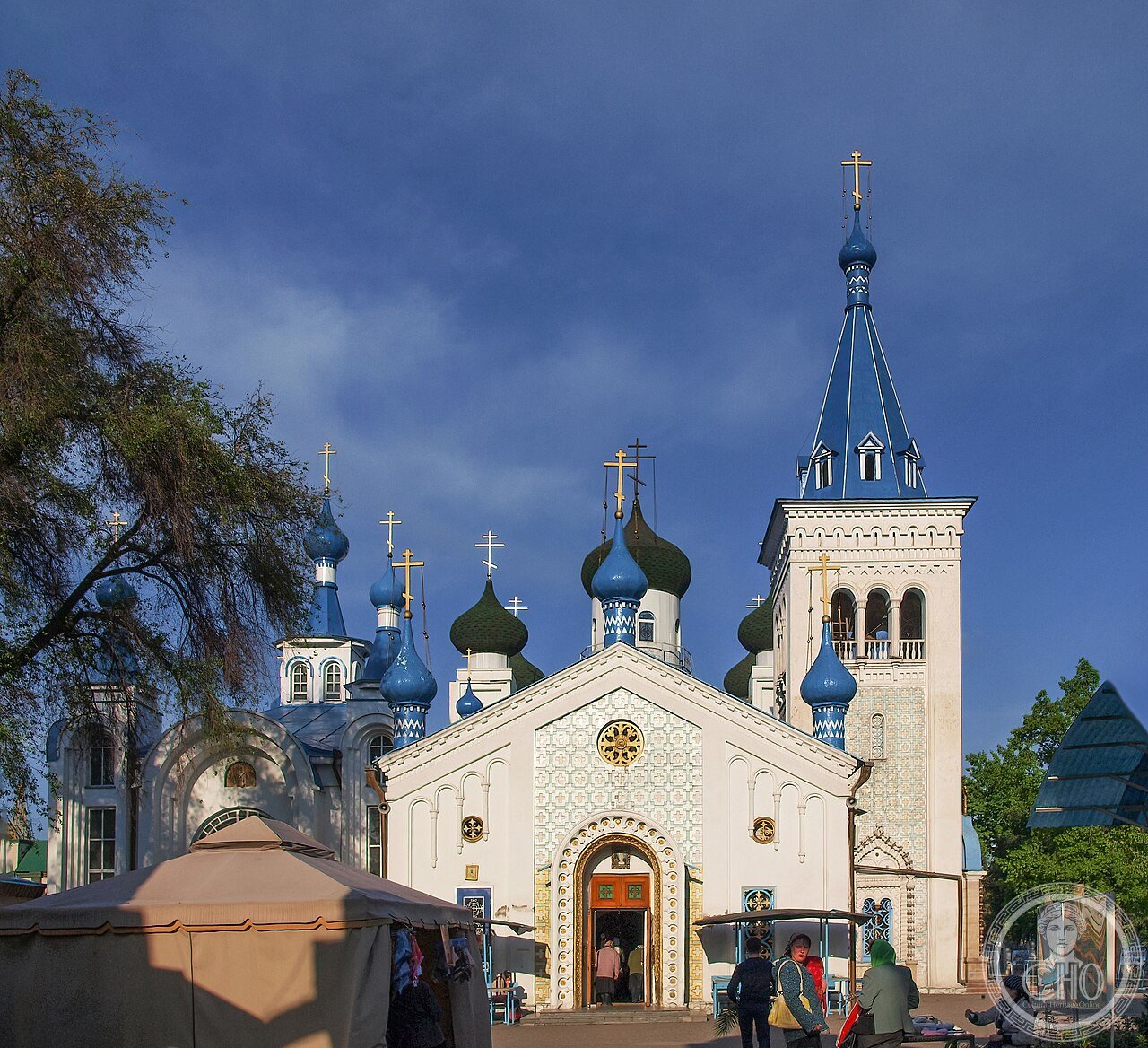
In Bishkek, Kyrgyzstan, then Frunze in the USSR, the question of building an Orthodox church in the capital was raised in 1943. In 1944 the local Orthodox community was assigned an unfinished building, according to the Russian sources consulted the so-called «Kirpromsovet», an administrative building tied to the brick industry, to be turned into a place of worship. The cathedral therefore did not begin as a church, but as the conversion of a Soviet civic structure left half-built. The conversion work, led by the master builder V. V. Veryuzhsky, ran from 1944 to 1947, with the services held in the open air at first. The consecration took place on 1 January 1947 at the hands of Bishop Guriy (Egorov) of Tashkent and Central Asia, after a preliminary blessing attributed in 1944 to Bishop Cyril (Pospelov). Unlike other Orthodox churches of Central Asia of the same period, often built of wood to withstand earthquakes, this cathedral is not a timber building: its walls are clad in ceramic tiles, with a fluted barrel-vault roof and six small blue onion domes on narrow drums, and a tent bell tower 29.5 metres tall. Inside, a single large hall of about 10 by 30 metres holds a three-tiered iconostasis and two altars, dedicated to the Resurrection of Christ and to Saint Alexius. The parish came through the anti-religious campaign of the Khrushchev era, at the end of the fifties and the beginning of the sixties, without being closed, unlike other churches of the city: the Cathedral of Saint Nicholas was turned into an art museum, and the Church of Saint Seraphim became an orphanage and was later pulled down. It did suffer restrictions, such as the moving of the main entrance to a side street to reduce its visibility from the main avenue. Despite the repressive climate, in 1953 the artist B. N. Chistyakov painted a fresco of the Resurrection on the eastern front, and between 1956 and 1957 a baptistery with a dome of its own was added. In 1996, for the 125th anniversary of the Orthodox diocese of Central Asia and a visit by Patriarch Alexy II, President Askar Akaev signed a decree to enlarge and lay out the grounds of the cathedral, pulling down nearby buildings to open the view from the street. On 27 July 2011 the diocese of Bishkek was set up and the church became its cathedral; on 28 May 2017 Patriarch Kirill of Moscow and All Russia celebrated the rite of the great consecration there in person. Today the cathedral is not on any UNESCO list, nor is a legal status as a protected monument in Kyrgyzstan confirmed, although it is currently described as a historic landmark of the city.
About Holy Resurrection Cathedral
In Bishkek, Kyrgyzstan (then Frunze, in the USSR), the question of building an Orthodox church in the capital was raised in 1943; in 1944 the local Orthodox community was assigned an unfinished building — according to Russian-language sources, the so-called “Kirpromsovet,” an administrative building tied to the brick industry — to convert into a place of worship. The cathedral therefore did not begin as a purpose-built church, but as the conversion of an unfinished Soviet civic structure. Conversion work, led by master builder V. V. Veryuzhsky, ran from 1944 to 1947, with services initially held outdoors; consecration took place on 1 January 1947 by Bishop Guriy (Egorov) of Tashkent and Central Asia, following a preliminary blessing attributed to Bishop Cyril (Pospelov) in 1944. Unlike many Central Asian Orthodox churches of the same period, often built of wood for earthquake resistance, this cathedral is not a timber structure: its walls are clad in ceramic tile, with a coffered barrel-vault roof, six small blue onion domes on narrow drums, and a 29.5-metre tent-roofed bell tower. Inside, a single hall roughly 10 by 30 metres holds a three-tiered iconostasis and two altars, dedicated to the Resurrection of Christ and to St. Alexius.
Key facts
- 1944: the local Orthodox community receives an unfinished Soviet building to convert into a church.
- 1944-1947: conversion work carried out under master builder V. V. Veryuzhsky.
- 1 January 1947: consecrated by Bishop Guriy (Egorov) of Tashkent and Central Asia.
- Late 1950s-early 1960s: survives Khrushchev-era church closures, unlike other Orthodox churches in the city.
- 1956-1957: a domed baptistery added despite Soviet-era restrictions.
- 2011: becomes the cathedral of the newly formed Bishkek Diocese.
- 28 May 2017: Patriarch Kirill of Moscow personally leads the rite of great consecration.
History
Converted rather than purpose-built, and consecrated in the earliest years after the Second World War, Holy Resurrection Cathedral is unusual for having kept its state registration and stayed open throughout the harsh Khrushchev-era anti-religious campaign that closed or repurposed other Orthodox churches in the same city — St. Nicholas Cathedral became an art museum, and St. Seraphim Church was turned into a children’s home and later demolished. That continuity of use, through decades when Soviet policy actively worked against organized religion, sets it apart within Bishkek’s own religious history, well before it gained cathedral status in 2011.
What you see
Ceramic-tiled walls, a coffered barrel-vault roof and six narrow-drummed blue onion domes give the building a profile distinct from the wooden Orthodox churches more typical of earthquake-prone Central Asia, while the 29.5-metre tent-roofed bell tower and decorative window surrounds lend it a silhouette some local guides describe as blending Russian Orthodox and Central Asian decorative motifs. Inside, the single hall’s three-tiered iconostasis and twin altars to the Resurrection and to St. Alexius anchor a space that has been expanded and redecorated repeatedly since the 1990s.
Practical information
- Opening hours: generally open daily outside services; check current hours before visiting.
- Address: Zhibek-Zholu Avenue 497, Bishkek 720033, Kyrgyz Republic.
Getting there
The cathedral stands on Zhibek-Zholu Avenue at its intersection with Togolok Moldo Street, a few blocks north of Chuy Avenue in central Bishkek, easily reached on foot or by public transport. GPS: 42°53′03″N, 74°35′51″E.
Nearby
- Chuy Avenue — Bishkek’s main central thoroughfare, a short walk south.
Sources
- Russian Wikipedia — “Воскресенский собор (Бишкек)”
- Sobory.ru — Russian church-architecture reference site.
- Pravoslavie.kg — official website of the Bishkek Diocese.
Find it on the map
See this place and what’s around it →📷 Become a Cultural Heritage Online photographer
Share your photos of places: they stay published under your name as the author. The more they're seen, the more you get noticed — and soon a contest will reward the most appreciated photos.
Log in or sign up free to add a photo