

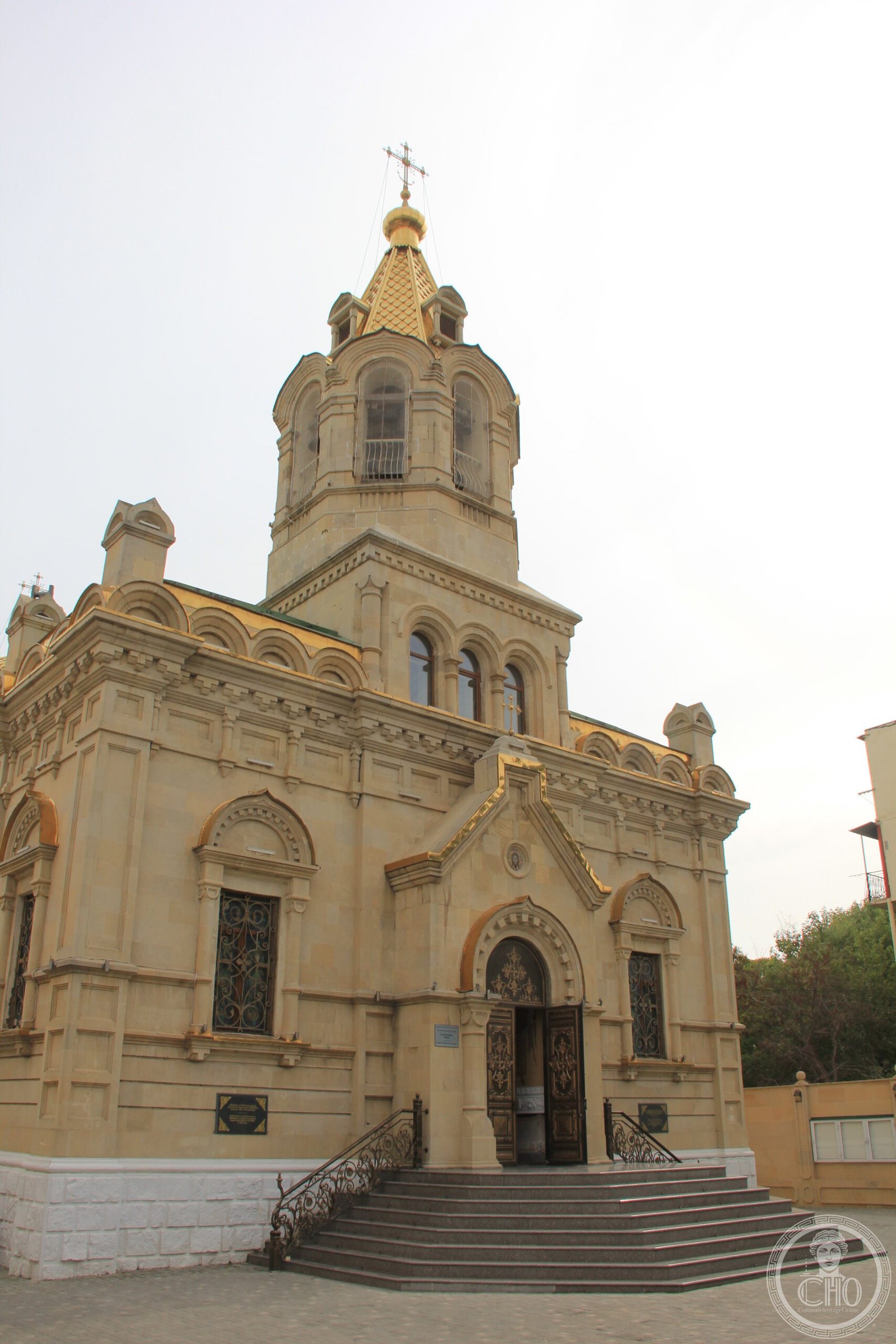
In Baku, the capital of Azerbaijan, the building known today as Holy Myrrhbearers Cathedral was built between 1908 and 1909 as a modest regimental chapel dedicated to the Archangel Michael, serving the 206th Salyan infantry regiment, to a design by the architect Fyodor Verzhbitsky, funded by the Tsarist War Ministry and by a private donation from the Muslim oil merchant Haji Zeynalabdin Tagiyev. It was not then the city’s main cathedral: that role belonged to the far larger Alexander Nevsky Cathedral, consecrated in 1898, about 81 metres high and funded for three quarters by donations from Baku’s Muslim community, destroyed with dynamite by the Soviet authorities in 1936 or 1937 depending on the source; the Bülbül music school stands on its site today. The regimental chapel too was closed in Soviet times and used as a warehouse and then a gym, while the last Orthodox church still active in Baku, that of the Archangel Michael known as “of the Fleet”, closed only in 1936, according to diocesan sources and the Russian Orthodox Encyclopedia. Damaged by artillery fire during the Soviet crackdown of January 1990, known as “Black January”, the building was returned to the Russian Orthodox Church in 1991 and restored, according to the Azerbaijani press, with the help of the Muslim philanthropist Aydin Gurbanov. Patriarch Alexy II of Moscow consecrated it as a cathedral on 27 May 2001, renaming it to the Holy Myrrhbearers because Baku already had another church dedicated to Michael, and the official reopening followed on 24 March 2003 in the presence of President Heydar Aliyev. On 15 November 2013 President Ilham Aliyev inaugurated here, beside the cathedral, a state-funded Orthodox religious and cultural centre, declaring on that occasion that “multiculturalism is the state policy of Azerbaijan, and it is also a way of life”. Patriarch Kirill returned on 14 November 2019 for a lesser consecration after restoration work, and on 19 August 2024 Presidents Vladimir Putin and Ilham Aliyev visited the cathedral together, with Putin donating an icon of the Transfiguration. On 4 May 2025 Kirill again celebrated the liturgy here, presenting a translation of the Gospel into Azerbaijani, and on 22 December 2025 the first complete Orthodox liturgy ever celebrated entirely in Azerbaijani was held here. The present bishop of Baku and Azerbaijan is Alexy (Smirnov), consecrated on 13 June 2024. The official narrative of interreligious tolerance promoted by the Azerbaijani state, of which this cathedral is a recurring showcase, coexists however, according to the US State Department, USCIRF and the organisation Forum 18, with systematic restrictions against unregistered or non-“traditional” religious groups, in particular independent Shia Muslims and some Protestant congregations.
About Holy Myrrhbearers Cathedral
In Baku, Azerbaijan, the building known today as Holy Myrrhbearers Cathedral was built between 1908 and 1909 as a modest regimental chapel dedicated to the Archangel Michael, serving the 206th Salyansky Infantry Regiment, designed by architect Fyodor Verzhbitsky and funded by the Tsarist War Ministry alongside a private donation from Muslim oil magnate Haji Zeynalabdin Tagiyev. It was not, at the time, Baku’s main cathedral — that role belonged to the far larger Alexander Nevsky Cathedral, consecrated in 1898, roughly 81 meters tall and three-quarters funded by donations from Baku’s Muslim community, dynamited by Soviet authorities in 1936 or 1937 depending on the source.
Key facts
- 1908-1909: built as a regimental chapel to the Archangel Michael.
- 1936/1937: Baku’s grand Alexander Nevsky Cathedral dynamited by Soviet authorities.
- January 1990: shelled during the “Black January” crackdown.
- 27 May 2001: consecrated as a cathedral by Patriarch Alexy II.
- 19 August 2024: Presidents Putin and Aliyev visit together.
- 22 December 2025: first full Orthodox liturgy ever celebrated in Azerbaijani.
History
Built as a minor garrison chapel while Baku’s grand Alexander Nevsky Cathedral stood as the city’s true seat, this building only became a cathedral in 2001, decades after Soviet authorities dynamited its far larger predecessor and closed every other Orthodox church in the city. Restored partly with a Muslim philanthropist’s funding and reopened in 2003, it has since become a recurring stage for Azerbaijan’s state-promoted tolerance narrative — hosting a presidential-opened religious-cultural center in 2013, a joint Putin-Aliyev visit in 2024, and, in December 2025, the first Orthodox liturgy ever celebrated entirely in the Azerbaijani language.
What you see
A carved sandstone facade in the standardized Russian imperial “garrison church” pattern rises beneath a tented bell tower topped by a gold-and-green onion dome and cross, with arched stained-glass windows and a hand-carved stone iconostasis added during the 2001-2003 restoration.
Practical information
- Opening hours: generally open daily outside services; check current hours before visiting.
- Address: Baku, Azerbaijan (street address disputed across sources).
Getting there
The cathedral stands in central Baku. GPS: 40°23′23″N, 49°49′15″E.
Nearby
- Bülbül School of Music — stands on the site of the demolished Alexander Nevsky Cathedral.
Sources
- Wikipedia (English and Russian) — “Holy Myrrhbearers Cathedral” and “Alexander Nevsky Cathedral, Baku”
- pravoslavie.az — official site, Baku and Azerbaijan Diocese.
- patriarchia.ru — Moscow Patriarchate coverage of patriarchal visits to Baku, 2010-2025.
- president.az and azertag.az — Azerbaijani state coverage of the 2013 Religious-Cultural Centre opening.
- US State Department, USCIRF and Forum 18 — religious freedom reporting on Azerbaijan.
Find it on the map
See this place and what’s around it →📷 Become a Cultural Heritage Online photographer
Share your photos of places: they stay published under your name as the author. The more they're seen, the more you get noticed — and soon a contest will reward the most appreciated photos.
Log in or sign up free to add a photo