
The imperial capital of the Habsburg dynasty and the most culturally dense city in Central Europe. Vienna contains within a single pedestrian circuit the Gothic cathedral where the Habsburg hearts are buried, the greatest concentration of Baroque palaces in any European capital, the Ringstrasse boulevard that remade the physical face of 19th-century urban ambition, and the coffeehouse culture where Freud, Wittgenstein, and the founders of modern psychoanalysis, philosophy, and atonal music debated each other across marble tables.
At a glance
The Historic Centre of Vienna, UNESCO WHS 2001, is the Innere Stadt, the First District, in a city of approximately 1.9 million people: the most populous in Austria and the second most populous German-speaking city in the world after Berlin, on the Danube River in the north-east of the country. UNESCO placed it on the World Heritage in Danger list in 2017, over plans for high-rise development inside the historic skyline zone — the proposed Wien-Mitte scheme and others threatened the visual integrity of that skyline — and as of 2026 the city is still negotiating with UNESCO over the scope and the height of what may be built. Vienna was the capital of the Haus Habsburg, the dynasty that ruled the Holy Roman Empire, the Austrian Empire and the Austro-Hungarian Empire from 1273 to 1918: the longest-reigning house in European history. At its greatest extent, in the 18th century, the empire covered approximately 700,000 km², the largest state in Europe, and at its end in 1918 it dissolved into Austria, Hungary, Czechoslovakia, Yugoslavia, Poland and Romania — one of the most consequential political dissolutions the continent has seen. From the 18th century to the early 20th the city gathered an extraordinary concentration of talent. Ludwig van Beethoven, 1770–1827, moved here in 1792 and died here. Franz Schubert, 1797–1828, was born here. Johannes Brahms, 1833–1897, came in 1863 and considered Vienna his definitive home. Gustav Mahler, 1860–1911, directed the Opera from 1897 to 1907 and was the greatest conductor of his age and one of the last great Romantic symphonists. Anton Bruckner, 1824–1896, was organist at the Hofburg chapel from 1868, and his symphonies are the most direct descendants of Beethoven’s Ninth in the 19th-century orchestral repertoire. Sigmund Freud, 1856–1939, practised at Berggasse 19 from 1891 to 1938, and the Freud Museum is one of the most visited intellectual heritage sites in the city. And in 1897 the Vienna Secession was founded, by Gustav Klimt, Egon Schiele and Oskar Kokoschka: the most important Art Nouveau movement in Central Europe.
Key facts
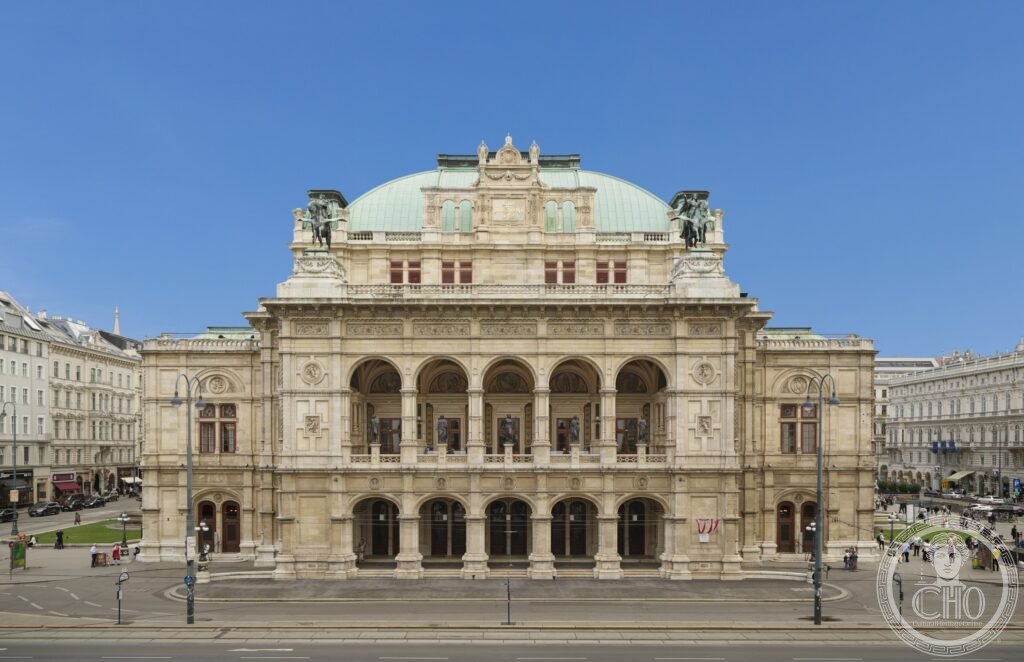
- The Ringstrasse: the most ambitious urban boulevard project of the 19th century. The Ringstraße — literally “ring road” — is the circular boulevard that replaced the medieval walls and the glacis, the zone of fortification, around the Innere Stadt, the First District. Emperor Franz Joseph I authorised it by decree in December 1857, and it was built between 1858 and 1890: 5.3 km lined with the most concentrated collection of historicist public buildings in the world, almost all of them raised within approximately 33 years. The Vienna State Opera, 1869, is Neo-Renaissance, by August Sicard von Sicardsburg and Eduard van der Nüll, and opened with Don Giovanni; what the critics did to it is told in the caption below. The Kunsthistorisches Museum, the Art History Museum, opened in 1891 to designs by Gottfried Semper and Karl von Hasenauer, and is the finest museum building in the world. Its Vermeer gallery holds two Vermeers, one of the finest concentrations in any museum; its Bruegel gallery is the finest single collection of Pieter Bruegel the Elder in existence, 12 of the approximately 37 surviving works, and the most important holding of 16th-century Flemish painting anywhere. Its Kunstkammer, the Habsburg collection of decorative art and curiosities, is among the oldest and most important in the world, and in it stands the Salt Cellar of Benvenuto Cellini, the Saliera of 1543, in gold: the most expensive object ever stolen, taken in 2003 by Robert Mang, who prised open a window, and recovered in 2006 — the most famous thing the museum owns. Across the Ring stands the Natural History Museum, a mirror image of it by the same architects, 1889, which holds the Venus of Willendorf, about 25,000 BCE, 11.1 cm of limestone: the most famous Upper Palaeolithic figurine in the world. The Burgtheater, 1888, also by Semper and Hasenauer, is the German-language theater of reference, as the Comédie-Française is for French or the National Theatre for English. The Parliament, 1883, by Theophil Hansen, is Greek Revival and the most prominent classical building on the Ring. The Rathaus, the City Hall, also 1883, by Friedrich von Schmidt, is Neo-Gothic and the tallest secular building on the boulevard at 97 m to the top of its central tower; the ice rink laid in front of it in winter is the most visited seasonal outdoor attraction in Vienna.
- The Schönbrunn Palace: the Habsburg summer palace and one of the great Baroque palaces of Europe. Schloss Schönbrunn was the summer palace of the Habsburg emperors: 1,441 rooms, of which the 40 state rooms open to the public are only a small part. Building began in 1696 under Emperor Leopold I, and the name comes from a “beautiful spring”, a schöner Brunnen, found here in the 16th century. Johann Bernhard Fischer von Erlach, one of the greatest Baroque architects and the builder of the Karlskirche, drew the original designs; Nikolaus Pacassi later cut back Fischer’s grandiose original plans to something more modest and still magnificent, and gave the palace its present facade of 1,476 windows. Maria Theresa, Empress of Austria and Queen of Hungary from 1740 to 1780, was the only woman to rule the Habsburg domains. Born in Vienna in 1717, she had 16 children, 13 of whom reached adulthood, and one of them, Marie Antoinette, 1755–1793, was born here and went on to be Queen of France and to die under the guillotine in 1793. The young Wolfgang Amadeus Mozart came in 1762, aged 6, to play for the Empress; the story that he proposed marriage to the Archduchess Maria Josepha, Marie Antoinette’s elder sister, is probably apocryphal and certainly charming. Franz Joseph I, Emperor from 1848 to 1916 and the longest-reigning Habsburg, worked at the Hofburg and lived privately here, and died at Schönbrunn in 1916. The gardens are the most important formal French gardens in Austria, crowned by the Gloriette, the 18th-century triumphal arch on the hill above, which gives the most dramatic view in Vienna: the roof of the palace and the city beyond. The Tiergarten Schönbrunn, opened in 1752 by Emperor Franz I Stephan, is the oldest zoo in the world still working. UNESCO WHS 1996, separately from the Innere Stadt inscription.
- The Kunsthistorisches Museum: the finest Habsburg art collection and one of the great museums of the world. The KHM, Kunsthistorisches Museum Wien, the Art History Museum Vienna, was opened in 1891 by Emperor Franz Joseph I. Gottfried Semper and Karl von Hasenauer built it between 1872 and 1891, the most ambitious museum building of the 19th century, with an octagonal dome above the entrance vestibule and a staircase hall that is the most dramatic museum interior in the city: the ceiling above the stairs was painted by Mihály Munkácsy, and the lunettes in the arch over the landing by a 26-year-old Gustav Klimt in 1890–1891 — one of Klimt’s earliest important commissions, small and exquisite, showing allegorical figures of ancient and Renaissance art. The Old Masters gallery gives 11 rooms to the Flemish school alone, and the Bruegel room holds 12 paintings, among them the “Tower of Babel”, the “Hunters in the Snow”, “The Return of the Herd” and “The Peasant Wedding”. There are Raphael and Titian, the finest Velázquez collection outside Spain, and Dürer. The Kunstkammer is the most important collection of its kind in the world, with the Saliera and the Ambras collection, assembled by Archduke Ferdinand II of Austria at Schloss Ambras near Innsbruck: the most important Renaissance Kunstkammer in existence.
- Heritage: UNESCO World Heritage Site, Historic Centre of Vienna, inscribed 2001. On UNESCO Danger List since 2017.
- GPS: 48.2082° N, 16.3738° E.
History
Roman Vindobona (the Roman legionary fortress on the site; the Emperor Marcus Aurelius died in Vindobona in 180 CE (the most famous death on Viennese soil before the modern era)). The Babenberg dynasty (976–1278; the first ruling dynasty of the Duchy of Austria; the Babenbergs made Vienna their residence in 1155 (Duke Heinrich II Jasomirgott; “yes, so be it” — a characteristically Viennese nickname)). The Habsburg dynasty (1278–1918; the definitive ruling dynasty; the Habsburgs acquired the Duchy of Austria through the defeat and death of Ottokar II of Bohemia at the Battle of Marchfeld (1278) — the beginning of 640 years of Habsburg rule). The siege of Vienna (1529 (first siege) and 1683 (second siege) by Ottoman forces; the 1683 siege is the most important event in early modern Austrian history; the relief of Vienna by John III Sobieski of Poland and the Duke of Lorraine on 12 September 1683 (the Battle of Vienna; the most decisive Christian victory against Ottoman expansion into Europe; the Ottomans retreated and never again threatened Vienna; the croissant legend (the crescent-shaped pastry created by Viennese bakers to celebrate the defeat of the Ottomans — the story is almost certainly apocryphal (the croissant appears to be a French adaptation of the Austrian Kipferl); UNESCO WHS 2001))).
What you see
The Innere Stadt, the first district, is the UNESCO core zone and can be walked in a day. Its symbolic centre is the Stephansdom, St. Stephen’s Cathedral. The first church here dates from 1137 and the present Gothic building was largely raised between 1304 and 1433. Its South Tower, the Steffl, reaches 136 m and was the tallest structure in Vienna for centuries: 343 steps to the view. The North Tower was never finished, and in 1578 a Renaissance dome went up instead of a Gothic spire because the city had run out of money; it holds the Pummerin, the great bell, the largest in Austria at 21 tonnes, which rings only on special occasions. Below lie the catacombs, with the remains of 11,000 people, and the ducal crypt with the copper urns that hold the Habsburg hearts. The dynasty buried itself in three places: the body in the Kaisergruft, the Imperial Crypt beneath the Kapuzinerkirche; the heart in the Herzgruft, the Heart Crypt, of the Stephansdom; the intestines in its Herzogskrypta. The Hofburg was the Imperial Palace, the main winter residence of the Habsburgs from the 13th century. Inside it the Spanish Riding School is the oldest equestrian academy in the world, home of the Lipizzaner horses and the most famous thing the palace offers — performances sell out weeks ahead. There are also the Imperial Apartments, the Sisi Museum, which most general visitors go to first, on the life of Empress Elisabeth, and the Imperial Silver Collection, the most complete surviving imperial dinner service anywhere.
Practical information
- Getting there: Vienna International Airport (VIE) is 18 km from the centre. The City Airport Train, the CAT, takes 16 min for EUR 14.90 with reserved seating and check-in possible at Wien Mitte station; the S-Bahn S7 takes 25 min for EUR 4.20. On the ICE and RailJet network, the Hauptbahnhof, the main station, opened in 2015 in place of the Südbahnhof and is a major hub of the European network: Munich in 3h 57min by ÖBB RailJet, direct and the most scenic route through the Alps; Budapest Keleti in 2h 40min, also direct, the fastest rail link between two major Central European capitals; Prague in 4h by RailJet, the most comfortable way there; Salzburg in 2h 27min. Vienna is also the hub of the ÖBB Nightjet, the most important night train network in Europe, with services to Berlin in 8h, Brussels in 13h, and on to Hamburg, Paris, Amsterdam, Rome and Venice. In the city, Wiener Linien runs 5 U-Bahn lines, of which U1 and U3 are the useful ones for visitors: U1 from Stephansplatz to Hauptbahnhof and Reumannplatz, U3 from Stephansplatz to Westbahnhof. The Vienna City Card gives 24, 48 or 72h of unlimited public transport plus museum discounts, and is the most economical choice for several days of sightseeing.
- The Coffeehouse culture: Vienna’s most distinctive contribution to European civilisation. The Viennese coffeehouse became UNESCO Intangible Heritage in 2011, and for 200 years it defined the intellectual culture of the city. Its principle is the coffeehouse as office: you may sit for hours, or for the whole day, over a single coffee, reading the newspapers the house provides free — all the dailies, foreign-language papers included — for the price of that one cup. Café Central, Herrengasse 14, opened 1860, was the house of Leon Trotsky, who played chess here before 1917, of Peter Altenberg, the Viennese poet who had his mail delivered to it, of Hugo von Hofmannsthal, Arthur Schnitzler and Sigmund Freud. Extensively restored, it is now a major attraction, and it keeps the KuK atmosphere — kaiserlich und königlich, imperial and royal, the most Viennese of all aesthetic qualities. Café Landtmann, Dr.-Karl-Lueger-Ring 4, opened 1873, stands directly opposite the Burgtheater: Freud’s favourite, Mahler’s too, and a place where Marlene Dietrich drank, the most glamorous address on the Ring, with a terrace looking at the theatre. Order a Mélange, Viennese espresso under milk foam, the most quintessential coffee of the city. Café Schwarzenberg, Kärntner Ring 17, opened 1861, is the oldest on the boulevard: there take a Grosse Braune, a double espresso with a small pitcher of cream beside it, the most refined way to drink coffee on the Ring.
- The Naschmarkt and the Viennese food culture: the Saturday flea market and the best outdoor food experience in Central Europe. The Naschmarkt is the most important open-air market in Vienna, open Monday to Saturday, with approximately 120 stalls of fresh produce and Austrian specialities. Among them: Liptauer, a spiced cheese spread, and Tafelspitz, boiled beef, the most traditional Viennese main course, simmered in a court bouillon with root vegetables for 2–3h and served with horseradish cream and chive sauce — the name means “tip of the rump”, after the pointed end of the cut. Wiener Schnitzel is properly made from veal, Kalbsschnitzel, and not from pork: the name is legally protected in Austria, where only veal may be called Wiener Schnitzel and the pork version must be sold as “Schnitzel Wiener Art”, Schnitzel Vienna style. The Sachertorte belongs to the Hotel Sacher, 1832: two layers of chocolate sponge with apricot jam under a chocolate glaze. In 1954 a 7-year court battle ended between the Sacher and the Café Demel, which also sold one, over the right to the name “Original Sacher-Torte”. The Sacher won the “Original”. The difference is in the jam: the Demel torte has a single layer under the glaze, the Sacher has two, one above and one below. On Saturday mornings only, the flea market takes over — the most important in Vienna and the best place in the city for vintage clothing, antique silverware and imperial-era porcelain.
Getting there
Vienna Airport (VIE; CAT train 16min EUR 14.90 or S-Bahn 25min EUR 4.20). RailJet from Munich 4h, Budapest 2h40, Prague 4h. GPS: 48.2082, 16.3738.
Nearby
- Schönbrunn Palace (UNESCO WHS 1996). 4 km south-west of the Innere Stadt, U4 to Schönbrunn, 10 min from Karlsplatz: the most visited heritage site in Vienna and one of the most visited in Europe, described above under Key Facts, The Schönbrunn Palace. In practice, buy the “Grand Tour”, 40 rooms, rather than the “Imperial Tour”, 22 rooms, on a first visit. The Gloriette café is the most dramatic place to have breakfast in the city, looking down on the palace with the town behind it. In the apartments, look for the answer to the Hall of Mirrors at Versailles — the Vieux-Lacque Room, and the Millions Room, a small parlour panelled in rosewood and set with Mogul miniature paintings: the most expensive small room in any European palace. The zoo needs a separate half day. The gardens are free, and the most civilised urban park in Vienna.
- Bratislava (Slovakia). 60 km east of Vienna (50 min by RailJet or 1h 15min by boat (the Danube river service; the most pleasant approach; Twin City Liner catamaran; approximately EUR 30 one way); the capital of Slovakia and the closest capital city to Vienna (no two capital cities in the world are as close as Vienna and Bratislava — separated by approximately 55 km as the crow flies); Bratislava Old Town (the compact historic centre; Bratislava Castle (the white castle on the cliff above the Danube; rebuilt after a fire in 1811; the most recognisable landmark of Bratislava); the coronation route (the route along which 11 Hungarian kings and queens were crowned in the Cathedral of St. Martin (1563–1830; Bratislava was the coronation city of the Kingdom of Hungary under Habsburg rule when Buda was under Ottoman control); the Michael Gate (the only surviving city gate)))).
- Klosterneuburg Monastery. 12 km north of Vienna (30 min by S-Bahn S40 or by boat). One of the most important Augustinian monasteries in Austria and the spiritual centre of the House of Habsburg. Klosterneuburg (founded 1114 by Margrave Leopold III of Babenberg (the patron saint of Austria); the monastery church (one of the finest Romanesque church interiors in Austria); the Babenberg collegiate chapter (the most important repository of medieval stained glass in Austria); the wine estate (Stift Klosterneuburg is one of the largest wine producers in Austria; the estate covers 108 hectares; the wine tastings and cellar tours are the most unusual heritage experience in the Vienna area)).
Sources
- Wikipedia, Vienna. Ringstrasse. Kunsthistorisches Museum. Schönbrunn Palace, accessed June 2026.
- UNESCO, Historic Centre of Vienna, WHS reference 1033, inscribed 2001. On Danger List from 2017.
- Carl E. Schorske, Fin-de-Siècle Vienna: Politics and Culture, Knopf, 1979.
Find it on the map
See this place and what’s around it →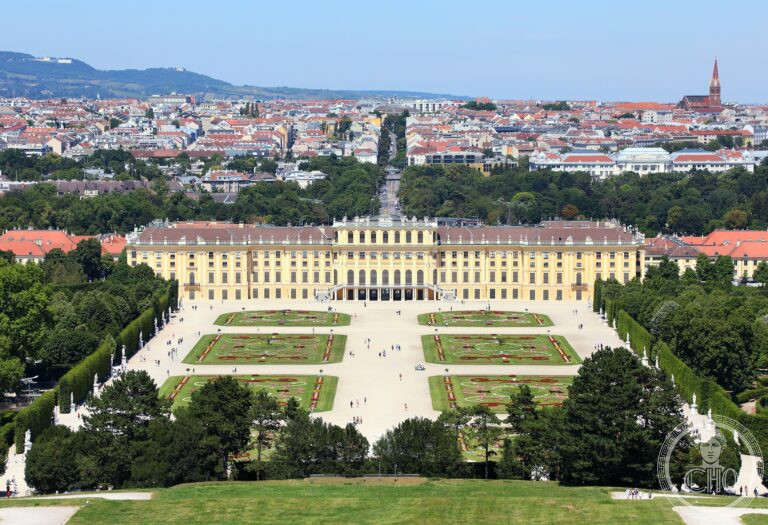
📷 Become a Cultural Heritage Online photographer
Share your photos of places: they stay published under your name as the author. The more they're seen, the more you get noticed — and soon a contest will reward the most appreciated photos.
Log in or sign up free to add a photo