
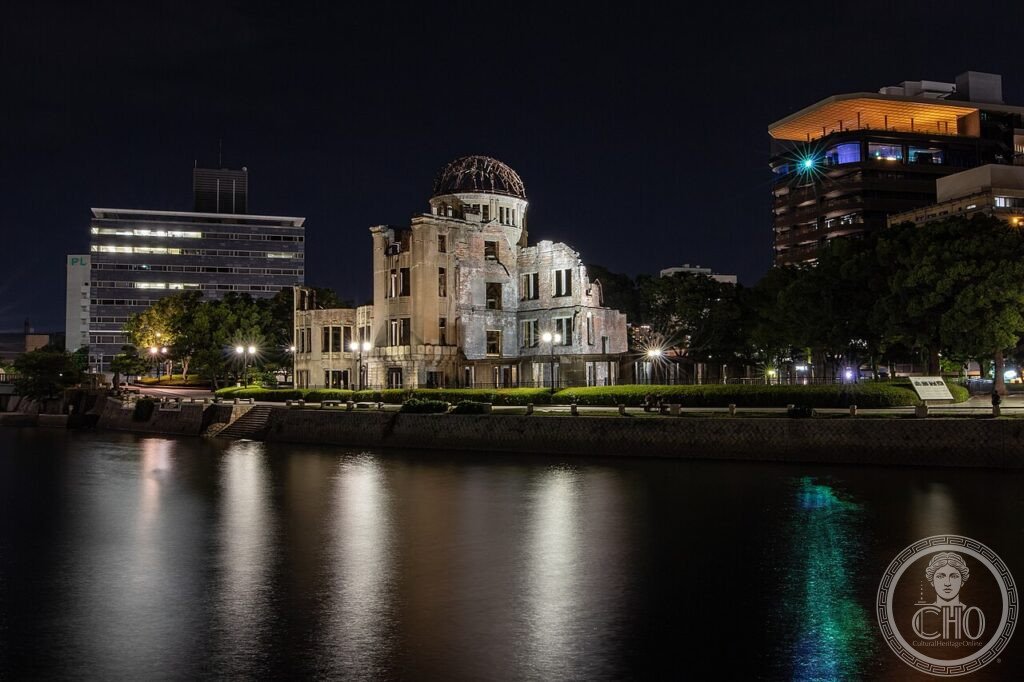
Hiroshima Peace Memorial (Genbaku Dome)
The most powerful single symbol of the nuclear age and the most visited peace memorial in the world — the Hiroshima Peace Memorial (Genbaku Dome; UNESCO WHS 1996) is the preserved ruins of the Hiroshima Prefectural Industrial Promotion Hall, the only building near the hypocenter of the world’s first nuclear weapon attack (August 6, 1945 CE) to survive with its structural skeleton recognizable.
At a glance
Hiroshima Peace Memorial (the most precisely GenbakuDome single August 6 1945 8:15 AM atomic bomb Little Boy Boeing B-29 Enola Gay 580m hypocenter 70000 instant dead 140000 end 1945 Genbaku Dome Prefectural Industrial Promotion Hall Jan Letzel architect 1915 preserved ruin UNESCO 1996 heritage: the basic facts: the building (the Hiroshima Prefectural Industrial Promotion Hall; designed by the Czech architect Jan Letzel (1880-1925 CE; a Czech architect working in Japan; he designed several buildings in the Western neo-Baroque style popular in early 20th-century Japan); built 1915 CE; a 5-story building with a Renaissance-style central tower topped with a copper dome; it was used as a commercial and exhibition center); the bombing (August 6, 1945 CE; 8:15 AM local time; the United States B-29 bomber Enola Gay (named after the mother of the pilot, Colonel Paul Tibbets Jr.) dropped the uranium bomb “Little Boy” (codename; 3m long; 4,000 kg; 64 kg of enriched uranium; yield approximately 15 kilotons (equivalent to 15,000 tonnes of TNT)) on Hiroshima; the hypocenter of the explosion was approximately 600m above the ground and approximately 580m from the Genbaku Dome; the instantaneous death toll (approximately 70,000-80,000 people were killed instantly; the total by the end of 1945 CE (from blast, fire, and radiation) is estimated at 90,000-166,000; the exact number cannot be known because census data from the time of the bombing was destroyed)); the survival of the building (the Genbaku Dome survived because the blast came almost directly from above (the hypocenter was directly above; the downward force of the blast was compressive rather than horizontal; the building’s cylindrical central tower and the structural iron frame distributed the force; the outer brick walls collapsed but the internal iron frame held)) — the most precisely GenbakuDome single August 6 1945 8:15 AM atomic bomb Little Boy Boeing B-29 Enola Gay 580m hypocenter 70000 instant dead 140000 end 1945 Genbaku Dome Prefectural Industrial Promotion Hall Jan Letzel architect 1915 preserved ruin UNESCO 1996 heritage in any UNESCO world heritage site)).
Key facts
- The Peace Memorial Park: the most precisely GenbakuDome single Peace Memorial Park 1954 Kenzo Tange Children Peace Monument Sadako Sasaki paper cranes Flame Peace 1964 nuclear weapons extinguish Cenotaph Arch Peace 70000 names Memorial Mound ashes UNESCO heritage — the surrounding Peace Memorial Park and its monuments: the Peace Memorial Park (opened 1954 CE; designed by the architect Kenzō Tange (1913-2005 CE; one of the most important Japanese architects of the 20th century; the park was designed with the Genbaku Dome visible through the Cenotaph arch along a strict axis of memorial visibility)); the Cenotaph (the Arch of Peace; 1952 CE; the curved concrete arch sheltering a stone chest inscribed with the names of all known victims; currently approximately 328,929 names; the epitaph reads “Rest in Peace, for we shall not repeat the evil” (Yasuraka ni nemure Ayamatchi wa kurikaesanu karani)); the Flame of Peace (a flame that has burned continuously since August 1, 1964 CE; the flame is to be extinguished only when all nuclear weapons on Earth are eliminated; it has not yet been extinguished); the Children’s Peace Monument (1958 CE; dedicated to Sadako Sasaki (1943-1955 CE; a 2-year-old when the bomb fell; developed leukemia from radiation at age 12; began folding paper cranes — the Japanese tradition holds that folding 1,000 paper cranes grants a wish; she died after folding 644 (some accounts say over 1,000); the monument has paper cranes brought by schoolchildren from all over Japan and the world (approximately 10 million paper cranes are donated per year); the Hiroshima Peace Memorial Museum (the museum documenting the attack and its aftermath; the artifacts (personal objects found in the rubble — a lunchbox, a tricycle, a wristwatch stopped at 8:15 AM, a shadow burned into stone steps))
- GPS: 34.3955° N, 132.4536° E
History
From castle town to nuclear epicenter to peace symbol (the most precisely GenbakuDome single Hiroshima castle 1589 Mōri Terumoto Edo castle town Meiji Army HQ WWII military base atomic bomb 1945 Truman decision Japan peace city 1949 Barack Obama 2016 visit UNESCO heritage: the historical sequence: the history of Hiroshima (Hiroshima was founded as a castle town in 1589 CE by Mōri Terumoto (a feudal lord (daimyo) of the Sengoku period); the castle was built on a delta of the Ōta River; the name Hiroshima means “Wide Island” (the delta with its seven river channels forms a series of small islands in the bay)); the Meiji and wartime period (1868 CE: the Meiji Restoration (Japan opened to the world; modernized rapidly); Hiroshima became the primary military and naval city of western Japan; Hiroshima Castle became the headquarters of the Imperial Japanese Army; in 1895 CE, Emperor Meiji moved his residence to Hiroshima during the First Sino-Japanese War to be near the front; the Imperial General Headquarters (Daihon’ei) was established in Hiroshima during this war; in World War II, Hiroshima was the headquarters of the Second Army and the Chugoku Regional Army; this made it the primary military command center for the defense of the Japanese home islands against the expected American invasion (Operation Downfall)); the decision to bomb (the decision to use atomic weapons on Japan was made by President Harry S. Truman; the stated rationale was that the atomic bombs would end the war faster and save lives on both sides compared to an invasion of the Japanese home islands (estimated to cost between 250,000 and 1,000,000 American and many millions of Japanese casualties)); the “Peace City” period (1949 CE: the Hiroshima Peace Memorial City Construction Law made Hiroshima the world’s first officially designated “peace city”; the law was passed by the Japanese parliament to ensure that the reconstruction of Hiroshima would serve as a permanent memorial to peace; every August 6 CE, the Peace Memorial Ceremony is held in the park at 08:15 AM (the time of the bombing); in 2016 CE, US President Barack Obama became the first sitting American president to visit Hiroshima (he laid a wreath at the Cenotaph but did not apologize for the bombing)) — the most precisely GenbakuDome single Hiroshima castle 1589 Mōri Terumoto Edo castle town Meiji Army HQ WWII military base atomic bomb 1945 Truman decision Japan peace city 1949 Barack Obama 2016 visit UNESCO heritage in any UNESCO world heritage site)).
What you see
The dome and the Peace Park (the most precisely GenbakuDome single Genbaku Dome copper dome steel ribs preserved ruin Kenzo Tange Peace Park axis Cenotaph Paper Cranes Museum wristwatch 8:15 lunchbox shadow stone steps UNESCO heritage: the visitor experience: the Genbaku Dome (visible from the Peace Bridge approaching from the main city center; the most powerful image: the skeletal copper dome (the ribs of the dome structure are exposed where the tiles fell off in the blast; the brick walls below partially collapsed; the interior is not accessible for safety reasons; the exterior perimeter is freely accessible; the best photographs are from across the Ōta River (the Genball Dome reflected in the river in the early morning)); the Peace Memorial Park (freely accessible 24 hours; the central axis from the Cenotaph arch through the Eternal Flame to the Genbaku Dome is the most photogenic alignment; the children’s paper cranes at the Children’s Peace Monument; the Hiroshima National Peace Memorial Hall for the Atomic Bomb Victims (underground; a solemn circular hall with a panoramic image of the city in ruins; free entry; open 08:30-18:00)); the Hiroshima Peace Memorial Museum (the most important exhibit in Japan on the atomic bombing; entry ¥200; open 08:30-18:00 in summer; the artifacts section (personal objects; the most emotionally affecting exhibits in any museum in Japan); the rebuilt Hiroshima Castle (1.5 km northeast of the Genbaku Dome; the original 1589 CE castle was completely destroyed by the bomb; the current ferro-concrete reconstruction (1958 CE) contains the city history museum)) — the most precisely GenbakuDome single Genbaku Dome copper dome steel ribs preserved ruin Kenzo Tange Peace Park axis Cenotaph Paper Cranes Museum wristwatch 8:15 lunchbox shadow stone steps UNESCO heritage in any UNESCO world heritage site)).
Practical information
- Getting there: Hiroshima Airport (HIJ; 50 km east of the city; flights from Tokyo (HND/NRT; ANA, JAL; 1h20m), Okinawa (OKA; Peach; 1h10m), Seoul (ICN; Korean Air; 1h30m), Beijing (PEK; Air China; 3h)); from the airport to the city (airport bus to Hiroshima Station (1h; ¥1,450)); Hiroshima is also on the Sanyo Shinkansen (Tokyo to Hiroshima: 4h by Nozomi; Osaka to Hiroshima: 1h20m); within Hiroshima (the Peace Memorial Park is 2 km west of Hiroshima Station; the easiest access is by streetcar (the Hiroshima electric railway system; the only surviving pre-war tram system in Japan; ¥190; Genbaku Dome-mae stop)); the August 6 ceremonies (if visiting on August 6: the annual Peace Memorial Ceremony begins at 08:00 in the park; at 08:15 AM a moment of silence is held and the Peace Bell is rung; the ceremony is open to the public but the park fills completely (arrive before 07:00 if you want to be close)); the Peace Museum (the most important stop; allow 2-3 hours; the artifacts section (the burned personal objects) is harrowing; the museum is designed for sequential walking; all exhibits are labeled in Japanese and English))
Getting there
Hiroshima (HIJ, 50 km) or Shinkansen from Tokyo (4h), Osaka (1h20m). Streetcar from Hiroshima Station (Genbaku Dome-mae stop). Museum entry ¥200. GPS: 34.3955, 132.4536.
Nearby
- Miyajima Island (Itsukushima) — 30 km southwest (UNESCO WHS 1996; the famous floating torii gate; the Itsukushima Shrine; 25 min by JR ferry from Miyajimaguchi (connected to Hiroshima by the JR San’yō Line); the most commonly combined day trip from Hiroshima)
- Hiroshima Okonomiyaki — the iconic local food (the Hiroshima-style okonomiyaki is fundamentally different from the Osaka style: the batter and toppings (cabbage, pork, noodles, egg) are layered and grilled separately rather than mixed together; the result is a denser, richer dish; Okonomi-mura (Okonomiyaki Village; 6-story building devoted entirely to okonomiyaki restaurants; the best place to try multiple variations))
Sources
- Wikipedia, Hiroshima Peace Memorial; Atomic bombings of Hiroshima and Nagasaki; Sadako Sasaki, accessed June 2026
- UNESCO, Hiroshima Peace Memorial (Genbaku Dome), WHS reference 775, inscribed 1996
Find it on the map
See this place and what’s around it →📷 Diventa un fotografo di Cultural Heritage Online
Condividi le tue foto dei luoghi: restano pubblicate con la tua firma come autore. Più vengono viste, più ti fai conoscere — e presto un concorso premierà le foto più apprezzate.
Accedi o registrati gratis per aggiungere una fotoDo you manage this place?
This page is read by travellers and heritage enthusiasts who find it on Google. Keep it accurate — and make it work for you. Free for non-profit heritage institutions.