
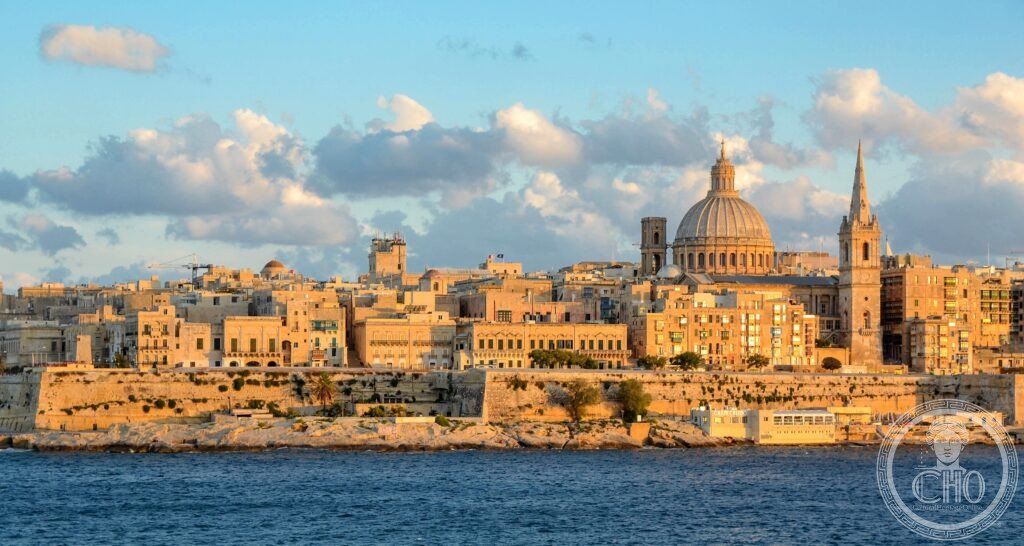
A capital city raised from bare rock in a single generation by the Knights of St John, Valletta packs one of the world’s densest concentrations of Baroque architecture, including Caravaggio’s largest and only signed painting, into a walled peninsula barely a kilometre long.
At a glance
Valletta is the smallest national capital in the European Union by area, occupying a compact rocky peninsula between the Grand Harbour and Marsamxett Harbour. Its population is small, numbered in the low thousands, though it sits at the heart of a much larger metropolitan area across the wider Maltese islands.
The city was laid out from scratch in 1566 on an uninhabited promontory, its regular grid of streets running parallel and perpendicular to the length of the peninsula so that every crosswise street catches the sea breeze. It takes its name from Jean de la Valette, Grand Master of the Knights Hospitaller, honoured by the order after his leadership during the Great Siege of Malta.
Key facts
- Founded: 1566, by the Knights Hospitaller of Saint John after the Great Siege of 1565
- Designers: Francesco Laparelli, a military engineer sent by Pope Pius V, with the work completed by the Maltese architect Girolamo Cassar
- Centrepiece: the Co-Cathedral of Saint John, with a Baroque interior and Caravaggio’s Beheading of Saint John the Baptist, the largest painting he ever produced and the only one he signed
- Status: Valletta was inscribed as a UNESCO World Heritage Site in 1980
- Scale: a walled historic centre containing hundreds of listed monuments within a very small area
- Coordinates: 35.8997° N, 14.5147° E
History
The Knights Hospitaller began as a religious military order founded in Jerusalem to care for sick pilgrims. Expelled successively from Jerusalem, Acre and Cyprus, the order was based on Rhodes until it was driven out by Suleiman the Magnificent, after which the Holy Roman Emperor Charles V granted the knights Malta, in exchange for a nominal annual tribute of a single Maltese falcon.
In 1565 an Ottoman force of some 40,000 men besieged around 6,000 knights and Maltese defenders for three and a half months. Grand Master Jean de la Valette, then in his seventies, directed the defence until Spanish relief arrived from Sicily and the Ottomans withdrew. The victory was celebrated across Christian Europe, and the order resolved to build a new fortified capital, Valletta, to ensure the islands could never again be besieged in this way.
Malta passed to Britain in 1800 after a brief period of French occupation under Napoleon, which had provoked a local revolt against anti-clerical French rule. During the Second World War Malta endured sustained bombing, and King George VI awarded the George Cross collectively to the island in recognition of its endurance, the only time the honour has been given to an entire territory. Malta became independent in 1964 and joined the European Union in 2004.
What you see
The Co-Cathedral of Saint John presents a plain, military façade by Girolamo Cassar, giving no hint of the Baroque interior beyond, where every surface is covered in gilded carving. The floor is inlaid with marble tombstones commemorating knights of the order, and the barrel vault carries Mattia Preti’s painted scenes from the life of John the Baptist. In the Oratory hangs Caravaggio’s Beheading of Saint John the Baptist, the only painting he ever signed, his name written into the pool of blood at the saint’s neck.
The Grand Master’s Palace, once the seat of the order and now home to Malta’s president and parliament, houses an armoury with a large collection of sixteenth-century arms and armour, including the elaborate parade armours worn by individual Grand Masters. The Upper Barrakka Gardens, set on top of the bastions, give a wide view over the Grand Harbour towards the Three Cities of Vittoriosa, Cospicua and Senglea, fortified settlements that predate Valletta itself and include Fort Saint Angelo, the oldest fortification in Malta and the knights’ headquarters before Valletta was built.
Practical information
- Access: the walled city is a pedestrian centre and is explored entirely on foot
- Main entrance: the City Gate at Pjazza Teatru Rjal, designed by Renzo Piano, replaced earlier gates on the same site
- Co-Cathedral visits: an audio guide is provided and is worth using, as it explains both the Caravaggio and the individual knights’ tombstones; current opening times and admission should be checked with the cathedral’s own visitor information
- Grand Master’s Palace Armoury: opening times and tickets are best confirmed through the official Valletta or Maltese heritage authorities before visiting
Getting there
Valletta is reached via Malta International Airport, which has direct flights from several European cities including London, Rome, Milan, Brussels and Munich, as Malta is part of the Schengen area. From the airport, bus routes run into Valletta, and taxis are also available; current fares and journey times are best checked with the airport or local transport operator.
Nearby
- Three Cities — across the Grand Harbour from Valletta, the older fortified settlements of Vittoriosa, Cospicua and Senglea, enclosed by the Cottonera Lines
- Fort Saint Angelo — within the Three Cities, the oldest fortification in Malta and the knights’ base before Valletta was built
- Ħaġar Qim and Mnajdra — prehistoric temple sites elsewhere in Malta
Sources
- UNESCO
- Co-Cathedral of Saint John
- Grand Master’s Palace Armoury
Find it on the map
See this place and what’s around it →📷 Become a Cultural Heritage Online photographer
Share your photos of places: they stay published under your name as the author. The more they're seen, the more you get noticed — and soon a contest will reward the most appreciated photos.
Log in or sign up free to add a photo