
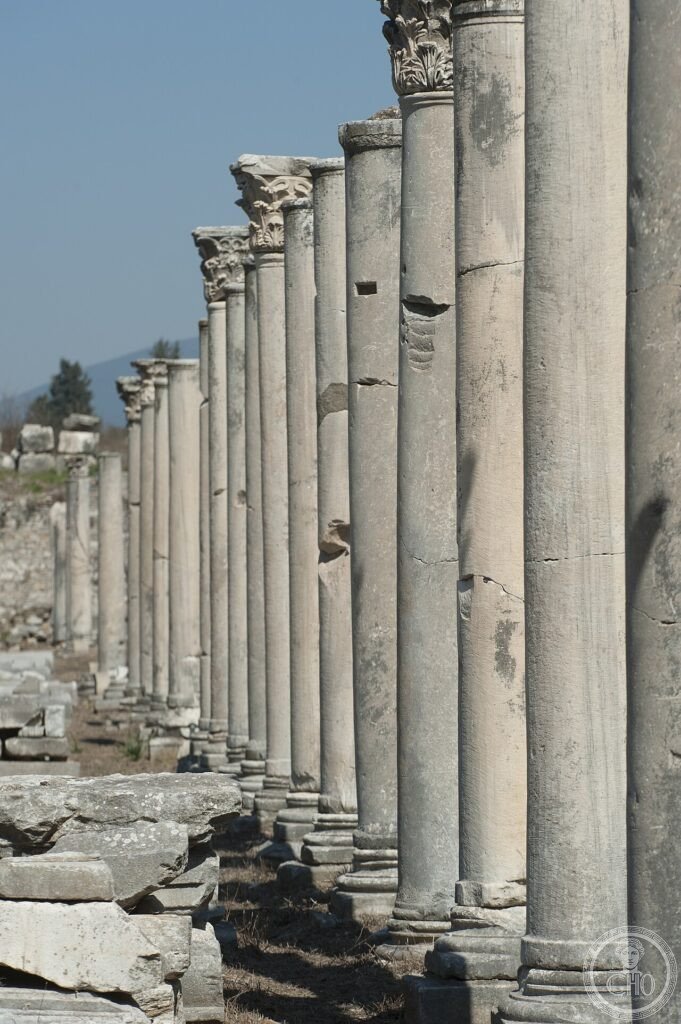
Ephesus preserves one of the most complete large Roman cities of the eastern Mediterranean, its marble streets leading past the reconstructed Library of Celsus to a theatre that once held twenty-five thousand people, on the site of the vanished Temple of Artemis.
At a glance
Ephesus stands on the slopes of the Bülbül and Panayır hills, several kilometres inland from the coast it once depended on. The ancient harbour, at the mouth of what is now the Küçük Menderes River, silted up over the centuries, and this slow geological change was the principal reason for the city’s decline. The excavated site covers only a fraction of the buried city, and the Austrian Archaeological Institute has been digging here continuously since 1895, still turning up new buildings and inscriptions each season.
At its height in the first and second centuries CE, Ephesus was one of the largest cities in the ancient world, ranked by some estimates just behind Rome, Alexandria and Antioch. Its main streets, the Curetes Street and the colonnaded Street of the Arcadians, still run through the site, the former still paved with its original marble.
Key facts
- Location: Selçuk, İzmir Province, Turkey
- Founded: traditionally by the Athenian prince Androclus around the 10th century BCE, on an earlier Anatolian settlement
- Refounded: 294 BCE, when Lysimachus moved the population to the present site
- Status under Rome: capital of the province of Asia from 133 BCE
- Heritage status: inscribed as a UNESCO World Heritage Site in 2015
- Coordinates: 37.9395° N, 27.3411° E
History
Greek tradition credits the founding of Ephesus to Androclus, son of King Codrus of Athens, in around the 10th century BCE, when Attic colonists settled among an existing Luwian population near the site later occupied by the Temple of Artemis. The city subsequently came under Lydian rule, including that of Croesus, and then Persian control, before Alexander the Great freed it in 334 BCE. In 294 BCE Lysimachus, one of Alexander’s successor-generals, relocated the entire population to a new site with a better harbour, laying it out on the street grid associated with Hippodamus of Miletus; this is the site visited today.
Ephesus became capital of the Roman province of Asia in 133 BCE, after Attalus III of Pergamon bequeathed his kingdom to Rome, and the first and second centuries CE mark its peak, the period that produced the Temple of Artemis in its final form, the Library of Celsus, the Great Theatre and the Terrace Houses. The apostle Paul preached in the city around 52 to 54 CE; the Book of Acts describes his two-year ministry there and the riot provoked by silversmiths who feared his teaching would ruin their trade in silver figurines of Artemis. In 431 CE Ephesus hosted the Third Ecumenical Council, held at the Church of Mary, which declared Mary to be Theotokos, God-bearer, the first formal statement of Marian doctrine in the Church.
The Temple of Artemis itself had a long and violent history. An early temple, built over an earlier sacred site around the 7th century BCE, was rebuilt on a vastly greater scale from 550 BCE with funding from the Lydian king Croesus, reaching 6,040 square metres with 127 columns eighteen metres tall. In 356 BCE, on the night Alexander the Great was born, a man named Herostratus burned it down simply to make his name immortal; he was executed and his name formally banned from record, though later historians recorded it anyway. The temple was rebuilt again from 323 BCE on a raised podium and was praised by every ancient writer who saw it, until the Goths sacked Ephesus and destroyed it in 262 CE. Its remains lay buried until the British engineer John Turtle Wood, working for the British Museum, rediscovered the site in 1869 after an eleven-year search through metres of swamp mud; the most important surviving fragments are now held by the British Museum, and the four allegorical statues from the Library of Celsus are in the Kunsthistorisches Museum in Vienna.
What you see
Most visitors enter through the Magnesia Gate, from which the Curetes Street descends for over half a kilometre towards the Library of Celsus, its white marble pavement worn smooth by two thousand years of use. Along the way stand the Trajan Fountain, where the foot of a statue of the emperor still rests in its original position, and the Temple of Hadrian, a small ornate Corinthian building whose frieze depicts the mythical founding of the city and a figure of Medusa above the entrance arch.
The Library of Celsus is the site’s most photographed monument, its two-storey façade of twelve columns and four niches holding copies of statues representing Wisdom, Goodness, Intelligence and Knowledge. Built as a funerary monument for Tiberius Julius Celsus Polemaeanus, governor of Asia, it once held around twelve thousand scrolls in wall niches, and Celsus himself is buried in a marble sarcophagus beneath the apse, an unusual honour. The building was destroyed by an earthquake in 270 CE and its façade collapsed again later; the structure seen today is a careful anastylosis reconstruction carried out by the Austrian Archaeological Institute, completed in 1978 using original fragments recovered on site.
The Great Theatre, cut into the western slope of Panayır Hill, seated around twenty-five thousand people and was used for gladiatorial combat, drama and public assemblies; it is still used today for concerts as part of the Ephesus International Festival. The Terrace Houses, covered by a protective modern structure, hold six luxurious Roman residences still under excavation, with well-preserved mosaic floors, wall paintings and everyday objects including cooking vessels, children’s toys and writing tablets displayed in situ; entry is separate from the main site ticket.
Practical information
- Entry points: the site has an Upper Gate near the Magnesia entrance and a Lower Gate close to Selçuk; the Terrace Houses require a separate entry
- Museum: the Ephesus Archaeological Museum in Selçuk holds artefacts removed from the site, including material connected to the Artemis cult
- Tickets and hours: check the official Ephesus site or the relevant Turkish heritage authority before visiting, as these change seasonally
Getting there
Ephesus is reached via İzmir, which has an international airport with connections to Istanbul, and from there by train or road to the town of Selçuk, the railway station closest to the site. From Selçuk the Lower Gate of Ephesus is a short taxi ride or a walk of under an hour.
Nearby
- Ephesus Archaeological Museum — in Selçuk, holding artefacts including the Artemis statues and the site’s inscription collection
- Site of the Temple of Artemis — near Selçuk, marking the location of the vanished Wonder of the Ancient World
- Selçuk town — the nearest town to the site, serving as the usual base for visitors
Sources
- Austrian Archaeological Institute
- British Museum
- Kunsthistorisches Museum, Vienna
- Acts of the Apostles (Acts 19)
Find it on the map
See this place and what’s around it →📷 Become a Cultural Heritage Online photographer
Share your photos of places: they stay published under your name as the author. The more they're seen, the more you get noticed — and soon a contest will reward the most appreciated photos.
Log in or sign up free to add a photoIs this page about you?
This page is read by travellers and heritage enthusiasts who find it on Google. Tell us how you are connected to this place and we will take it from there.