

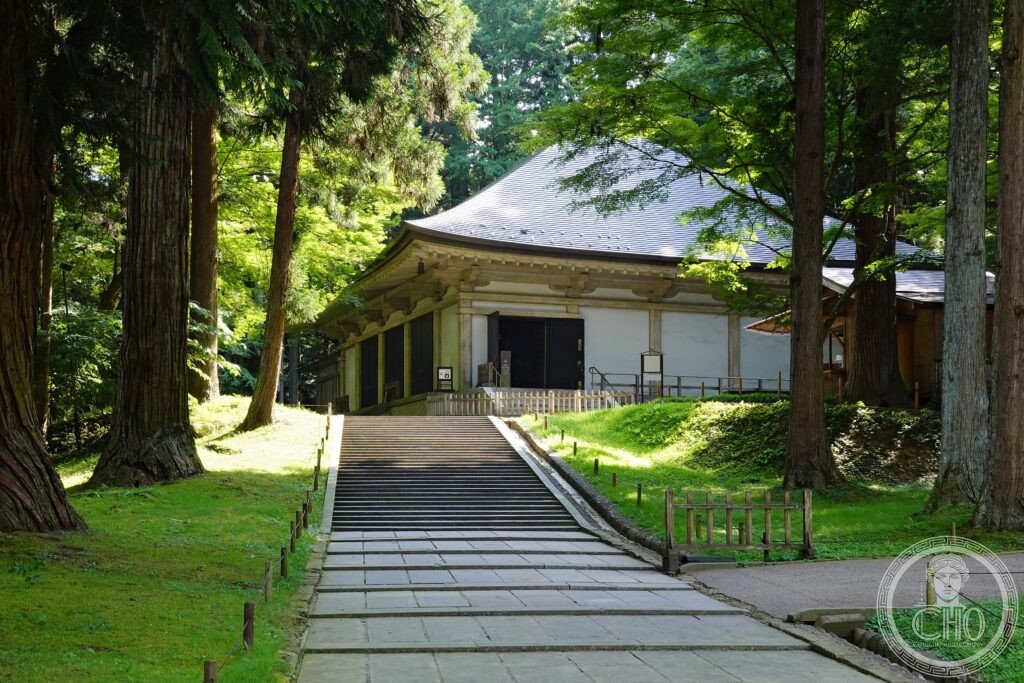
In Hiraizumi, a small town in northern Honshu, the Ōshū Fujiwara clan tried to build the Buddhist Pure Land paradise on earth. Almost everything they made was burned in 1189. What survives, above all the gold-leafed Konjikidō and the water garden of Motsuji, remains one of the most complete visions of that paradise anywhere in Japan.
At a glance
For a few generations in the twelfth century, Hiraizumi rivalled Kyoto as the seat of power in Japan. The Ōshū Fujiwara clan, four lords ruling in succession between 1094 and 1189, controlled the gold and horse trade of northern Honshu and used that wealth to build a city conceived as an image of the Buddhist Western Paradise. Their patronage of Pure Land Buddhism, the school that promises rebirth through recitation of the nembutsu, produced temples of unusual ambition.
Almost none of it survived the destruction of the Fujiwara realm by Minamoto no Yoritomo’s forces in 1189. Of the hundreds of buildings that once stood at Hiraizumi, only the Konjikidō remains, preserved because it had been enclosed within a protective outer shrine. It stands today as the sole physical survivor of the largest temple complex ever attempted in northern Japan.
Key facts
- Konjikidō: the Golden Hall, built around 1124 by Fujiwara no Kiyohira, measuring roughly 5.5 by 5.5 by 5 metres and covered entirely in gold leaf inside and out, with lacquerwork inlaid in mother-of-pearl, ivory and gold dust.
- The mummified lords: the hall’s three altars hold the mummified remains of Kiyohira, Motohira and Hidehira, together with the severed head of the fourth lord, Yasuhira.
- Motsuji garden: the largest surviving Heian-period Pure Land garden in Japan, built around the Ōizumi-ga-ike pond and set out with rocks of specific symbolic shapes, white sand beaches and an artificial stream.
- Bashō’s pilgrimage: the poet Matsuo Bashō visited the ruins of the Fujiwara palaces in 1689 and wrote of them in Oku no Hosomichi, producing one of the best-known haiku in the Japanese language.
History
The Ōshū Fujiwara were a collateral branch of the powerful Kyoto Fujiwara who had lost central political influence but retained considerable wealth drawn from the gold deposits of Iwate and Miyagi and from the horse trade of the north. From their base at Hiraizumi they built a city planned as a Buddhist paradise, and in a single generation their patronage produced the temples of Chūson-ji, Motsuji, Muryōkōin and Kanjizaiō-in.
Muryōkōin, built by Hidehira in the mid-twelfth century, was a scaled-up version of the celebrated Byōdōin temple at Uji, said to have been slightly larger than its Kyoto model. It was destroyed along with almost everything else at Hiraizumi when Minamoto no Yoritomo’s armies overran the Fujiwara realm in 1189, ending the clan’s rule. Only its garden earthworks and foundation stones remain, and the site is included within the area recognised by UNESCO.
What you see
What survives at Chūson-ji today centres on the Konjikidō itself, alongside the Kofukushin-in temple and the Kyōzō sutra repository, built in 1108 and the oldest surviving timber building on the site, which once housed a cylindrical rotating sutra case made with imported Chinese materials. The Sankozo Treasure Museum nearby holds several thousand Buddhist artefacts from the Heian period, including gilded lacquer altar fittings, cosmetic boxes and screens, along with original architectural fragments removed from the Konjikidō for conservation.
The museum also displays the results of CT and X-ray examinations carried out on the mummified remains of the four Fujiwara lords, an analysis that confirmed the dates of death and identities of the men preserved in the hall’s altars.
At Motsuji, the Heian-period garden survives close to its original form, reconstructed from archaeological excavation around the Ōizumi-ga-ike pond, and remains the largest example of its kind in the country.
Practical information
- Sites: Chūson-ji, Motsuji and Muryōkōin are all within walking distance of Hiraizumi Station, and rental bicycles are available locally.
- Tickets and hours: entry fees and opening times change periodically; check the current details through Chūson-ji’s and Motsuji’s own visitor information before travelling.
- Best seasons: the Motsuji gardens are especially notable in mid-April, for cherry blossom, and in early November, for autumn colour.
Getting there
Hiraizumi Station lies on the JR Tōhoku Main Line, reachable from Sendai or Morioka by local train, or via the shinkansen to Ichinoseki, the nearest shinkansen station, followed by a short bus journey to Hiraizumi. Current timetables are best checked directly with JR East.
Nearby
- Matsushima — around 80 km southeast, reached by train via Sendai; one of the traditional Three Views of Japan, its bay scattered with some 260 small pine-covered islands, and home to the Zen temple of Zuiganji, built in 1609.
- Sendai — around 100 km southeast, the largest city in Tōhoku; sites include a museum devoted to the daimyo Date Masamune, the ruins of Aoba Castle, and the Osaki Hachimangu shrine of 1607, a national treasure and the oldest Shinto shrine building in the region.
Sources
- Wikipedia, Hiraizumi
- Wikipedia, Chūson-ji
- Wikipedia, Motsuji
- Wikipedia, Oku no Hosomichi
- UNESCO, Hiraizumi — Temples, Gardens and Archaeological Sites Representing the Buddhist Pure Land
Find it on the map
See this place and what’s around it →📷 Become a Cultural Heritage Online photographer
Share your photos of places: they stay published under your name as the author. The more they're seen, the more you get noticed — and soon a contest will reward the most appreciated photos.
Log in or sign up free to add a photo