

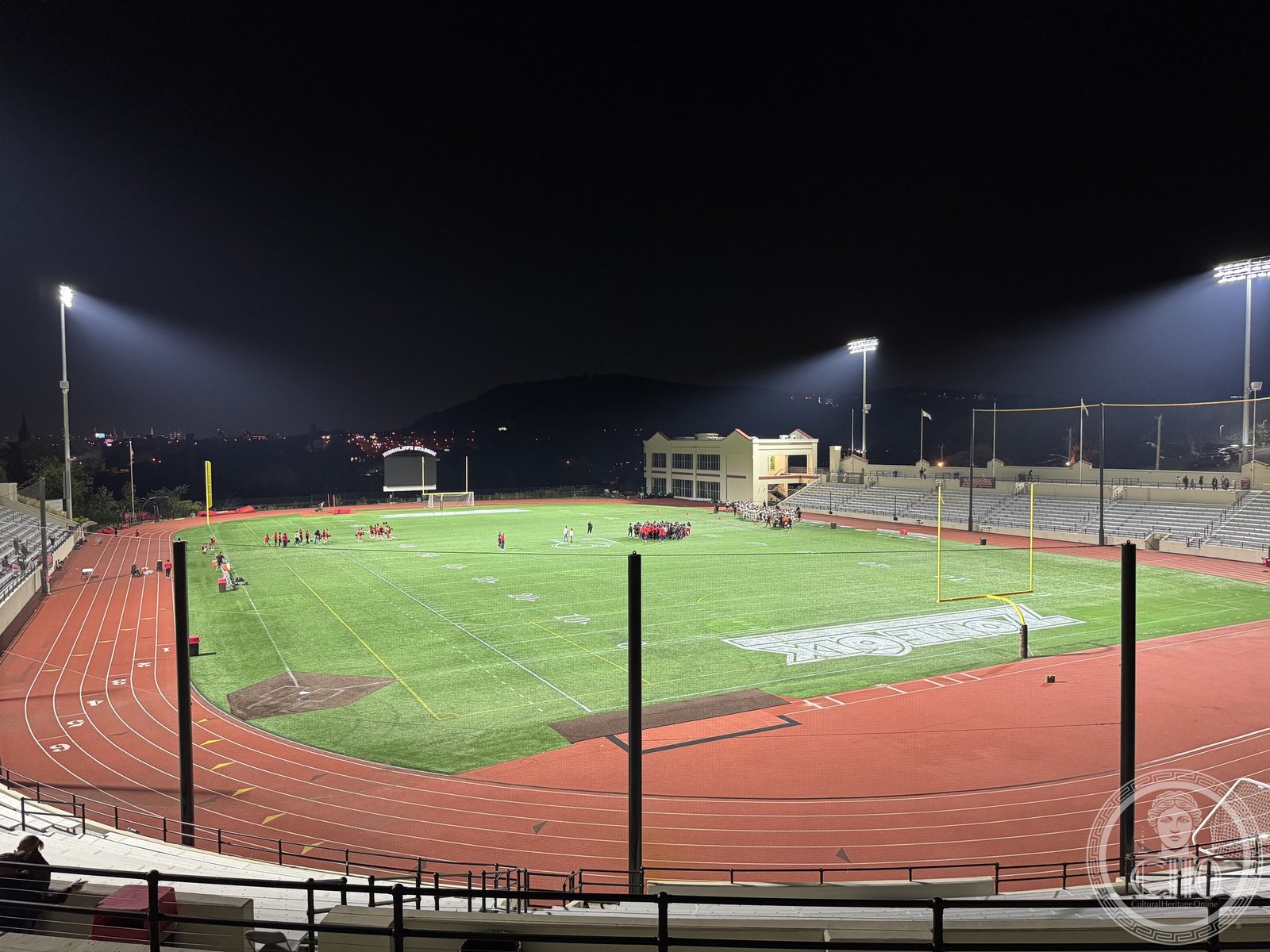
Built in 1932 on the banks of the Passaic River, Hinchliffe Stadium is one of the last surviving venues of the Negro Leagues, its Art Deco concrete shell rising above Paterson’s Great Falls gorge.
At a glance
A municipal stadium that became an accidental archive of American sports history, Hinchliffe preserves the physical memory of the Negro Leagues in a form almost no other city retained. Its broad terraces and banded Art Deco parapet have survived decades of neglect intact, and a federally backed restoration programme is returning them to use. For anyone tracing the geography of Black baseball in the industrial Northeast, this is an essential site.
Key facts
- Built: 1932, City of Paterson
- Style: Art Deco municipal stadium
- Location: Maple Street area, Paterson, New Jersey
- Named for: Mayor Hinchliffe of Paterson
- Designation: National Historic Landmark; National Register of Historic Places
- Notable tenants: New York Black Yankees and other Negro League clubs
- Setting: Adjacent to Paterson Great Falls National Historical Park
History
Built during the Great Depression by the City of Paterson, Hinchliffe Stadium opened in 1932 as a multi-use municipal athletic facility for track and field, football, and baseball. Its primary historical distinction arose almost immediately from its role as a hub of Negro League baseball: the New York Black Yankees and other Negro League clubs played here during the 1930s and 1940s, when the colour line barred Black players from major-league venues. The stadium is named after Mayor Hinchliffe, who championed its construction as a civic investment in Paterson’s working-class communities.
After Jackie Robinson integrated major-league baseball in 1947 and the Negro Leagues began to contract, Hinchliffe fell into decades of limited use and eventually disrepair. By the late twentieth century the concrete terraces had deteriorated significantly, yet the structure remained standing — a rare physical remnant of a chapter in American history that left few buildings behind. In 2014 Congress designated it a National Historic Landmark, anchoring its preservation in federal law and unlocking restoration funding. Work to bring the stadium back into active community use has been underway since.
What you see
The stadium’s Art Deco vocabulary is muscular and civic rather than ornamental. Broad raking concrete terraces rise on all sides, framed by a banded parapet that gives the perimeter a monumental weight. The shallow arched portal entries at field level — poured concrete with minimal ornament, their geometry purely geometric — are characteristic of the style as it was applied to public works infrastructure during the New Deal era: architecture that conveys permanence and civic seriousness without recourse to classical ornament.
The relationship between the stadium and its setting is distinctive. The Great Falls of the Passaic River — among the most powerful waterfalls in the eastern United States, and now a National Historical Park in their own right — are visible and audible from the upper tiers. The pairing of an industrial-era natural wonder with a Depression-era public stadium captures the layered history of Paterson: a city built on water power, organised labour, and the overlooked contributions of communities that mainstream American heritage has been slow to reclaim.
Practical information
- Access: Restoration work ongoing; verify current public access before visiting
- Nearby anchor: Paterson Great Falls NHP visitor centre provides full historical context
- Time needed: Allow 1–2 hours including the Great Falls overlook
- Footwear: Sturdy shoes recommended around the stadium perimeter
- Best season: Spring through autumn; avoid icy conditions in winter
Getting there
Paterson, New Jersey is approximately 20 miles west of Midtown Manhattan. From New York Penn Station, NJ Transit trains reach Paterson in under 40 minutes; the stadium is roughly a 15-minute walk from the station through the Great Falls historic district. By car, exit Route 80 at exit 57A and follow signs to the Great Falls National Historical Park — Hinchliffe Stadium is within the same corridor. Street parking is available in the surrounding neighbourhood.
Nearby
- Paterson Great Falls National Historical Park — the most powerful waterfall east of Niagara, a short walk from the stadium; the falls powered America’s first planned industrial city
- Lambert Castle (1892), Garret Mountain Reservation — a Romanesque Revival castle built by silk manufacturer Catholina Lambert, overlooking the Passaic Valley
- Newark Museum of Art — approximately 30 minutes south by car, with strong American art and Tibetan collections
Sources
- National Park Service, National Historic Landmarks Programme — Hinchliffe Stadium nomination file
- National Register of Historic Places, NJ Historic Preservation Office — nomination form
- Paterson Great Falls National Historical Park, nps.gov/pagr
- Negro Leagues Baseball Museum, nlbm.com — historical rosters and venue records
Find it on the map
See this place and what’s around it →Record researched and written by Luigi De Marchi for Cultural Heritage Online, 2026.
📷 Become a Cultural Heritage Online photographer
Share your photos of places: they stay published under your name as the author. The more they're seen, the more you get noticed — and soon a contest will reward the most appreciated photos.
Log in or sign up free to add a photoIs this page about you?
This page is read by travellers and heritage enthusiasts who find it on Google. Tell us how you are connected to this place and we will take it from there.