
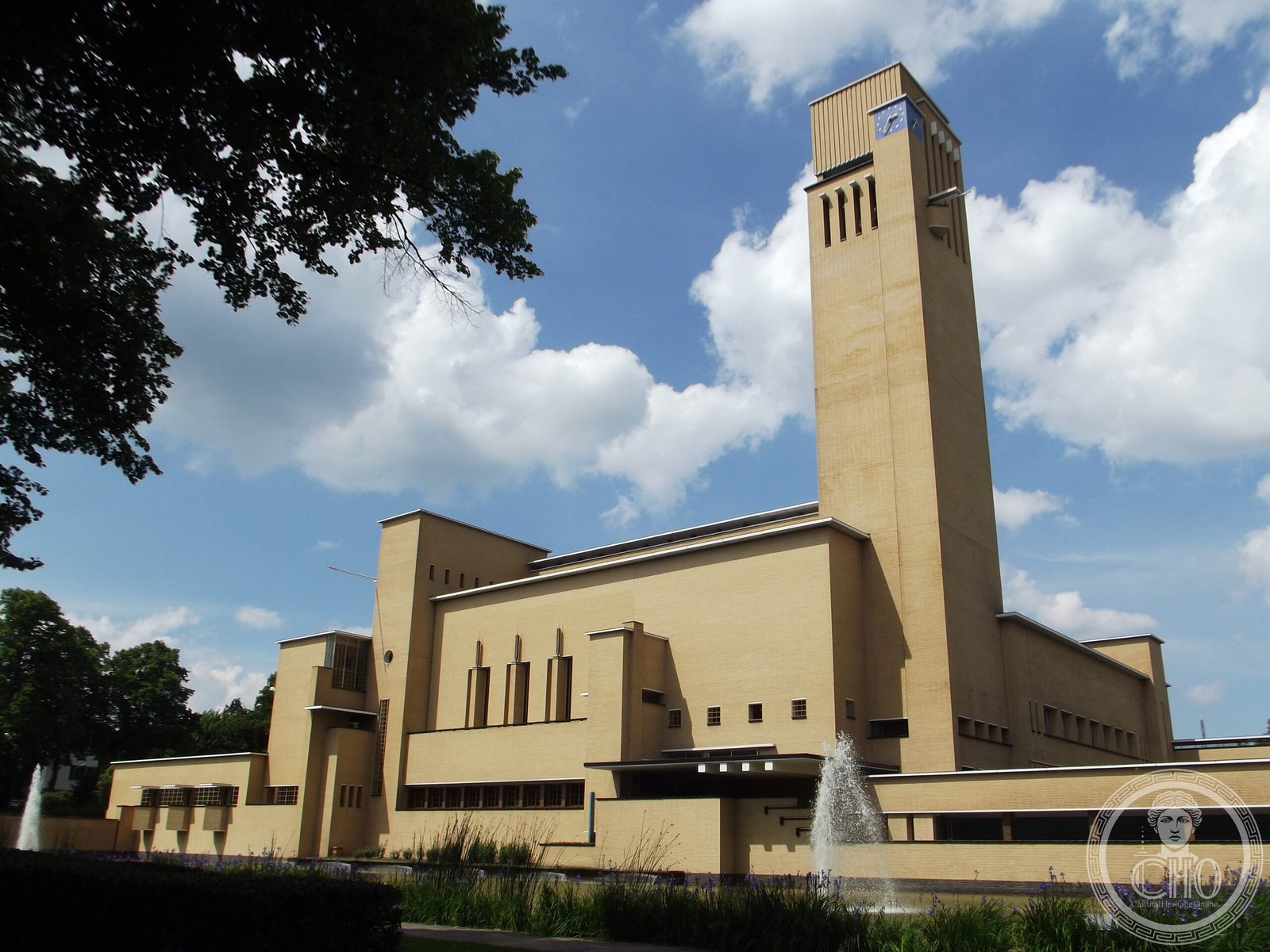
Hilversum Town Hall, known in Dutch as the Raadhuis Hilversum, is a masterwork of twentieth-century civic architecture completed in 1931 to designs by Willem Marinus Dudok. Located in Hilversum, a city in the North Holland province that grew as the Netherlands’ principal media broadcasting centre, the building has been described by architectural historians as one of the most influential structures of its era and among the greatest achievements of the modernist movement. Dudok served as the city’s Director of Public Works from 1915, shaping its urban fabric over decades, and the town hall represents the culmination of his brick-based, horizontally dynamic approach. The building is set within a park and water landscape, its asymmetric tower and long horizontal bands of brick and glass projecting an image of restrained civic authority that inspired architects worldwide.
At a glance
- Type
- Municipal town hall
- Period
- 1924–1931
- Style
- Modernism; Brick Expressionism (Dudok Modernism)
- Location
- Hilversum, North Holland, Netherlands
- Coordinates
- 52.2293° N, 5.1695° E
- Architect(s)
- Willem Marinus Dudok
Overview
Hilversum Town Hall stands as one of the defining monuments of Dutch civic architecture in the twentieth century. Designed by Willem Marinus Dudok, the city’s long-serving Director of Public Works, the building combines a two-square plan arranged around an inner courtyard with a landmark tower that orients visitors from across the surrounding park and water. Its surfaces of warm brick, strongly horizontal window bands, and carefully composed volumes embody Dudok’s synthesis of Frank Lloyd Wright’s Prairie School influence and the geometric rigour of the De Stijl movement. The building also served a functional second courtyard with lower service spaces and a service road. Since its completion in 1931, it has functioned as the operational seat of Hilversum’s municipal government.
History
Willem Dudok was appointed Director of Public Works for Hilversum in 1915, a role that gave him sweeping influence over the city’s built environment for decades. Early designs for a new town hall were proposed but set aside due to the disruptions of the First World War and subsequent municipal funding constraints. Dudok presented fresh sketches for the current design in 1924, and construction proceeded on a site acquired from the former Den Witten Hull estate, purchased by the municipality in 1923. The building was completed in 1931. During the Second World War it served as the headquarters for the German Wehrmacht garrison in the area; the tower was camouflaged to reduce its visibility. A major restoration programme ran from 1989 to 1995, renewing the structure while preserving its architectural integrity.
Architecture & Design
Dudok’s design is organised around two interlocking squares: the primary zone contains a courtyard flanked by office wings, while a secondary courtyard accommodates lower-height service functions. The composition rises from a horizontal podium set within a park and water landscape, so the building appears to float above its surroundings when viewed from a distance. The distinctive asymmetric tower anchors the composition and establishes a civic presence legible from multiple approaches. Warm yellow brick is the primary material, used in both structural and expressive roles, with long continuous window bands emphasising the horizontal. Dudok avoided historicist ornament entirely, achieving richness through proportion, material texture, and the precise control of light across planar surfaces. The building’s bell was broadcast hourly on Dutch public radio until the 1960s.
Cultural significance
Hilversum Town Hall is consistently cited by architectural historians as one of the most significant civic buildings of the twentieth century. Its influence spread internationally: the building was studied and admired by architects in Britain, the United States, and Japan, where Dudok’s brick grammar found particular resonance in the post-war reconstruction era. The building embodies a distinctly Dutch contribution to modern architecture — humanising the austerity of the International Style through material warmth and landscape sensitivity. Its role during the German occupation, when it served as Wehrmacht headquarters, adds a layer of difficult historical memory to its civic identity. It remains a functioning town hall, a rare case of a celebrated monument in continuous institutional use.
Visiting today
Hilversum Town Hall is an active municipal building and the exterior and surrounding park are freely accessible to visitors at all times. The building is set within a landscaped park with water features that enhance Dudok’s intended relationship between architecture and nature. Occasional guided tours and open-day events offer access to the interior spaces; the Hilversum tourist office can provide current schedules. Photography of the exterior is welcomed and the park setting makes the building approachable as a destination in its own right.
Getting there
Hilversum is well connected by rail to Amsterdam Central (approximately 30 minutes by intercity train) and Utrecht. Hilversum railway station is a short walk or bus ride from the town hall. By car, the city is accessible from the A1 motorway (Amsterdam–Amersfoort) and the A27; parking is available in the town centre. Local bus services link the station to the town hall and surrounding neighbourhoods. Hilversum is also served by regional cycle routes, making arrival by bicycle a pleasant option during warmer months.
Sources & resources
Find it on the map
See this place and what’s around it →📷 Diventa un fotografo di Cultural Heritage Online
Condividi le tue foto dei luoghi: restano pubblicate con la tua firma come autore. Più vengono viste, più ti fai conoscere — e presto un concorso premierà le foto più apprezzate.
Accedi o registrati gratis per aggiungere una fotoDo you manage this place?
This page is read by travellers and heritage enthusiasts who find it on Google. Keep it accurate — and make it work for you. Free for non-profit heritage institutions.