

On the northeastern edge of modern Amman, the Neolithic settlement of Ain Ghazal was the largest known human settlement on earth at its peak around 6500 BC – and the birthplace of the oldest large-scale sculptural tradition in human history.
At a glance
Ain Ghazal (“Spring of the Gazelle”) was occupied from approximately 7250 to 5000 BC and at its peak covered some 15 hectares, home to an estimated 2,000-3,000 people. Discovered in 1974 when road construction exposed ancient remains, it is the largest known Pre-Pottery Neolithic site in the world. The site’s defining treasures – 32 large plaster statues excavated in 1983 and 1985 – are the oldest large-scale human figures ever found, predating comparable sculpture in Mesopotamia by several millennia. Partially preserved as an open-air archaeological display beside a modern highway, Ain Ghazal is a place where the very origins of settled human civilisation remain tangibly, if precariously, present.
Key facts
- Period: c. 7250-5000 BC (Pre-Pottery Neolithic B/C through Yarmoukian Neolithic)
- Peak size: approximately 15 hectares, c. 2,000-3,000 inhabitants – largest known settlement of its era worldwide
- Discovery: 1974, during road construction on the Zerqa highway northeast of Amman
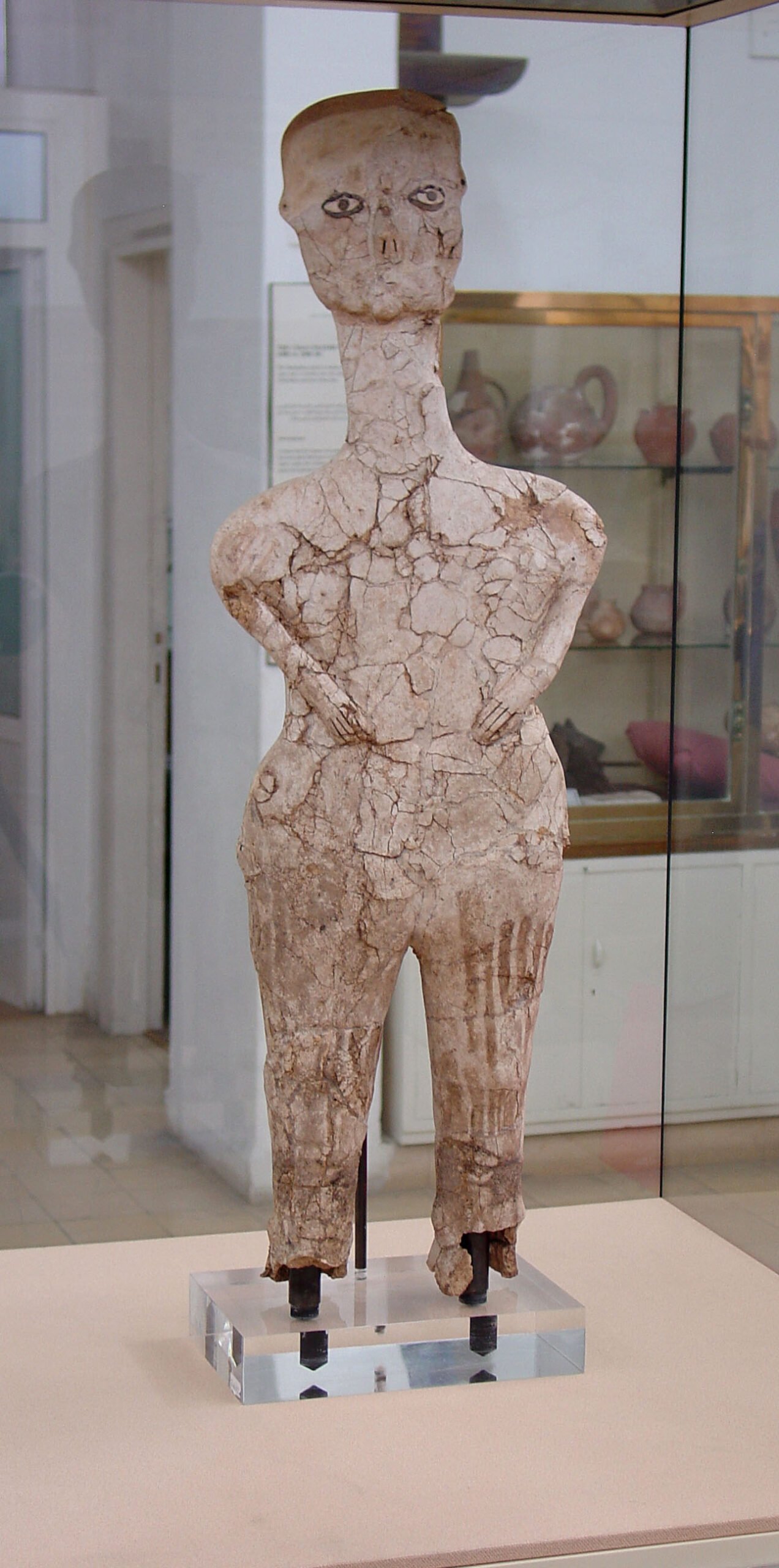
- Statues: 32 plaster figures on reed armatures, 35-90 cm tall, excavated in two caches (1983 and 1985); oldest large-scale sculpture in the world
- Collections: originals in the Jordan Archaeological Museum, Amman; two busts at the Smithsonian Institution, Washington, D.C.
- Abandonment: c. 5000 BC, apparently due to soil exhaustion from intensive grain agriculture
- GPS: 31.9997 N, 36.0103 E
History
Ain Ghazal was settled around 7250 BC, in the period archaeologists call Pre-Pottery Neolithic B – a phase during which communities across the Levant were shifting from hunting and foraging toward settled agriculture, but had not yet adopted ceramic vessels. The settlement grew steadily: by approximately 6500 BC it covered some 15 hectares, making it by far the largest known human agglomeration on earth for its period. Its economy combined cultivated emmer wheat and lentils with the herding of goats and cattle, supplemented by hunting of gazelle. The scale of agricultural activity eventually exhausted the thin soils of the Jordan Valley fringe: by around 5000 BC, Ain Ghazal had been abandoned – one of the earliest documented examples of human-induced environmental degradation.
The most remarkable discovery came in two dramatic episodes. In 1983, a cache of 15 large plaster statues was found concealed beneath a house floor; in 1985, a second cache of 17 more figures was uncovered nearby. Modelled over armatures of twisted reeds, with facial features built up in white plaster, eyes inlaid with bitumen, and traces of paint preserving hair and clothing, the statues stand between 35 and 90 centimetres tall and are thought to represent venerated ancestors or supernatural beings. The practice of plastering human skulls – removing them from burials, covering them with plaster, and caching them beneath floors – is well attested at Ain Ghazal and at contemporary sites across the Levant, suggesting a cult of ancestor veneration that the statues may have served.
Excavations have continued intermittently since 1982 under Gary Rollefson (San Diego State University) and Zeidan Kafafi (Yarmouk University), revealing communal buildings interpreted as shrines, craft production evidence, and a stratigraphic sequence documenting the transition from Pre-Pottery Neolithic B through the Yarmoukian Neolithic. The site is now hemmed in by housing development on three sides and bisected by the Zerqa highway.
What you see
The open-air archaeological display preserves excavated building foundations beneath protective metal shelters beside the highway – rectangular mud-brick structures, some with plastered floors, whose organisation into clusters suggests extended-family domestic units. Interpretive panels in Arabic and English explain the sequence of occupation. The site is modest in visual impact, but the proximity of 12,000-year-old remains to rushing modern traffic gives it a particular charge: this is one of the oldest towns on earth, absorbed into a contemporary Middle Eastern city.
The statues are not at the site but in museums. The Jordan Archaeological Museum in Amman holds a substantial collection of originals; the Smithsonian’s National Museum of Natural History in Washington holds two busts acquired in the 1980s. A visit to Ain Ghazal is best combined with the museum, where the significance of what was found here becomes fully apparent.
Practical information
- Location: Zerqa Highway, northeastern Amman, Jordan (approximately 8 km from city centre)
- Access: Open-air display accessible from the highway service road; no formal entrance gate or ticket required for the outdoor area
- Jordan Archaeological Museum: Amman Citadel; open daily except Tuesday; entrance included in Citadel ticket
- Best season: March-May and September-November; summer midday heat is extreme
- Duration: Site: 30-45 minutes; Jordan Archaeological Museum: 2-3 hours
- Guided tours: Jordan Tourism Board and licensed guides in Amman offer heritage tours combining the Citadel, museum, and Ain Ghazal
Getting there
Ain Ghazal lies approximately 8 km northeast of central Amman along the Zerqa highway. By taxi from downtown Amman or the Citadel, expect 20-30 minutes depending on traffic; ask for “Ain Ghazal archaeological site” (Arabic: عين غزال). Public buses run the Zerqa corridor but there is no formal bus stop at the site; a taxi is the most practical option. GPS coordinates: 31.9997 N, 36.0103 E. Parking available on the highway service road.
Nearby
- Amman Citadel – the historical heart of Amman, with Roman temple, Byzantine church, and Umayyad palace; Jordan Archaeological Museum on site with the Ain Ghazal statues
- Jericho (Tell es-Sultan) – one of the world’s oldest continuously inhabited cities, contemporary with Ain Ghazal, c. 90 km northwest via the Jordan Valley
- Zarqa River – the water source that sustained Ain Ghazal; the modern city of Zarqa lies adjacent to the site
Sources
- Rollefson, G. O. and Kohler-Rollefson, I. (1993). “PPNC adaptations in the first half of the 7th millennium BC.” Paleorient, 19(1), 33-42.
- Tubb, K. W. and Grissom, C. A. (1995). “Ayn Ghazal: A Comparative Study of the 1983 and 1985 Statuary Caches.” Studies in the History and Archaeology of Jordan, 5, 437-447.
- Schmandt-Besserat, D. (1998). “Ain Ghazal monumental figures.” Bulletin of the American Schools of Oriental Research, 310, 1-17.
- Smithsonian Institution – Human Origins: Ain Ghazal
- Department of Antiquities of Jordan – Department of Antiquities of Jordan
Find it on the map
See this place and what’s around it →📷 Become a Cultural Heritage Online photographer
Share your photos of places: they stay published under your name as the author. The more they're seen, the more you get noticed — and soon a contest will reward the most appreciated photos.
Log in or sign up free to add a photo