

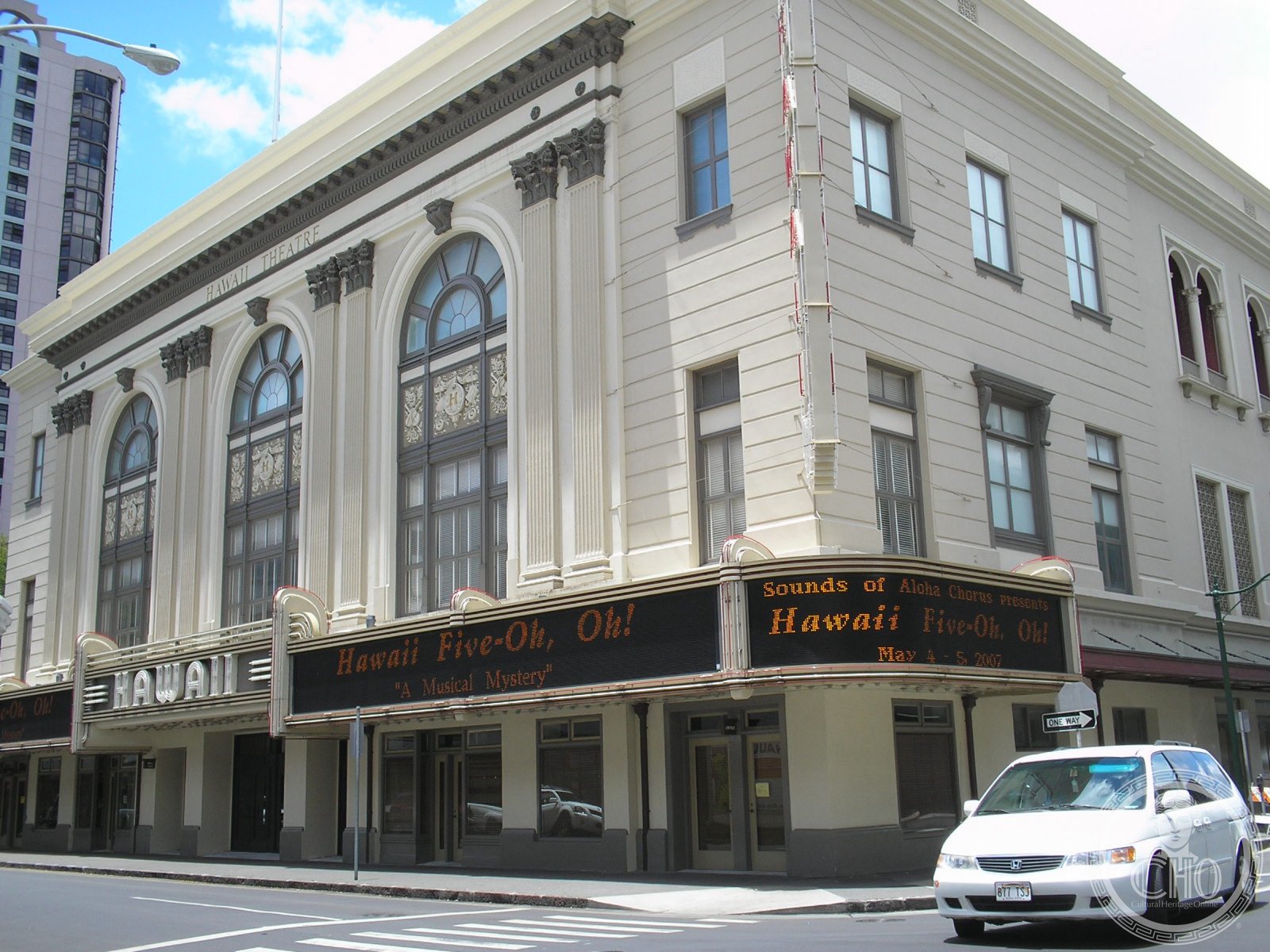
On Bethel Street in the heart of downtown Honolulu, the Hawaii Theatre Center has been the premier performing arts venue of the Hawaiian Islands since it opened in 1922 — a lavishly decorated classical movie palace built at the height of the silent film era whose ornate interior and distinguished facade earned it the designation “Pride of the Pacific” and whose fully restored grandeur continues to anchor the cultural life of Chinatown and downtown Honolulu.
At a glance
The Hawaii Theatre Center at 1130 Bethel Street is the oldest surviving movie palace in Hawaii and one of the finest examples of 1920s theatrical architecture anywhere in the Pacific. Designed in 1922 by local architects Emory and Webb in a richly ornamented Beaux-Arts and Baroque Revival style, the theater opened to serve Honolulu’s growing population with the full experience of the silent cinema era — a building designed to make moviegoing feel like a special occasion. Its gilded interior, painted murals, and ornate plasterwork remained largely intact through the subsequent decades. A comprehensive restoration completed in the 1990s returned the theater to its original splendor and reopened it as the performing arts center it is today, hosting concerts, theater, film festivals, and the Hawaii International Film Festival.
Key facts
- Address: 1130 Bethel Street, Honolulu, HI 96813
- Opened: 1922
- Architects: Emory and Webb
- Style: Beaux-Arts / Baroque Revival
- Capacity: approximately 1,400 seats
- Current use: Active performing arts venue; Hawaii International Film Festival
- Designation: National Register of Historic Places
- GPS: 21.3074° N, 157.8600° W
History
Honolulu in 1922 was a city undergoing rapid transformation: the territorial capital of Hawaii, a Pacific crossroads whose strategic position had drawn American investment and whose growing population created demand for the cultural amenities of mainland American cities. The motion picture industry was at the height of its silent era success, and the construction of elaborate movie palaces in cities of all sizes reflected the film industry’s confidence that cinema was not a passing entertainment but a permanent and prestigious form of public culture.
The firm of Emory and Webb designed the Hawaii Theatre as a building that would announce the seriousness of that ambition. The Beaux-Arts and Baroque Revival exterior — with its arched entrance portal, ornamental detailing, and the elegant proportions of a building that aspired to the tradition of European theaters — gave Bethel Street a structure that read as civic and artistic rather than merely commercial. The interior was designed to an even higher standard: gilded surfaces, painted murals on the ceiling and walls, ornate plasterwork in the boxes and balcony, and the atmospheric lighting that made the act of attending a film feel elevated.
The theater served Honolulu audiences through the golden age of Hollywood and the transition from silent to sound film, continuing as a cinema through the mid-twentieth century before closing as audience patterns shifted. By the time restoration efforts began in the 1990s, the interior had survived largely intact despite decades of reduced use — a remarkable preservation outcome that made the restoration project feasible. The restored Hawaii Theatre reopened as a performing arts center, host to the full range of musical, theatrical, and cinematic programming that serves contemporary Honolulu’s arts audience.
What you see
The Bethel Street facade presents the Hawaii Theatre’s Baroque Revival character: a rhythmic composition of arched openings, ornamental pilasters, and the decorative elaboration characteristic of a building designed to announce its purpose as a place of theatrical entertainment. The marquee and vertical signage identify the theater on a street that has changed significantly around it since 1922, but the facade’s composition retains the original architects’ intention.
The auditorium is the building’s defining interior: a gilded room of extraordinary richness, with ceiling murals depicting Hawaiian and classical imagery, ornate plasterwork in the boxes and balcony, and the warm atmospheric light that the 1990s restoration returned to something close to the original 1922 scheme. The experience of sitting in the restored auditorium conveys precisely what the architects intended — the sense that attending a performance here is an occasion, not a convenience.
Practical information
- Programming: Concerts, theatrical productions, film festivals, special events; check hawaiitheatre.com for schedule
- Hawaii International Film Festival: Annual event hosted at the Hawaii Theatre; programming across multiple Honolulu venues
- Chinatown district: The theater anchors the Bethel Street arts corridor; surrounding blocks include restaurants, galleries, and the Hawaiian Chinatown market
- Tours: Behind-the-scenes tours of the restored interior are available on selected days
Getting there
The Hawaii Theatre is in downtown Honolulu, at the eastern edge of the Chinatown district, a short walk from the waterfront and the historic Aloha Tower Marketplace. Daniel K. Inouye International Airport (HNL) is approximately 6 miles west. The theater is served by TheBus routes along Bethel Street and the connecting downtown grid; downtown Honolulu’s compact scale makes it walkable from the major hotels of the waterfront. Parking is available in nearby municipal structures.
Nearby
- Aloha Tower Marketplace (1926) — the ten-story Art Deco lighthouse tower and its surrounding marketplace complex at Pier 9 of Honolulu Harbor, four blocks south; the Aloha Tower was the tallest structure in Hawaii at its completion and served as the landmark that greeted incoming passenger ships
- Chinatown Historic District — the blocks immediately surrounding the Hawaii Theatre, with their mix of late nineteenth-century commercial architecture, open markets, galleries, restaurants, and cultural organizations that have given the district its distinctive character since the nineteenth century
- ‘Iolani Palace (1882) — the only royal palace in the United States, six blocks east, where Queen Lili’uokalani was imprisoned following the 1893 overthrow of the Hawaiian Kingdom; the Renaissance Revival building preserves the material culture of the Hawaiian monarchy and is a National Historic Landmark
- Honolulu Museum of Art (1927) — the premier art museum of Hawaii, eight blocks east, with collections spanning Asian, American, European, and Pacific art; its courtyard garden is one of the finest outdoor museum spaces in the Pacific
Sources
- National Register of Historic Places, Hawaii Theatre nomination
- Hawaii Historic Places Review Board documentation
- Hawaii Theatre Center institutional history
- Honolulu Star-Advertiser archives — Hawaii Theatre restoration coverage
- State Historic Preservation Division, Hawaii architectural surveys
Find it on the map
See this place and what’s around it →Record researched and written by Luigi De Marchi for Cultural Heritage Online, 2026.
📷 Become a Cultural Heritage Online photographer
Share your photos of places: they stay published under your name as the author. The more they're seen, the more you get noticed — and soon a contest will reward the most appreciated photos.
Log in or sign up free to add a photoIs this page about you?
This page is read by travellers and heritage enthusiasts who find it on Google. Tell us how you are connected to this place and we will take it from there.