
Hattusa was the capital of the Hittite Empire, one of the three great powers of the Bronze Age Near East alongside Egypt and Babylon. Its ruins hold monumental gates, a vast cuneiform archive and the rock sanctuary of Yazılıkaya, and its diplomatic record includes the oldest surviving peace treaty in the world.
At a glance
Hattusa lies on the Anatolian plateau near the modern village of Boğazkale. From around 1650 to 1200 BCE it was the capital of the Hittite Empire, a state that controlled much of Anatolia and rivalled Egypt for influence over Syria and the Levant. The walled city covered roughly 1.8 square kilometres and was defended by an outer wall some eight kilometres long, pierced by three monumental gates.
Around 1200 BCE the city was burned and abandoned, an event linked to the wider Bronze Age Collapse that also brought down Mycenae, Troy, Ugarit and the Egyptian New Kingdom. The causes are still debated, with sea peoples, drought, earthquakes and internal rebellion all proposed. Excavation of the royal archive, ongoing since the early twentieth century, has recovered around 30,000 cuneiform clay tablets recording Hittite law, mythology, diplomacy and ritual, making it the most important archive of Bronze Age Anatolia.
Key facts
- Capital of: the Hittite Empire, c.1650-1200 BCE
- Treaty of Kadesh: signed 1259 BCE between Hattusili III and Ramesses II, the oldest surviving peace treaty in the world, with a replica held in the UN Security Council chamber
- Yazılıkaya: an open-air rock sanctuary about a kilometre from the city, with a procession of twelve gods and goddesses in one chamber and a relief of King Tudhaliya IV embraced by the god Sharruma in another
- Postern tunnel: a 70-metre corbelled stone tunnel beneath the city walls, dated to around 1300 BCE, built to allow sorties or supply movement without opening the main gates
- Heritage status: inscribed as a UNESCO World Heritage Site in 1986
History
The German archaeologist Hugo Winckler began excavating Hattusa in 1906. In his first season he uncovered more than ten thousand cuneiform tablets, including the text of the Treaty of Kadesh, which confirmed that the site was indeed the Hittite capital. In 1915 the Czech linguist Bedřich Hrozný deciphered the Hittite language and showed it to be Indo-European, making it the oldest written Indo-European language known and a landmark discovery in the history of linguistics.
Excavation of the state archive has continued since Winckler’s work began, and the tablets recovered there remain central to understanding Hittite law, religion and diplomacy.
What you see
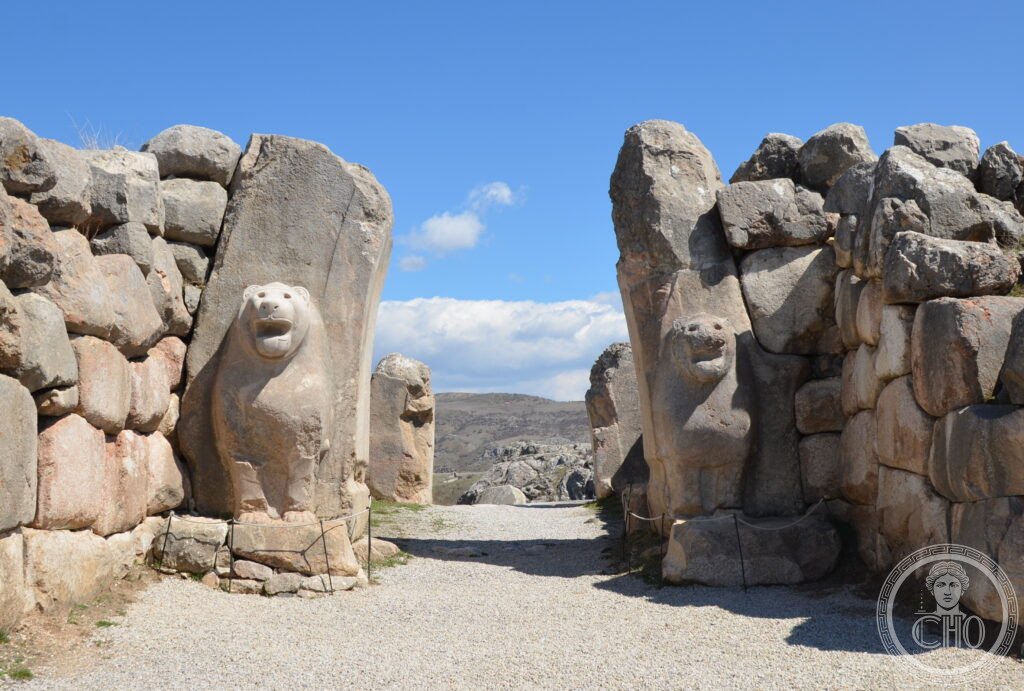
The outer city wall, roughly eight kilometres in circuit and built around 1300 BCE, is pierced by three monumental gates. The Lion Gate carries two guardian lion sculptures and is considered the finest of the three. The Sphinx Gate stands at the highest point of the city and originally included an earth ramp for access. The King’s Gate once carried a carved warrior relief, now replaced on site by a cast, with the original held at the Museum of Anatolian Civilisations in Ankara.
In the lower city stands the Great Temple, the largest at Hattusa, dedicated to the Storm God and the Sun Goddess and built around 1400 BCE. It comprised several buildings arranged around a central courtyard with a temple pool, and two colossal green basalt containers used for offerings still stand in place.
Practical information
- Getting around the site: Hattusa covers around 1.8 square kilometres of open, hilly ground, and seeing it properly, together with the nearby Yazılıkaya sanctuary, takes a good part of a day.
- Season: the site is more easily walked in the drier months of spring through autumn.
- Tickets and hours: check current entry arrangements and opening times through the site’s official visitor information before travelling.
- Combine with Ankara: the Museum of Anatolian Civilisations in Ankara holds many of the finest objects removed from Hattusa and is worth pairing with a site visit.
Getting there
Hattusa is most commonly reached from Ankara, with Samsun to the north offering an alternative approach. The nearest town is Sungurlu, from where onward transport to the site itself is limited, and travellers generally find a hire car the most practical way to reach and explore Hattusa and Yazılıkaya together.
Nearby
- Alacahöyük — a Chalcolithic and Bronze Age settlement that predates the Hittites by a thousand years, known for the rich gold and bronze finds of its Royal Tombs period and for a Hittite Sphinx Gate better preserved than the sphinxes at Hattusa itself.
- Museum of Anatolian Civilisations, Ankara — home to the original Lion Gate sphinx and King’s Gate relief from Hattusa, along with cuneiform tablets and gold and silver objects from the Hittite royal tombs.
Sources
- Wikipedia
- UNESCO
Find it on the map
See this place and what’s around it →📷 Become a Cultural Heritage Online photographer
Share your photos of places: they stay published under your name as the author. The more they're seen, the more you get noticed — and soon a contest will reward the most appreciated photos.
Log in or sign up free to add a photo