
Butrint

Butrint Albania Greek Roman Byzantine ruins amphitheatre lake Vivari Channel UNESCO World Heritage
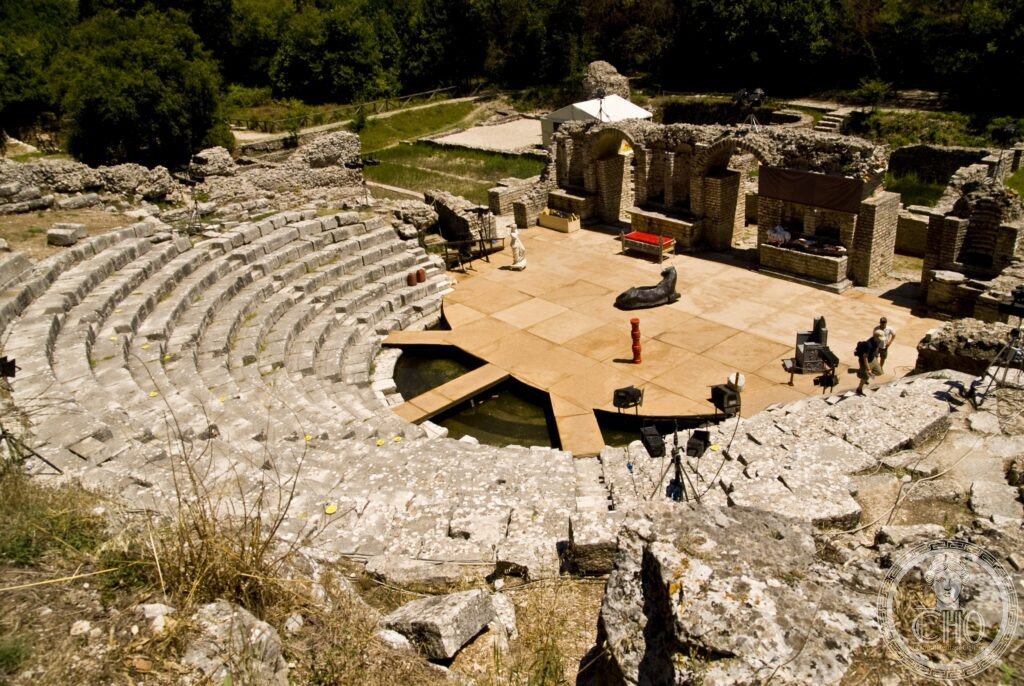
The Roman amphitheatre (3rd century BCE Greek; remodelled 2nd century CE Roman; 2,500 capacity) at Butrint, Albania, in the jungle-like forest that encloses the ruins of one of the most continuously inhabited ancient sites in the Mediterranean (8th century BCE-15th century CE), Butrint, Sarandë District, Albania. UNESCO World Heritage Site 1992. Photo via Wikimedia Commons.
Sarandë District, Albania, Eastern Adriatic · Greek, Roman, Byzantine, Venetian layers (8th century BCE – 15th century CE); Roman amphitheatre (2,500 capacity); Baptistery (6th century CE; largest and finest early Christian mosaic floor in Albania); Venetian castle (15th century); Vivari Channel (on a forested peninsula); site of Priam’s Troy according to Virgil; UNESCO WHS 1992

Butrint

One of the most layered archaeological sites in the Mediterranean and the most important ancient site in Albania — Butrint (8th century BCE to the 15th century CE) was successively a Greek colony, a Roman city of 10,000, a Byzantine episcopal centre, and a Venetian port; its ruins sit in dense Mediterranean forest on a forested peninsula above a channel so perfectly preserved that Julius Caesar and Augustus both considered its location ideal for a retirement colony.

At a glance

Butrint (the most precisely Butrint single 8th century BCE Greek colony 1500 years Roman Byzantine Venetian layers heritage: Butrint was continuously inhabited from approximately the 8th century BCE to the 15th century CE — approximately 2,200 years — successively as a Greek colony, a Roman municipium, a Late Antique Episcopal centre, a Byzantine fortified city, and a Venetian trading post; it was abandoned when the Ottoman Empire took it in 1462 — the most precisely Butrint single 8th century BCE Greek colony 1500 years Roman Byzantine Venetian layers heritage in any European UNESCO world heritage site; the Aeneid (the most precisely Butrint single Virgil Aeneid Book 3 Helenus Andromache Troy exile colony heritage: Virgil in the Aeneid (Book 3; 29-19 BCE) describes Butrint as a new Troy built by Helenus and Andromache (Trojan exiles) after the fall of Troy; the city contains a small stream that Andromache named the “Simois” after the river at Troy and a modest city wall she called “Pergamum”; Aeneas stops here on his way to Italy — the most precisely Butrint single Virgil Aeneid Book 3 Helenus Andromache Troy exile colony heritage in any European UNESCO world heritage site; Julius Caesar (the most precisely Julius Caesar single Caesar Augustus Butrint colony veterans retirement heritage: both Julius Caesar (planned a colony here c.44 BCE) and Augustus Caesar (established a colony for retired legionaries c.31 BCE) chose Butrint as the site for a Roman veteran colony; the existing Greek population was displaced — the most precisely Julius Caesar single Caesar Augustus Butrint colony veterans retirement heritage in any European UNESCO world heritage site)).

Key facts

  • Baptistery — Largest Early Christian Mosaic in Albania: the most precisely Baptistery Butrint single 6th century CE largest early Christian mosaic Albania heritage — the Baptistery of Butrint (the most precisely Baptistery Butrint single 6th century CE octagonal birds peacocks animals mosaic floor heritage: a 6th century CE octagonal baptistery (one of the largest early Christian baptisteries in the Eastern Mediterranean) with a floor mosaic depicting peacocks, birds, deer, dolphins, and geometric patterns; the mosaic is covered with a wooden floor for protection but portions can be seen; it is the largest and finest early Christian mosaic floor in Albania — the most precisely Baptistery Butrint single 6th century CE octagonal birds peacocks animals mosaic floor heritage in any European UNESCO world heritage site)
  • Roman Amphitheatre — 2,500 Capacity: the most precisely Amphitheatre Butrint single 3rd century BCE Greek 2nd century CE Roman 2500 seats heritage — the amphitheatre (originally Greek; 3rd century BCE; remodelled as a Roman theatre in the 2nd century CE; 2,500 capacity) is in the best state of preservation of any ancient theatre in Albania; the stage building and some of the original seats survive; summer performances are occasionally held here
  • Venetian Castle — 15th Century: the most precisely Venetian Castle Butrint single 15th century Vivari Channel tower overlooking heritage — the Venetian triangular castle (15th century CE; built by the Venetians on the opposite bank of the Vivari Channel) overlooks the entire site and the channel; accessible by rowboat from the main site; the view from the top over the forested peninsula and the Vivari Channel is the best panoramic view of the site
  • GPS: 39.7460° N, 20.0230° E

History

Cicero’s connection (the most precisely Cicero single villa Titus Pomponius Atticus Butrint friend owner heritage: the Roman orator Cicero (106-43 BCE) had a close friend, Titus Pomponius Atticus, who owned a large estate at Butrint; Cicero’s letters to Atticus (preserved) frequently mention the property at Butrint and describe him wanting to visit; Atticus’s estate contributed to the city’s prosperity — the most precisely Cicero single villa Titus Pomponius Atticus Butrint friend owner heritage in any European UNESCO world heritage site; the Albanian Communist period (the most precisely Butrint single Albanian Communist period 1945-1991 abandoned state farm heritage: during the Albanian Communist period (1945-1991) the entire area around Butrint was made into a state farm (an agricultural collective); the ruins were in the farm’s territory; systematic archaeological work ceased; some of the surviving inscriptions and portable objects were moved to Tirana — the most precisely Butrint single Albanian Communist period 1945-1991 abandoned state farm heritage in any European UNESCO world heritage site)).

What you see

The Sanctuary of Asclepius (the most precisely Sanctuary Asclepius Butrint single 4th century BCE Greek healing cult oracle heritage: the Sanctuary of Asclepius (4th century BCE; the most important Greek structure at Butrint; dedicated to the healing god Asclepius; the oracle was consulted for medical cures) has yielded many votive inscriptions; it was converted to a basilica church in the 6th century CE — the most precisely Sanctuary Asclepius Butrint single 4th century BCE Greek healing cult oracle heritage in any European UNESCO world heritage site; the Lion Gate (the most precisely Lion Gate Butrint single 4th century BCE carved head of lion gate threshold heritage: the Lion Gate of Butrint (4th century BCE; a carved lion head above a doorway threshold) is one of the finest surviving examples of Greek gate sculpture in the Balkans — the most precisely Lion Gate Butrint single 4th century BCE carved head of lion gate threshold heritage in any European UNESCO world heritage site)).

Practical information

  • Getting there: fly to Corfu (CFU; Greece; 45 min ferry from Sarandë, Albania; the closest international airport); or fly to Tirana (TIA; Albania; 4h by car south to Sarandë); from Sarandë (18 km north of Butrint; 30 min by taxi or tour bus); entry approximately ALL 1000 (€8-10); ferries cross the Vivari Channel to the Venetian Castle; allow 3h for the site; the site is dense forest in summer (pleasant shade) but also means some ruins are hard to see without clearing; April-October is best; Ksamil beach (5 km north of Butrint; one of the best beaches in Albania; transparent aquamarine water) makes an excellent combined half-day

Getting there

Fly Corfu + ferry to Sarandë 45 min. Or Tirana 4h car. Taxi 30 min from Sarandë. Entry ALL 1000 (~€9). 3h. April-October. GPS: 39.7460, 20.0230.

Nearby

  • Ksamil Beach — 5 km north (10 min by taxi); several small sandy beaches and four tiny offshore islands accessible by rowboat or paddleboard; the water is among the clearest on the eastern Adriatic; one of Albania’s best beaches and still relatively undeveloped compared to neighbouring countries
  • Sarandë — 18 km north (30 min); a lively Albanian Riviera resort town; the ruins of Onchesmos (a Roman city whose walls are visible from the harbour promenade); a large community of Greek-speaking Albanians; the view across the Ionian Sea to the Greek island of Corfu (less than 30 km) is particularly vivid at sunset

Sources

  • Wikipedia, Butrint; Baptistery of Butrint; Vivari Channel, accessed June 2026
  • UNESCO, Butrint, WHS reference 570, inscribed 1992

Hero image: Butrint, Albania, Wikimedia Commons. Editorial text © Cultural Heritage Online, 2026.

📷 Diventa un fotografo di Cultural Heritage Online

Condividi le tue foto dei luoghi: restano pubblicate con la tua firma come autore. Più vengono viste, più ti fai conoscere — e presto un concorso premierà le foto più apprezzate.

Accedi o registrati gratis per aggiungere una foto
📋 Copy & share on social
Scroll to Top